We'll the spring brassicas (cabbage, kohlrabi, broccoli) are working their way past the finish line; I have the flail mower on the tractor and ready to mow them down. This allows us to clean up the field as well as make room for a new crop. But even while I eye the spring brassicas, I took an hour yesterday and planted the fall brassicas, including broccoli, cabbage, and cauliflower. The nice think about fall brassicas is that they typically do better than their spring brethren since they have a long cool fall to mature. I've given up trying to raise cauliflower in the spring which simply gets purple and ugly due to stress in the summer heat.
This two season cropping is also common with other veggies on the farm. We also have a spring and fall crop of spinach, cool-season greens, and head lettuce makes a comeback as well. So, if you're a cool-season veggie-eater yourself, don't despair; just wait a couple months.
In the box:
Green Cabbage
Broccoli
Red Ace Beets
Summer Squash - we mostly had zucchini but there are some yellow zucchini and yellow staightneck squash too.
Parsley
Red Basil
Fresh or "green" garlic - this is uncured garlic which is a bit stronger tasting than cured. You can simply leave on your kitchen counter for a week and I'll dry down if you'd like to cure yourself.
Purple Kohlrabi - I know, you're sick of kohlrabi, but at least this one's a different color!
Dino Kale - the dark green which is all crinkly (see recipe below)
Frisee - the frilly green also called curly endive. This is in the endive family, so has a nutty flavor. It's typically mixed in a lot of salad mixes you would buy.
Green onions
Note - check out our facebook page where we've been posting a picture of the box each week with each veggie labeled.
Ryan's Never Fail Greens Recipe
1 bunch greens (collards, kale, chard)
2-3 slices of bacon
1 small onion
Dice onions, bacon, and greens. Fry bacon in skillet together with the onion or garlic. When the onion gets translucent, throw in greens until wilted and season with some salt. Done. If you like heat, add red pepper flakes.
Friday, July 13, 2012
Friday, July 06, 2012
Dealing with Bad Weather on the Farm
I swear I spend half of my time complaining about weather on
this website, but this week I have good reason.
Monday night we got some serious hail. Typically we experience 30-45 seconds of hail
when the weather front first comes through, but this time it just kept coming
down for a good ten minutes. You’ll see
evidence of this on the produce like white blotches on the peas where they took
a hailstone or greens with healed over holes.
Some of the best advice I got from my mentor on whose farm I
apprenticed was “if you get hail, don’t even look at the plants for a couple
days.” Even though hail inflicts a lot
of damage, it’s amazing how quickly the plants recover.
Now, today, I’m sitting in our kitchen writing this because
our power’s out after a major streak of lightening tried hitting our house
while a rain poured on my head out picking peas. I can’t even fill the tanks to harvest and
wash produce. But desperate times call
for desperate measures, so I fired up the PTO generator just to make some
coffee.

In the box:
- Snap peas: fatter peas, which are edible pod, so don’t try shelling. You'll see these white marks where hail hit, but I've been eating a bunch in the field and I think they are fine.
- Snow peas: the flat ones
- Kohlrabi: see recipe below
- Red Sails red leaf lettuce: the leafy red green
- Radicchio: the small round red green. It is often mixed into a mix of other greens in a salad. It's got a pretty strong nutty, bitter flavor, so it's not for everybody.
- Small Romaine lettuce
- Broccoli
- Green cabbage
- Basil
- Cilantro
- A couple sweet onions (Alisa Craig variety)
- First cucumber of the year
Honey-Mustard Kohlrabi from St. Paul Farmers Market Cookbook
2 cups kohlrabi, peeled and sliced
2 T olive oil
2 T honey
1-2 T Dijon mustard
Steam kohlrabi until tender, about 10 minutes. In a bowl, mix together oil, honey, and
mustard. Taste and adjust for
flavor. Toss with cooked kohlrabi. Makes 4 servings.


Friday, June 29, 2012
Minerals on the Farm
This week as I was harvesting broccoli for the box, I was looking across the brassica field where we have the kohlrabi, cabbage, broccoli and brussel sprouts and thought just how good the field looked this year. The good timings I've had with cultivating helps, but one thing which I'd like to highlight is the mineral fertilizer I've incorporated this year.
Plants in the brassica family like broccoli are pretty heavy "feeders" of micronutrients (macro-nutrients are nitrogen, potash, and potassium) like calcium, boron, and manganese. To better feed the plant, this year we sourced a mineral blend from Midwestern Bio-Ag which the brassicas really responded to. We've never had such healthy-looking cabbages. People always wonder what we do about insects when raising vegetables without pesticides, but this is part of the secret. If you have healthy plants with proper nutrition, the bug pressure is always less - kind of like those healthy people you know who never get sick.
In the box:
1/4 cup rice vinegar (not seasoned)
2 teaspoons sugar
1 teaspoon grated peeled ginger
2 tablespoons vegetable oil
1 fresh serrano chile, finely chopped, with seeds
1 small head Napa cabbage (1 1/2 pounds), cored and cut crosswise into 1/2-inch slices
1 bunch scallions, sliced
1/2 cup coarsely chopped cilantro
Whisk together vinegar, sugar, ginger, oil, chile, and 1/2 teaspoon salt. Add remaining ingredients and toss well. Let stand, tossing occasionally, 10 minutes.
Read More http://www.epicurious.com/recipes/food/views/Spicy-Napa-Cabbage-Slaw-with-Cilantro-Dressing-243168#ixzz1zDu8T5Ia
 |
| Ryan harvesting Napa Cabbage |
Plants in the brassica family like broccoli are pretty heavy "feeders" of micronutrients (macro-nutrients are nitrogen, potash, and potassium) like calcium, boron, and manganese. To better feed the plant, this year we sourced a mineral blend from Midwestern Bio-Ag which the brassicas really responded to. We've never had such healthy-looking cabbages. People always wonder what we do about insects when raising vegetables without pesticides, but this is part of the secret. If you have healthy plants with proper nutrition, the bug pressure is always less - kind of like those healthy people you know who never get sick.
In the box:
- Cilantro
- Kohlrabi
- Napa Cabbage: It seems like not a lot of people cook with Napa, but I absolutely love the stuff! Follow this recipe below from the Epicurious website for an idea on how to use it.
- Radishes
- Strawberries
- Snap Peas: These are edible pod peas, so please don't try to shell; just eat them.
- Spinach
- Broccoli
- Red lettuce: Most people got a red oakleaf variety called Cocarde, but some did Red Sails red leaf.
- Salad Mix
Spicey Napa Cabbage Slaw with Cilantro Dressing from Epicurious
Whisk together vinegar, sugar, ginger, oil, chile, and 1/2 teaspoon salt. Add remaining ingredients and toss well. Let stand, tossing occasionally, 10 minutes.
Read More http://www.epicurious.com/recipes/food/views/Spicy-Napa-Cabbage-Slaw-with-Cilantro-Dressing-243168#ixzz1zDu8T5Ia
Friday, June 22, 2012
My Farm Philosophy (CSA week 1)
We'll this is week number one for our 8th CSA season as Lida Farm! I'm feeling good about where we're heading and I think it'll be a great season.
I think individual farms have their own "take" on agriculture and how their farm fits in the world; this is probably even more important for CSA operations where people choose an operation to make "their farm" for the season. My own farm philosophy is geared towards three things: soil, people, and community.
We are committed to growing our produce without the use of any synthetic chemicals EVER (we haven't use a chemical on the place for the 8 years we've lived here). We also do the best we can to build the soil as much as possible each year, incorporating livestock into our operation and interplanting cover crops to fix nitrogen and add organic matter.
People are the core of our operation. We do our utmost to make sure our members and farmers market customers get clean, quality food. I love the feeling of knowing we are helping to feed families and giving them a direct connection to farming. I love getting to know people who eat our food and learning about what their interested in. We're going to have a few events over the season this year to make connecting a bit easier, including an open house and fall feast so stay tuned. We want our farm to be your farm, so please make a point to attend some events or simply come out and visit!
Lastly, community is big for us. Not only our local communities of Pelican Rapids and Vergas, but also our fellow local farmers. Just as local residents support us in becoming CSA members and customers, we in turn support our local businesses. Building up a stronger local economy in our little rural part of the state is a core part of our mission and I feel so much more can be accomplished if we all cooperate together. We also take on a role of educating the community on sustainable agriculture. For the last 3 years we've hosted Pelican Rapids early childhood classes in the fall and the local 4-H club was out just last week.
In the Box:
- Bok Choy
- Garlic Scapes - the curly green bunch. Think of scapes and use them as garlic-y green onions. You can also use them in place of garlic cloves; they'll be a bit more mild than garlic cloves.
- Arugula - the bunch of greens which look like elongated oak leaves. This can be eaten fresh or steamed or in a pasta; a traditional Italian green. I prefer as a simple side salad with parmesan, oil, pepper, and some balsamic vinegar.
- Radishes - some got cherry belle (red variety) and others got French breakfast variety (look like long pink/white bobbers).
- Red Russian Kale - big bunch of purple greens. These need to be cooked. I typically do kale with sauteed bacon and onions and then simmer down the cropped greens for 10 minutes or so.
- Green Onions
- Salad Mix (in the bag) or Romaine Lettuce
- Spinach - loose greens with the pink roots
Stir-Fired Bok Choy from the Food Network
Ingredients
- 1 tablespoon olive oil
- 2 cloves garlic, minced
- 1 tablespoon minced fresh ginger
- 8 cups chopped fresh bok choy
- 2 tablespoons reduced-sodium soy sauce
- Salt and ground black pepper
Directions
Heat oil in a large skillet over medium heat. Add garlic and ginger and cook 1 minute. Add bok choy and soy sauce cook 3 to 5 minutes, until greens are wilted and stalks are crisp-tender. Season, to taste, with salt and black pepper.
I suggest you use the garlic scapes in this recipe in place of the garlic cloves - it'll work fine.
Wednesday, June 13, 2012
Why Raise Livestock on a Produce Farm?
We mainly raise vegetables, but we have been expanding livestock on the farm. For the past four years, we have raised broilers (chickens for eating, not laying) along with laying hens and a flock of sheep; last year we even tried our hand at a few pigs.
Why? Meat is tasty and allows us something else to offer CSA members and other customers, but one really big reason is manure. Veggies need a lot of fertility, and, when raising produce organically without high-powered manufactured fertilizers, you almost have to have livestock manure.
We keep experimenting with ways to create good compost out of manure. One thing we have been trying is doing a slow composting method where we let the manure pack break down under a roof and out of the rain for 6 months + which keeps more nitrogen in the compost instead of leaching out in the elements.
Last week I shoveled out the chicken shed in preparation for this year's batch of 200 broilers. We let last year's chicken litter break down since last August and we'll spread in a windrow in a shady spot on our hill to break down some more for fall spreading on the fields.
Why? Meat is tasty and allows us something else to offer CSA members and other customers, but one really big reason is manure. Veggies need a lot of fertility, and, when raising produce organically without high-powered manufactured fertilizers, you almost have to have livestock manure.
We keep experimenting with ways to create good compost out of manure. One thing we have been trying is doing a slow composting method where we let the manure pack break down under a roof and out of the rain for 6 months + which keeps more nitrogen in the compost instead of leaching out in the elements.
 |
| Tools of the trade - a manure fork and a grain shovel |
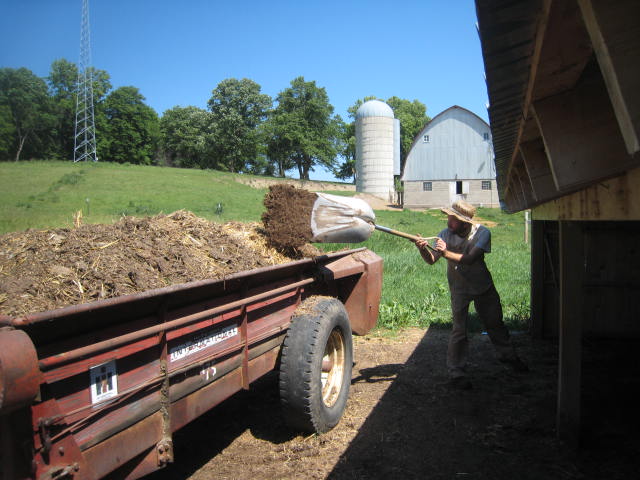 |
| Filling up the manure spreader |
 |
| The finished product - half-complete compost |
 |
| Shed ready for new birds! |
Saturday, June 02, 2012
A few CSA shares available for 2012 season
Our first CSA delivery of fresh in-season produce will be coming up in a few weeks. We're a small operation which is totally family run. Maree and I both the owner/operators and the entire workforce of Lida Farm (plus three kids under the age of 7, but they are not great contributors yet). Last year I harvested for and assembled about 30 shares each Friday. We currently stand at about 27 shares, so it's not too late to sign up.
Our season runs for 16 weeks (Mid-June through Mid-October) and we also do every-other-week shares for couples or families which just want to try out a CSA. The cost is $450 for a full share delivered directly to your home or $250 for every other week. We also give a $50 discount if you pick up at the farm yourself (at $400/season, this is $25/week). Besides the produce we will also be hosting a few events on-farm for the 2012 season for our members. Check out details under "Join our CSA" on this website or get a hold of us at lidafarmer@gmail.com or 218-342-2619.
Our season runs for 16 weeks (Mid-June through Mid-October) and we also do every-other-week shares for couples or families which just want to try out a CSA. The cost is $450 for a full share delivered directly to your home or $250 for every other week. We also give a $50 discount if you pick up at the farm yourself (at $400/season, this is $25/week). Besides the produce we will also be hosting a few events on-farm for the 2012 season for our members. Check out details under "Join our CSA" on this website or get a hold of us at lidafarmer@gmail.com or 218-342-2619.
 |
| CSA box from June, 2011 |
Saturday, April 21, 2012
How much comes in a share?
Signing up for the season must feel like a leap of faith for people new to CSA. What will I get each week? Is it a bunch of crazy stuff I don't eat? Is it too much? Too little?
At Lida Farm we deliver a bushel box of produce each week to both with full shares and every-other-week shares. A full share should supply a family of 4 veggies for the season
The picture below is an example from early July last year and the mix of things changes throughout the season. In early July we were still delivering early season stuff last year with salad mix, greens like chard, kohlrabi, radishes, braising mix, spinach, garlic scapes, and strawberries.
 |
| CSA box, early July 2011 |
More details about the 2012 CSA season are found on the "Join our CSA" webpage.
Sunday, April 15, 2012
Lida Farm on TV
I spent a good portion of today getting pretty wet and cold. I was bedding down young chickens in a leaky coop in the pasture, securing a greenhouse in some high winds, and seeding in our greenhouse kept cool so as not to burn too much propane in a spring storm. To warm everybody up a bit, I thought I'd share this video Lakes Country Living TV program did on us last summer. It was hot out and produce was peak season. Try not to pay too close attention to that sea of foxtail in the onion patch!
Monday, February 27, 2012
Hanging out with other Foodies at the MOSES Conference
Maree, Graham, and I finally made our way down to the mecca of organic growers in the US, the Midwest Organic Conference (http://www.mosesorganic.org/conference.html). About 3,200 organic growers, wanna-be farmers, and organic foodie types descended on LaCrosse, WI last Thursday-Saturday to take in workshops about soils and raising livestock as well as a poetry slam and a lot of organic foods and snacks.
 I presented a poster as Ryan Pesch, Extension Educator, about a food survey I did in Renville County-it was not the headliner of the event-but the ideas we got for our own farm were the highlights. Since we raised three hogs last year, we appreciated the session on raising hogs on pasture and also the session on integrating CSA with other enterprises like farmers market and livestock. The presenters were doing some cool things around farm to table like making pizzas made with all-farm ingredients for on-farm dinners, but we didn't think it was something we'd pull off for this year. Still, at the very least, we're much more fired up about the farm season. Inspiration is great fuel!
Friday, February 10, 2012
Looking for a Few Good CSA Members

If you know of others who may be interested in joining a CSA in the area, please feel free to forward the link and materials to them. We will be adding a few more shares this year, so are looking for new recruits.
Saturday, December 31, 2011

Friday, October 07, 2011
End of the CSA Season
Wow, quite a season! After just coming back from the last CSA delivery, I'm always reflective. This season was probably the hottest since I've been farming in Otter Tail. It was also one of the driest.
This made for great crops which love the heat like melons, tomatoes, and anything in the cucurbit family like cucumbers and summer and winter squash. The way the season ran allowed these plants to get established well with heat and moisture and then ripen under dry conditions. It's a good recipe for good looking produce. Some other things, however, didn't like this weather. For example I always plan for a planting of brassicas like broccoli and kohlrabi in the fall as well as the spring, but the fall set didn't go anywhere with little fall rain. Any which way, each season is it's own beast and I thank each of you sharing the ride with us.
 |
| Kids on Way to Farmers Market |
In the box:
Komatsuna bunch: a green with a stalk kind of like boc choy. This is an Asian green which is good in a stir fry. You simply chop up and add at the end until wilted a bit. Here's a link to a Komatsuna recipe which looks simple and quick since it's one of those odd "crazy" greens:
http://woodwart.blogspot.com/2005/10/komatsuna-saute.html
http://woodwart.blogspot.com/2005/10/komatsuna-saute.html
Spinach: the one with dark green and round leaves. You could use for either a salad or cooked.
Butternut squash: big tan squash
Celeriac: The strange-looking bulb on the end of a small stalk of celery. You can use it in replace of celery in recipes It has the same flavor and also keeps well in the crisper in your fridge.
Delicata squash: yellow and green-striped squash. This one should be baked without a water bath because the outside shell is pretty thin.
Buttercup squash: the dark green squash with the little button the bottom
Russet potatoes
Carrot bunch
A couple onions
A head of garlic
A few small turnips
"Better than Nothing" beets
Friday, September 30, 2011
Hot but Still Fall
This past week felt like summer even though the tasks were fall in nature. Typically when I think of work at the end of september/early october, I think of dunking my hands in freezing water trying to hold a brush to clean squash, but not this year. Today we were cleaning squash outside with a slight breeze in the air and a warm sun in the sky. It was nice. Also I was out pulling in the turnips this morning and it didn't seem right that I was harvesting this crop in a t-shirt. However, it's undoubt-ably fall because everything in the fields just doesn't grow. Even with warm days, the loss of sunlight and shorter days really slows things down. I keep having high hopes that the carrots in the last bed will bulk up, but they just seem to sit there. There's no issue with greens bolting too soon, however, so let's be thankful.
On Monday we had the Pelican Rapids Early Childhood classes out and it was a real blast to have that many people here. Our quarter-mile driveway was lined with cars and I had to do three groups for the haywagon ride. The kids got a kick out of throwing old tomatoes to the pigs, seeing the sheep and our one donkey, and finding a pumpkin to take home. I made sure to do a little ag education when taking people on the tour, pointing out how we graze our sheep in rotation and giving the lowdown on what's alfalfa and hay vs. straw.
In the box:
Braising mix: this is a mix of greens you can use at the end of a stir fry or as a cooked side green. Simply start with some garlic and oil in a skillet, chop the greens, and saute until wilted a bit.
A turnip or two
An onion or two
Celery
Brussels sprouts: the big ugly stick in the box. You don't eat the stick, just the sprouts
Acorn Squash
Spaghetti Squash: See video below to see how to prepare as a pasta.
Long Island Cheese Squash or Kakai Pumpkin: The Long Island Cheese looks like a cheese wheel and is the color of a Butternut. Mar and I really dig the flavor of this squash and Maree makes these pumpkin-cream cheese bars with them. A Kakai pumpkin is dark green and orange and is supposed to be super for pumpkin seeds.
Carrots
Vegetable Garden Spaghetti Squash:
On Monday we had the Pelican Rapids Early Childhood classes out and it was a real blast to have that many people here. Our quarter-mile driveway was lined with cars and I had to do three groups for the haywagon ride. The kids got a kick out of throwing old tomatoes to the pigs, seeing the sheep and our one donkey, and finding a pumpkin to take home. I made sure to do a little ag education when taking people on the tour, pointing out how we graze our sheep in rotation and giving the lowdown on what's alfalfa and hay vs. straw.
In the box:
Braising mix: this is a mix of greens you can use at the end of a stir fry or as a cooked side green. Simply start with some garlic and oil in a skillet, chop the greens, and saute until wilted a bit.
A turnip or two
An onion or two
Celery
Brussels sprouts: the big ugly stick in the box. You don't eat the stick, just the sprouts
Acorn Squash
Spaghetti Squash: See video below to see how to prepare as a pasta.
Long Island Cheese Squash or Kakai Pumpkin: The Long Island Cheese looks like a cheese wheel and is the color of a Butternut. Mar and I really dig the flavor of this squash and Maree makes these pumpkin-cream cheese bars with them. A Kakai pumpkin is dark green and orange and is supposed to be super for pumpkin seeds.
Carrots
Vegetable Garden Spaghetti Squash:
Friday, September 23, 2011
Workers Matter in Agriculture
I was really struck this week when I read a short article on leaflets being left at Hugo's groceries in the sugar aisle by union workers currently locked out of the American Crystal plants when the company left negotiations. The leaflets were pretty basic that just asked customers to go to this website http://www.bctgm.org/ACS_Lockout.html and read up on the issue.
I grew up in East Grand Forks in a union household (my dad was a member of IBEW local 1426) and used to work at Hugo's myself carrying out groceries, so the lockout is personal to me. These workers aren't "those people" I can quickly brush off, but my peers, parents of schoolmates, neighbors, and the people I went to church with. I never got the impression that sugar beet plant workers were a bunch of overpaid lazybones as you hear on angry AM talk radio all day, but really modest folks who had to go into work at 11 pm or do these crazy 14-hour shifts through harvest season.
When reflecting about this and farming, I think Americans tend to overlook workers in agriculture and instead focus on farmers. We think that agriculture begins and ends with those working the land, proud and heroic farm owner-operators who till the soil and bring in bountiful harvests in the American heartland. We see this all the time from Chevy truck commercials to every politician talking about the farm bill. I like that romantic imagery too. But in that picture we paint of agriculture, every now and then we should stop looking only at the proud farmer in the center of the picture and appreciate the harvest crew or processing plant in the background. They are just as integral a part of how food gets to the table today. Without them, the system stops.
Reminders: Our harvest party is this saturday at 6:30. Also the last box is Friday, Oct. 7.
In the box:
Broccoli Raab: Yes, a crazy green. See recipe.
Fresh Dill: Chop up with the potatoes and some butter or sour cream
A couple green peppers
A butternut squash
A couple Blue Bonnet squashes or a couple Carnival squashes
A pie pumpkin: bake upside down on a pan and use cooked pumpkin in replacement of any of that stuff that comes out of a can
White onion
Garlic
Edamame: This is the big mess of brown sticks in the box. You only want to use the pods on the stalk. Simply boil in salt water for a few minutes, drain, and eat with beer...it's good.
A mix of carrots
Russet potatoes
Recipe: Sauteed Broccoli Raab
Note: don't use the center stem of the raab since it gets woody, but use the leaves, small stems, and florets.
Cut off and discard 1 inch from stem ends of broccoli rabe. Cook broccoli rabe, uncovered, in 2 batches in a 6- to 8-quart pot of boiling salted water until just tender, about 3 minutes, transferring with a slotted spoon to a large bowl of ice and cold water to stop cooking. Drain well in a colander.
Read More http://www.epicurious.com/recipes/food/views/Sauteed-Broccoli-Rabe-109539#ixzz1YpEfcDSp
I grew up in East Grand Forks in a union household (my dad was a member of IBEW local 1426) and used to work at Hugo's myself carrying out groceries, so the lockout is personal to me. These workers aren't "those people" I can quickly brush off, but my peers, parents of schoolmates, neighbors, and the people I went to church with. I never got the impression that sugar beet plant workers were a bunch of overpaid lazybones as you hear on angry AM talk radio all day, but really modest folks who had to go into work at 11 pm or do these crazy 14-hour shifts through harvest season.
When reflecting about this and farming, I think Americans tend to overlook workers in agriculture and instead focus on farmers. We think that agriculture begins and ends with those working the land, proud and heroic farm owner-operators who till the soil and bring in bountiful harvests in the American heartland. We see this all the time from Chevy truck commercials to every politician talking about the farm bill. I like that romantic imagery too. But in that picture we paint of agriculture, every now and then we should stop looking only at the proud farmer in the center of the picture and appreciate the harvest crew or processing plant in the background. They are just as integral a part of how food gets to the table today. Without them, the system stops.
Reminders: Our harvest party is this saturday at 6:30. Also the last box is Friday, Oct. 7.
In the box:
Broccoli Raab: Yes, a crazy green. See recipe.
Fresh Dill: Chop up with the potatoes and some butter or sour cream
A couple green peppers
A butternut squash
A couple Blue Bonnet squashes or a couple Carnival squashes
A pie pumpkin: bake upside down on a pan and use cooked pumpkin in replacement of any of that stuff that comes out of a can
White onion
Garlic
Edamame: This is the big mess of brown sticks in the box. You only want to use the pods on the stalk. Simply boil in salt water for a few minutes, drain, and eat with beer...it's good.
A mix of carrots
Russet potatoes
Recipe: Sauteed Broccoli Raab
Note: don't use the center stem of the raab since it gets woody, but use the leaves, small stems, and florets.
- 1 bunch broccoli rabe
- 2large garlic cloves, thinly sliced lengthwise
- 1/4 cup extra-virgin olive oil
- 1 teaspoon salt (preferably sea salt), or to taste
- Accompaniment: lemon wedges
Cut off and discard 1 inch from stem ends of broccoli rabe. Cook broccoli rabe, uncovered, in 2 batches in a 6- to 8-quart pot of boiling salted water until just tender, about 3 minutes, transferring with a slotted spoon to a large bowl of ice and cold water to stop cooking. Drain well in a colander.
Cook garlic in oil in a 12-inch nonstick skillet over moderate heat, stirring occasionally, until garlic is golden, about 5 minutes. Add broccoli rabe and cook, tossing to coat with oil, until heated through, 3 to 5 minutes. Toss broccoli rabe with salt.
Read More http://www.epicurious.com/recipes/food/views/Sauteed-Broccoli-Rabe-109539#ixzz1YpEfcDSp
Friday, September 09, 2011
A Race against Time
I always feel like I'm racing against time in early September. It has been beautiful lately but I typically can count on a September 15 first frost date, so I feel a need to take in as many of those summery veggies as possible. It is like working on the crew of a ship which you know is going to hit a big iceberg...I'm trying to get as many into the lifeboats to safety as possible but I know some will die needlessly. A pretty melodramatic vision, I know.
This week we had to irrigate for the first time this season. It's getting just like cement out there. Especially for some of these fall crops I have planted like kohlrabi and broccoli, they need some water if they are going to get to size.
In the Box:
A couple Red Onions
Tomatoes
Sugar Baby Watermelon
Cantaloupe
A little salad mix
Celery
Acorn squash: I figure it's getting to be the time of year when people get in the mood for Delicata winter squash: a sweet potato squash. Winter squash gets sweeter as it's cured, so leave in a dry sunny place until ready to eat.
Peppers: a sweet Italia pepper, a green pepper, and a semi-hot Anaheim (the small green pointy one)
Rosemary: small bunch of pine-needles
Oregano
This week we had to irrigate for the first time this season. It's getting just like cement out there. Especially for some of these fall crops I have planted like kohlrabi and broccoli, they need some water if they are going to get to size.
In the Box:
A couple Red Onions
Tomatoes
Sugar Baby Watermelon
Cantaloupe
A little salad mix
Celery
Acorn squash: I figure it's getting to be the time of year when people get in the mood for Delicata winter squash: a sweet potato squash. Winter squash gets sweeter as it's cured, so leave in a dry sunny place until ready to eat.
Peppers: a sweet Italia pepper, a green pepper, and a semi-hot Anaheim (the small green pointy one)
Rosemary: small bunch of pine-needles
Oregano
Friday, September 02, 2011
Summer's Coming to a Close
The produce season is about where it should be this time of year. Last week we harvested all the onions and put into the barn to cure. The tomatoes and peppers are coming due in a big way and those melons are ripe for their annual two week window. I was peeking at the winter squash and pumpkins and many look like they are ready to go. Nights are getting cooler and our minds turn to autumn.
With fall upon us, one thing which should get on your schedule is our annual fall harvest party. It will be Saturday, September 24 at the farm from 6:30 pm to whenever. This is a time to check out the farm and meet some other interesting people who are also CSA members. This is an appetizer/drinks/bonfire event. We used to do a potluck dinner, but this is more relaxed and casual affair. We provide all drinks and snacks, so just show up for a while.
 Another thing you should be thinking about in fall is turkey. I'm happy to partner with a neighbor of mind, Alex Johnson, who is raising free-range turkeys. His family's been in the business since 1888 which makes him a 4th generation turkey farmer who really knows what he's talking about. Later this fall he will have heritage-breed Bourbon Red turkeys at $2.05/pound and standard white turkeys at $1.50/pound. I'm helping him get the word out, so please call or email us to reserve a turkey and we'll make arrangements.
In the box:
Celebrity slicing tomatoes
A Green pepper
A couple sweet Carmen peppers
An orange or yellow bell pepper
Cippolini onions: this is a really nice, flavorful onion from Italy. I dig it. I remember when I was studying in Rome, you'd see long braids of these things in the markets. I was thinking about this today and I just have to some more next year so we can do this because it's so cool.
Garlic
Potatoes
A smattering of Tongue of Fire beans: this is a fresh shelling bean. Like dried beans, you can use in a soup or other dish, but the cooking time is a lot less since they are fresh.
Daikon Radish: This is the white radish with the top. Peel and use as you would any radish. Since it's an Asian radish, a typical way I like to make it up is grated with some rice vinegar and sugar.
Eggplant
Yellow watermelon
Athena canteloupe
 Another thing you should be thinking about in fall is turkey. I'm happy to partner with a neighbor of mind, Alex Johnson, who is raising free-range turkeys. His family's been in the business since 1888 which makes him a 4th generation turkey farmer who really knows what he's talking about. Later this fall he will have heritage-breed Bourbon Red turkeys at $2.05/pound and standard white turkeys at $1.50/pound. I'm helping him get the word out, so please call or email us to reserve a turkey and we'll make arrangements.
 In the box:
Celebrity slicing tomatoes
A Green pepper
A couple sweet Carmen peppers
An orange or yellow bell pepper
Cippolini onions: this is a really nice, flavorful onion from Italy. I dig it. I remember when I was studying in Rome, you'd see long braids of these things in the markets. I was thinking about this today and I just have to some more next year so we can do this because it's so cool.
Garlic
Potatoes
A smattering of Tongue of Fire beans: this is a fresh shelling bean. Like dried beans, you can use in a soup or other dish, but the cooking time is a lot less since they are fresh.
Daikon Radish: This is the white radish with the top. Peel and use as you would any radish. Since it's an Asian radish, a typical way I like to make it up is grated with some rice vinegar and sugar.
Eggplant
Yellow watermelon
Athena canteloupe
Monday, August 29, 2011
Old Pictures
We just got back some pictures we thought we had lost (it's a long story). These are from a couple years ago and just scream "this is what's great about summer in Minnesota":


I like they way the farm looks from from pond:

Friday, August 26, 2011
New Tools at Lida Farm
 Each year we typically add a new tool or two to the farm arsenal. This year, after breaking about 5 potato forks last year, we picked up a broadfork from Johnnys in Maine (it's even made in Maine). As you can see from the picture it is like a potato fork but with two handles. It's a strong steel design with about 15 tines on the bottom that even I haven't been able to break yet. A broadfork is designed for deep tillage or aerating ground so as to break up hardpan or the area at the depth of a plow or disk where the ground is quite hard. I use it to harvest potatoes and I've found it to work great for harvesting carrots where I can dig a foot and a half of the row instead of the 8 inches with a traditional potato fork. Cool.
 Like everybody we try to find those tools which make out life a bit easier and fit our scale. The tempation in this kind of work is to put a motor on everything. Sometimes that makes sense, but I always say "but then I have to take care of another engine..." I guarantee my broadfork will work when it's rainy or cold or hot - more than I can say for my snowblower.
In the box:
Watermelon: Most everybody should have received a yellow variety called Sunshine, although some of you hit the jackpot and got a new variety I grew called Orange Sherbert - they look the same from the outside so it's a surprise. Man, these are nice.
Melon: Most everybody got a white-fleshed Ananas variety called San Juan, although some got a green-fleshed Galia melon called Diplomat.
Sweet Corn
Russet Potatoes
Leeks
Italia Pepper: This is the long green-red pepper...it is sweet, not hot. This first flush aren't the prettiest, but I wanted to get some in the box, because, if you're like me, you're getting impatient for some colored peppers.
Islander Purple Pepper
A Roma Tomato Mix: I thought we'd switch up from the standard slicing varieties for a week. The yellow romas are nice - they are either a variety called Powers or Golden Rave. The reds are San Marzano.
Carrot Bunch: Mixed varieties again or standard orange with some Atomic Red or White Satin or Yellow Sun mixed in.
A Couple Cucumbers
Japanese or Italian Eggplant: It's Japanese if it's long and slender or a varity called Nadia or Zebra if standard eggplant shape. They cook and are prepared the same way.

Friday, August 19, 2011
Lida Farm in August
Well, here we are in mid-August and the bounty of the season is coming in: tomatoes, melons, sweet corn. It's always a nice time on the farm for me. We hit a rhythm where we catch up on weeds Sunday through Wednesday and harvest Thursday, Friday, Saturday. Since we started getting cool nights like this past week, those weeds which were like a unrelenting horde of barbarians in June and July slow down in a big way and I can turn the tide of war. We've spent some beautiful evenings this past week uncovering pepper plants or tomatoes stuck in a jungle of junegrass. We also managed to plant some fall greens this past Sunday: salad mix, head lettuce, spinach, and some Asian greens.
In the box:
Cherokee Purple Tomatoes: The ugly dark purple/green tomatoes. These are really good for fresh slicing. I have a plate of slices on our dinner table right now with only some salt on top.
Regular Earlygirl or Celebrity Tomatoes: Use for a sauce or slicing.
Cherry Tomato Mix: We've got the entire tomato family covered this week.
Parsley
Sweet Corn: If it's bi-color, it's a variety called Seneca Dancer...if it's white, it's a variety called Silver King.
A couple green peppers
A mix of carrots
A melon: There is a real mix of melons here just because they are just starting to come in. You may find a red watermelon, Galia green-fleshed melon, Canary yellow melon, or a traditional canteloupe.
Garlic
A couple shallots
.
In the box:
Cherokee Purple Tomatoes: The ugly dark purple/green tomatoes. These are really good for fresh slicing. I have a plate of slices on our dinner table right now with only some salt on top.
Regular Earlygirl or Celebrity Tomatoes: Use for a sauce or slicing.
Cherry Tomato Mix: We've got the entire tomato family covered this week.
Parsley
Sweet Corn: If it's bi-color, it's a variety called Seneca Dancer...if it's white, it's a variety called Silver King.
A couple green peppers
A mix of carrots
A melon: There is a real mix of melons here just because they are just starting to come in. You may find a red watermelon, Galia green-fleshed melon, Canary yellow melon, or a traditional canteloupe.
Garlic
A couple shallots
.
Friday, August 12, 2011
Heirlooms are Pretty

In the box:
Cherry tomato mix
A dozen corn (mainly a yellow variety called Bodacious)
Earlygirl Tomatoes
Basil
Fresh Thyme
Cukes
A mix of Summer Squash
A couple Sweet Onions
Garlic
Swiss Chard
Green Beans
Basil Green Beans and Cherry Tomatoes
From The St. Paul Farmers Market Produce Cookbook
I know I've included this recipe in the past, but it's perfect for this week's box.
2 cups green beans, steamed
1 cup cherry tomatoes, halved
1/2 T. olive oil
1-2 cloves garlic, minced
1/4 t. salt
ground black pepper to taste
1 T. fresh basil, finely chopped
Cut steamed beans into 1 inch pieces. In a large bowl, combine cherry tomatoes, olive oil, salt and pepper. Add hot beans along with the basil. Mix well. Makes 4 servings.
Tuesday, August 09, 2011
Farm Stand Now Open

The tomatoes are starting to come in as well as the corn. It's not as bountiful yet as the picture from last year, but we do have cherry tomatoes, zucchini, cucumbers, sweet onions, and potatoes with more variety in the weeks to come.
The stand is open 7 days a week and self-serve at the end of our driveway on the farm.
Friday, August 05, 2011
Bugs for 2011
Every year we generally see the same kinds of bugs, however, every year brings new variations and the 2011 season is no different.
The big change this season that I have never seen before is grubworms in the potatoes. Yes, the same ugly white grubs that you may find in your sod when you tear up your lawn. A potato or two may have gotten past me and into your box where a crater is eaten into the side...that's the grub's signature handiwork. My neighbor of 70-plus years has never seen this, so it makes me wonder what's going on. Is it just the hot soil temps which cause them to thrive?
 The potato bugs are worse than usual, but cucumber beetles are just not to be seen. This is a situation I can live with since the cucumber beetles are very tough on a large family of produce from melons to winter squash. Slugs, on the other hand, have been taking their toll. It's strange though, since this is the first year I've ever seen them. They messed with the strawberry crop a bit and I see them in the tomatoes too, but nothing we can't manage. I hope it stays that way.
News: We'll be hosting a work day for members this Sunday afternoon (anytime between 1-4 - weather permitting). This is by no means mandatory, but a chance to visit the farm and get your hands dirty. Come if you can.
In the Box:
Purple pepper: always the first pepper for some reason.
Sweet corn: not a dozen yet, but it was typical "hunt and peck" exercise when a crop first comes in. I always think there's more there than there actually is.
Cherry tomatoes: most are an orange variety I really like called "sungold," but there are also some Isis ans traditional red cherry tomatoes in the mix too.
Cilantro
Parsley
Cucumbers
Yukon potatoes
Red onions
The big change this season that I have never seen before is grubworms in the potatoes. Yes, the same ugly white grubs that you may find in your sod when you tear up your lawn. A potato or two may have gotten past me and into your box where a crater is eaten into the side...that's the grub's signature handiwork. My neighbor of 70-plus years has never seen this, so it makes me wonder what's going on. Is it just the hot soil temps which cause them to thrive?
 The potato bugs are worse than usual, but cucumber beetles are just not to be seen. This is a situation I can live with since the cucumber beetles are very tough on a large family of produce from melons to winter squash. Slugs, on the other hand, have been taking their toll. It's strange though, since this is the first year I've ever seen them. They messed with the strawberry crop a bit and I see them in the tomatoes too, but nothing we can't manage. I hope it stays that way.
News: We'll be hosting a work day for members this Sunday afternoon (anytime between 1-4 - weather permitting). This is by no means mandatory, but a chance to visit the farm and get your hands dirty. Come if you can.
In the Box:
Purple pepper: always the first pepper for some reason.
Sweet corn: not a dozen yet, but it was typical "hunt and peck" exercise when a crop first comes in. I always think there's more there than there actually is.
Cherry tomatoes: most are an orange variety I really like called "sungold," but there are also some Isis ans traditional red cherry tomatoes in the mix too.
Cilantro
Parsley
Cucumbers
Yukon potatoes
Red onions
Friday, July 29, 2011
Lurching into High Season
This is always a gear-changing time of the produce season. We're really done with the early season stuff, but the high season crops like tomatoes, melons, and sweet corn haven't come in yet. That's why this week's produce box is a bit tough to fill. I found myself scrounging around for the last of the broccoli and when I went out to pull in the Japanese eggplant, I only found 10 on the plants...bummer.
Still, it's also an good housecleaning moment on the farm. I'm going to take out the flail mower this weekend and mow all those areas where the early crops grew. The stawberry patch looks like a small jungle and the spinach area is a solid mass of pigweed...things are ugly and need to go. They also allow us the room to squeeze in some fall crops like fall cabbage and broccoli. Also another set of greens and spinach and a big area for fall carrots (I've been talking about planting this for the last 2 weeks, but, like raising the debt ceiling, I NEED to get it done) :)
In the box:
Sweet Onions
Grenoble Green beans
Fresh basil
Red Potatoes
Cucumbers
Zucchini
Red Kale or Swiss Chard
Broccoli
Cilantro
Still, it's also an good housecleaning moment on the farm. I'm going to take out the flail mower this weekend and mow all those areas where the early crops grew. The stawberry patch looks like a small jungle and the spinach area is a solid mass of pigweed...things are ugly and need to go. They also allow us the room to squeeze in some fall crops like fall cabbage and broccoli. Also another set of greens and spinach and a big area for fall carrots (I've been talking about planting this for the last 2 weeks, but, like raising the debt ceiling, I NEED to get it done) :)
In the box:
Sweet Onions
Grenoble Green beans
Fresh basil
Red Potatoes
Cucumbers
Zucchini
Red Kale or Swiss Chard
Broccoli
Cilantro
Saturday, July 23, 2011
Garden Explosion
Wow...the weather over the last couple of weeks has been crazy. I remember saying to myself about three weeks ago, "Hey, things are looking pretty good and the weeds are pretty much under control." But that was before we hit this stretch of heat, rain, and evening temperatures in the 80's. This cocktail of elements made for a garden explosion where small weeds turned into small trees and produce popped up over night.
This sounds like I good thing. I would agree it's great for those heat-loving plants like melons, tomatoes, and corn. However, it does throw off the plan for the season. I've had the second planting of beans I put in three weeks after the first catch up and start putting on beans at the same time. That wasn't supposed to happen. We had our second planting of lettuce go from beautiful to all bitter and bolting over the course of three days. Lastly, I'm used to spacing out pickings of zucchini and cucumbers every 3-4 days, but when I tried this last week, little zucchini turned into baseball bats in about 36 hours. Yikes.
Still lots to do. We're trying to get the tomato trellis up, get fall cole crops, carrots, and other greens planted, all the while rescuing plants that currently buried under 2 foot-high pigweed or lamb's quarters. Overwhelming, yes, but a situation we've found ourselves in the past. We always seem to pull out of it.
In the box:
Fennel: The bulb with the frilly frawns on top which smells like licorice.
Dill: Exhibit one of a crop which got overwhelmed by the fast growing weeds. It isn't as pretty as it should be, but it should work. I planned it to be delivered with the first potatoes.
Flat-leaf parsley
Norland Potatoes: I like this fresh potatoes, which you can tell are fresh by their tender skins which rubs off easily.
Broccoli
Cabbage: Mostly standard green Stonehead, but some of you received Alcosa, a wrinkly Savoy cabbage variety.
Green Onions
Fresh Garlic: Uncured garlic which is a bit stronger than cured garlic, but also with a fresh, bright flavor. Use as you would any garlic.
Cukes
Summer Squash
Green Beans
This sounds like I good thing. I would agree it's great for those heat-loving plants like melons, tomatoes, and corn. However, it does throw off the plan for the season. I've had the second planting of beans I put in three weeks after the first catch up and start putting on beans at the same time. That wasn't supposed to happen. We had our second planting of lettuce go from beautiful to all bitter and bolting over the course of three days. Lastly, I'm used to spacing out pickings of zucchini and cucumbers every 3-4 days, but when I tried this last week, little zucchini turned into baseball bats in about 36 hours. Yikes.
Still lots to do. We're trying to get the tomato trellis up, get fall cole crops, carrots, and other greens planted, all the while rescuing plants that currently buried under 2 foot-high pigweed or lamb's quarters. Overwhelming, yes, but a situation we've found ourselves in the past. We always seem to pull out of it.
In the box:
Fennel: The bulb with the frilly frawns on top which smells like licorice.
Dill: Exhibit one of a crop which got overwhelmed by the fast growing weeds. It isn't as pretty as it should be, but it should work. I planned it to be delivered with the first potatoes.
Flat-leaf parsley
Norland Potatoes: I like this fresh potatoes, which you can tell are fresh by their tender skins which rubs off easily.
Broccoli
Cabbage: Mostly standard green Stonehead, but some of you received Alcosa, a wrinkly Savoy cabbage variety.
Green Onions
Fresh Garlic: Uncured garlic which is a bit stronger than cured garlic, but also with a fresh, bright flavor. Use as you would any garlic.
Cukes
Summer Squash
Green Beans
Friday, July 15, 2011
Hot, Hot, Hot

In the box:
Deep Purple Scallions: A different color from your typical green onions, but the same flavor.
Gonzales Green Cabbage
A mix of Cucumbers: They are first starting to come in, so there's a motley mix. Some are squat pickling cucumbers, some are the first regular slicing cucumbers, and the smooth-skinned ones are a Middle-Eastern variety called Socrates.
Zucchini: Everyone has a standard zuke called Cashflow, and most should also have a round zuke called 8-Ball. Otherwise you got a yellow straightneck.
Salad Mix: Sorry for the over abundance of lettuce, but this stuff needed to be cut or it would all go bad.
Red Oakleaf Lettuce
Romaine Lettuce
Frisee: The really frilly green which is typically found in a salad mix.
Snap Peas: These are edible pods peas, so don't shell them...just eat them.
Red Rubin Basil: Use the same as you would regular green basil.
"Green" Garlic: This is fresh garlic so it's not dried down or cured yet. You use the same way as any garlic....it's just a bit stronger flavor.
Friday, July 08, 2011
Disaster Strikes Again!
 July 4th typically brings some fanfare...fireworks, that kind of stuff. This year I thought I would just get an interesting show of lightning as I
watched the bolts scrawl across the night sky on my driveway. But when I was sleepily moping my way down to feed the chickens just like I do every morning, I had a quite a surprise when I looked past the barn to our high tunnel all torn apart by high winds. This was soon followed by me kicking a couple feed buckets and words I won't repeat here.
Although not the best development of the season, after I cool down, I always find the positive side.
1. The frame of the high tunnel didn't get blown away or damaged.
2. No hail. Maree and I thought hail would be a real possibility when the front hit.
3. Generally the crops are looking good this year-that's what matters. Even the plants in the high tunnel weren't damaged.
I fully expect I can repair the plastic with greenhouse tape, a strong and clear tape used in situations just like these.
Otherwise the rest of the week was fairly normal. I did spend last night haying our few fields with my neighbors even though I really should have rather been picking peas for the box. But when bales need to come in, they need to come in. It's all ok with me, regardless, since it's a job I always love doing. It's one of the toughest jobs on a farm physically, but a person just feels good getting the bales stacked in the barn and nice and dry. A person also sleeps really well too. I told my neighbor Marv that I think anybody who currently needs sleeping pills for a good night's rest find some baling party they could help out with.
In the box:
Mammoth Melting Snow Peas
Strawberries
Basil
Arugula: The ones that look like little oak leaves.
Packman Broccoli
Napa Cabbage aka Chinese Cabbage: I thought I'd throw in a recipe video (below)...you really can't go wrong with this by sauteing it. I like a basic recipe which is only cabbage, sugar, rice vinegar, and cayenne or red pepper flakes.
Green Onions
Red Sails Lettuce
Green Lettuce
Kohlrabi
Zucchini: Hey, first of the year.
Braising Mix (colorful bunch of greens): Some last week, but this stuff is "ready" and wouldn't last another week.
Chinese/Napa Cabbage Video Recipe:
Friday, July 01, 2011
How Organic is Organic?
 At least once a season I like to take a little time to explain our growing practices. I'm always asked if we're organic, and I have to explain that the term has become pretty confusing since the national organic standards were put in place by USDA. Since I'm not certified by an official third-party, I cannot use the term "organic" without being subject to a fine, so I just explain a bunch of details about our practices. I've found eaters are most concerned about individual practices anyway and are not too concerned that I don't have the official USDA organic logo.
First and foremost we NEVER use any synthetic pesticides, herbicides, or fertilizers. The only bug we do control is the Colorado Potato Beetle with a natural spray with an active ingredient called Spinosad, which is a bacteria which affects the bug's nervous system. This spray is approved under organic certification, which, I know sounds kind of confusing, but there is a family of natural organic pesticides. Since we don't have much recourse for bugs, sometimes we will use a physical barriers. We will put a row cover (kind of like a big dryer sheet) over some greens, for example, that are really susceptible to flea beetles, so the bugs just can't get at the plants.
For fertility we use good old fashioned manure we procure from our neighbors and manure from our chickens and sheep. Last year we had nearly 20 loads spread from my neighbor's dairy herd besides the bedding from last year's broilers and a good fall cleaning of the barn where the egg layers and sheep hang out. Corn is a heavy feeder, so we sidedress the young plants with a composed chicken manure in pelletized form. Also this year we are experimenting with using worm castings on our celery and lettuce, which are both heavy feeders but need a fertilizer which is gentle and safe. We actually get this from one of our CSA members, Betty and Leroy Fiedler, who just started their worm composting business last year called Genesis on Lake Franklin.
For weeds, it's a 3 stage process. We do our best to take out as many as possible by mechanical cultivation with the tractor, next we hoe, and, we always end up pulling weeds by hand. If a person is really good at timing stage 1 and 2, you never need to get to stage 3, but that hasn't been the case with us so far.
Bottom line, we raise our stuff as best we can to make sure the farm and plants are healthy which produces good food which makes your family and our own family healthy. Let me know if there's anything you want to know more about.
Important Note: We will have to deliver on Saturday, July 23 instead of Friday, July 22 since I have to be out of town for my other job. Let me know if this is an issue and we'll try to work something out.
In the box:
Strawberries: the heavy rains last week did splash dirt a bit on them, so I advise washing.
Kohlrabi
Salad Mix (see recipe below)
Swiss Chard
French Breakfast Radishes
Braising Mix (colorful greens) or Green Lance (small broccoli plants): Either are good for adding to a stir fry right at the end.
Spinach
Garlic scapes (funny curly onions): these are shoots that garlic put up this time of year. Think of them as a garlic-y green onion and use where you would garlic.
Recipe
If you haven't read Barbara Kingsolver's book, Animal, Vegetable, Miracle, you may just want to check it out during this CSA season. It's a good read with recipes included that may help you out when stumped on how to use something in the box. Here's a recipe for this week on using greens: http://www.animalvegetablemiracle.com/EGGS%20IN%20A%20NEST.pdf
This recipe also uses eggs...you are able to add on Lida Farm eggs through Local Dirt as they are available throughout the season!
Friday, June 24, 2011
Start of the Produce Season
I was thinking out in the field this morning that today I'm kind of like a baseball player on the first day of spring training. I'm excited to start another produce season, but, after a winter without the constant game schedule, I find I'm a bit out of shape and just not into the swing of it. I remember harvesting, washing, and packing spinach much quicker than I was able to today. The hands just didn't work as quickly as before. Oh well, after 7 CSA seasons, I don't panic since I know that it's a matter of adjustment and the season will get into full swing.
The produce is much the same way. Since it's out of practice, the ground can only produce funky cool-season greens this time of year (Mizuna, anyone?). This makes for the kind of CSA box which could really freak somebody out. But, I assure you, the garden will get into the swing of the season too and start kicking out a whole mix of veggies without effort. I know this is true because I've seen the signs of summer out on the farm like the first strawberries and blossoms on squash. A rock-solid season may take some cooperation from the weather, but I'm optimistic.
In the box:
Mizuna - A Japanese green which looks like a bunch of Dandelions. This is commonly used in a salad mix with lettuce or in a stir fry at the end (see recipe)
Bok Choy - a few received a purple bok choy
French Breakfast Radishes
Spinach
Bunch of Red Russian or Lacinato Kale - You have Lacinato or Dino kale if the leaves of your bunch are dark green. You have Red Russian kale if your bunch is purple and the leaves are big and jaded.
Mint - small bunch of 4-6 sprigs. I got into Mojitos this year using fresh mint. Give it a whirl.
Strawberries (some members) - sorry, I know it's completely unfair, but we had just a small portion of the strawberry patch ripening, so I had to "play god" with who did and who did not get a pint.
Bok Choy and Mizuna stir fry
Ryan's version based on a recipe from Epicurious
1 bunch mizuna
1-2 bok choy, roughly chopped
2 cloves garlic, minced or pressed
2 T soy sauce
2 t sesame
2 t peanut oil
1 t rice vinegar
Mix the sauce (2 T soy sauce, 1 t rice vinegar, 2 t sesame oil) and set aside. Add 2 t peanut oil to pan over medium high heat. Add the bok choy stalks and saute until crisp tender. Add bok choy leaves and garlic and saute a minute before adding the sauce. Once the bok choy leaves start to wilt, add the mizuna for 1-2 minutes. You can serve over rice or rice noodles. I broiled some teriyaki-merinated pork which I tossed in at the end.
The produce is much the same way. Since it's out of practice, the ground can only produce funky cool-season greens this time of year (Mizuna, anyone?). This makes for the kind of CSA box which could really freak somebody out. But, I assure you, the garden will get into the swing of the season too and start kicking out a whole mix of veggies without effort. I know this is true because I've seen the signs of summer out on the farm like the first strawberries and blossoms on squash. A rock-solid season may take some cooperation from the weather, but I'm optimistic.
In the box:
Mizuna - A Japanese green which looks like a bunch of Dandelions. This is commonly used in a salad mix with lettuce or in a stir fry at the end (see recipe)
Bok Choy - a few received a purple bok choy
French Breakfast Radishes
Spinach
Bunch of Red Russian or Lacinato Kale - You have Lacinato or Dino kale if the leaves of your bunch are dark green. You have Red Russian kale if your bunch is purple and the leaves are big and jaded.
Mint - small bunch of 4-6 sprigs. I got into Mojitos this year using fresh mint. Give it a whirl.
Strawberries (some members) - sorry, I know it's completely unfair, but we had just a small portion of the strawberry patch ripening, so I had to "play god" with who did and who did not get a pint.
Bok Choy and Mizuna stir fry
Ryan's version based on a recipe from Epicurious
1 bunch mizuna
1-2 bok choy, roughly chopped
2 cloves garlic, minced or pressed
2 T soy sauce
2 t sesame
2 t peanut oil
1 t rice vinegar
Mix the sauce (2 T soy sauce, 1 t rice vinegar, 2 t sesame oil) and set aside. Add 2 t peanut oil to pan over medium high heat. Add the bok choy stalks and saute until crisp tender. Add bok choy leaves and garlic and saute a minute before adding the sauce. Once the bok choy leaves start to wilt, add the mizuna for 1-2 minutes. You can serve over rice or rice noodles. I broiled some teriyaki-merinated pork which I tossed in at the end.
Friday, June 10, 2011
Dead Chickens and a Half Completed Greenhouse
Well, a typical spring season so far. I wish the produce were growing better and further along-another cool spring isn't helping matters. I'm behind on most things that need to get done and if it's not one challenge it's another.
Today's Challenge
This morning as I sleepily went out to feed the laying hens like normal I noticed big piles of feathers all about the coop. Being the sleuth that I am, I followed the trail out into the pasture where I found not one, not two, but four dead chickens. Argghhh! Whatever came in last night wasn't even courteous enough to kill off the old laying hens, but went for the young ones now just begging to produce eggs. Don't these predators
know I've got better things to do this time of year than to play security guard to some laying hens?
Typical Incomplete Spring Project

Like most people who farm, I dream up how the spring season will unfold every winter from the warm confines of my home. This winter I was thinking that I would leisurely put up a new 26 by 96 foot high tunnels and have it planted with tomatoes, cucumbers, and pepper by early May.
Hah...three weeks ago we finally finished the frame and it still sits there without any plastic covering (a greenhouse is pretty useless without a covering).
Winter plans never foresee the crazy planting schedule that explodes in my face every spring. It's a lot of waiting and waiting because of cold, rain, and high winds before trying to plug in as many seeds and plants as possible in a whatever window of time nature gives me. I also have to juggle this with the beginning battle with weeds which erupts in June as well as the first forays of insect mercenaries who try begin their invasion on all fronts. Typical...
Dad and I working on high tunnel in April (note snow on ground!):

Still, it always turns around. The plants will grow. I'll fight the weeds and bugs. Produce will be harvested and delivered. It's only a matter of time, but I know we'll get there.
Sunday, May 01, 2011
What Keeps us Busy in the Spring?
Before we start planting outside and really firing up the greenhouse, we try to take care of some items we won't have time to do when the vegetable season starts in earnest. We take care of jobs related to the sheep like trimming hooves and shearing (I thankfully hired this out this year).
For the last three years we've been out sugaring in April, tapping trees and waiting, waiting, waiting for sap to boil down in to syrup. Here's a picture of Maree and Graham finishing off syrup at the end of the process:

The finished product:

Ever wonder what happens to old laying hens? It's called canned chicken and broth. The chickens are cut up, put into mason jars, and processed in a pressure canner. The final product is kind of gross looking, but the flavor is great. It's pretty convenient when you're making a pot pie or chicken soup and you have pre-cooked chicken on hand. The backs and necks get boiled for broth and then processed in the pressure canner. 4 chickens yielded 14 quarts of broth and 7 quarts of canned chicken:


Saturday, March 12, 2011
Turbine up and running
It took two cranes to pull up the 110-foot tower. One of our big setbacks was the cold in January since cranes and hydraulics don't work so well in below-zero temperatures.
 Almost there:
Complete:
It's an exciting thing putting up a turbine. For the first couple weeks I think we checked how many kilowatt hours were produced about every hour. Ours is a grid-tied system, so we don't have any batteries or whatever and are still attached to the grid just like anybody's house. If it's windy and we're producing power, we use the electricity from the turbine instead of the electrical system. If we're producing more than we need, Lake Region buys back the power through "net metering" if you've heard of that.
A small wind system isn't cheap and the payback takes a long time. So why did we do it? We were motivated some by being self-sufficient. But our main driver was the need to take responsibility for our own contributions to climate change and the negatives that come with energy production. Did you know that it takes a lump of coal the size of your fist to produce a kilowatt hour? Image throwing 1,000 down in your basement each month...does that give you a better sense of how your electrical needs effect the planet? A portion of North Dakota is being strip mined right now so I can flip on a light switch; in other parts of the US, a mountaintop in West Virginia is literally being blown right off. We were entrusted to steward Creation not simply consume it.
Thursday, January 20, 2011
Consider joining Lida Farm CSA
Looking for fresh produce delivered to your door throughout the upcoming growing season? Well become a member of Lida Farm's CSA program.
If CSA is new to you, check out this neat video a couple members from a different CSA in the cities made last year, explaining CSA and what to expect:
We offer an every week CSA share for between $400-$450, where you will receive a delivery of what's in season each week for 16 weeks. We also offer an "every-other-week" CSA share for $200-250. We deliver to Pelican Rapids, Detroit Lakes, Vergas, and a lot of the lakes in between. Besides the produce we also will be raising whole chickens again this year for $2.85/lb. You have the option of reserving how every many you'd like.
This will be our 9th season operating a CSA in Otter Tail County, so we like to think we know what we're doing at this point. All our crops are grown without any synthetic pesticides, herbicides, or fertilizers. We have a number of new crops we're planning as well as a new high tunnel going up this spring to help us get some peppers and tomatoes to you earlier in the season. We concentrate on the staples like lettuce, tomatoes, and sweet corn, but we also make sure to mix it up with some interesting crops too.
So, if you are interested in becoming a member of Lida Farm, please get in contact with us. Our e-mail is lidafarmer@gmail.com and our phone is 218-342-2619. Call with questions...you won't be bugging us. Our brochure about our CSA program and the order form are linked below. But please make sure we are not filled up for the season and you're in our delivery area before sending in the order form.
Click here for our brochure
Click here for the 2013 order form
Wednesday, January 12, 2011
Small Wind Project Almost Done
The small wind project is almost complete. We've had a big tower sitting on our hill for the last month first waiting for the turbine itself to come, and now we've been waiting for the go ahead from our electric cooperative, Lake Region Electric. We're still looking to finalize our interconnection agreement and also have the electrical work inspected for the final ok. The last thing after that is to get a crane here to tilt the tower up and hopefully the wind still blows.
Last month RWP put together the tower and affixed the turbine. The tower came in a bunch of pieces and needed to be assembled in the snow: A completed 110-foot tower:
 A close up of the turbine hub without the blades attached yet:
A completed 110-foot tower:A close up of the turbine hub without the blades attached yet:

Thursday, December 02, 2010
Small Wind Turbine Construction In Process
Well, the small wind turbine construction project continues. Dan and Bill from Residential Wind Power are looking to complete the project before Christmas. The tower from Rohn tower is now manufactured and on its way and RWP has the turbine from Ventera Energy on hand, ready for final connection to the tower.
First Dan dug a really deep hole, about 14 feet across and 10 feet deep for the foundation. This step is obviously important, considering the foundation not only needs to hold up a 110-foot tower with a 500 lb turbine on top, but also keep that tower up nice and straight in some major winds.
 After some serious digging, Dan and Bill poured the foundation. Since this is a tripod tower with three legs, three pylons were put in place with mounts on top to attach to the tower.
  After putting in the foundation, Dan and Bill ran the wire about 300 feet down to our woodshed where the inverter will be placed. Power will run down the line to the inverter, become transformed into usable energy and then run the short distance to our main junction box. This was done just in time before freeze up. Once the ground froze, this would have been impossible.
Sunday, November 21, 2010
Small Wind Turbine Construction
After figuring that if the organic vegetable growers weren't willing to buy into wind energy in this environment, then nobody would, we decided to take the plunge and purchase a small wind system. Our system is a 10 kW Ventera made in Duluth, MN and our installers are Residential Wind Power from New York Mills, MN. They started construction this October and I'll be sharing some pictures from start to finish.

This is our pre-turbine picture. The tower will stand behind the barn at 110 feet, so should clear these trees pretty easily.

Right now this area is home to our sheep pasture. The orange flag marks the spot the tower will go. It probably won't be till the first of the year that the tower and turbine are in place since it takes 12 weeks or so to construct the tower...they only start manufacturing the tower when they get the order.

The excavator is in place...Dan and Bill figure it will just take a few days to excavate for the foundation, trench the wire a few hundred yards to the electrical box, and pour the foundation.
Subscribe to:
Posts (Atom)