Showing posts with label lida farm. Show all posts

Friday, April 28, 2017

Do you want to buy from corporations or neighbors?

Where you buy your food matters. Twenty years ago, if you bought organic, you were buying from family operators. Today, organic has gone corporate. Organic retailers and manufacturers are publically traded and stock market traders want their financial return.

In the shadow of well-known organic brands owned by multinational behemoths like General Mills and ConAgra stands a thin phalanx of local farms building an alternative supply chain. When you choose to buy from these families and neighbors, you feed not just your stomach but really the businesses which will grow around you. It's not only money in the pocket of the farmer himself, but how those dollars flow to other local farmers and small businesses in your backyard. 
Hugh Dufner, Hugh's Gardens
A simple example is my potato seed. Last week I drove to Halstad Minnesota to pick up 500 lbs of seed potatoes from Hugh Dufner of Hugh's Gardens. Hugh has worked the trenches of organic production and marketing for a long time, and, like many I've known in organic farming, he is more motivated by healthy foods and farming than a dream of some potato empire.

When I visited his warehouse, I was impressed by the activity. Five people were employed working the wash and packing line, a real buzz of activity in a seemingly sleepy town.   

An even more inspiring part of Hugh's story is how he is actively transitioning his business. Instead of liquidating or selling out to some of the many new large operators jumping into the organic market, he instead is training in two young farm operators to take over. They are buying a home and moving up to Halstad. This is what a true organic food movement looks like. We not only grow without pesticides, but we deliver on the promise of organics to contribute to the wealth of rural communities. 

Too often as corporations enter into organic food, they employ their same old tried and true tactics: drive down price by squeezing suppliers and cutting labor and wages. Their replacement of family-based businesses may save you 10 cents on your next food purchase, but I assure you that your rural communities becomes all the poorer for it. Instead, please seek out local producers like ourselves who are committed a local food system that benefits our Main Streets, not Wall Street.  

Fergus dropsite is filled, but we still have room in Pelican Rapids, Detroit Lakes, and Perham on Friday afternoon. See http://www.lidafarm.com/p/2012-csa-information.html or contact lidafarmer@gmail.com for details.  


Friday, July 15, 2016

Artisan?

ar·ti·san
ˈärdəzən/

noun
  1. a worker in a skilled trade, especially one that involves making things by hand.
    • (of food or drink) made in a traditional or non-mechanized way using high-quality ingredients.
      "local artisan cheeses"

This is now also one of the food industry's most abused marketing terms.  I read not too long ago about Tostitos introducing a line of "artisan" corn chips.  What?  Does Fritolay actually think there is any validity to this claim?  Do people buying them think so?  It all seems kind of silly. 

As one who actually fit the definition a lot of days, I sometimes wish I were a little less artisan.  I do walk out into a field with a broadfork in hand to dig carrots and wheel a Vermont Cart across a field to pull in cucumbers.  Sometimes my kids are by my side helping me...it's all very artisan.  Today, however, digging potatoes by hand, I really hated the whole experience.  With six inches of rain in the last week, this was a dreadful process, kind of like trying to fish heavy rocks out of wet cement.  

All told, however, I understand the desire to buy artisan in this very mass produced, plastic culture we live in.  Scale matters.  We actually do have some basic equipment such as a potato digger and undercutter we use (in much drier conditions) for harvest.  These are powerful implements which help us with the heaviest crops, but are also very small scale in comparison to typical farm equipment to suit our 6-foot wide beds.  

The power of small scale is all about quality.  A mechanized bean picker pulls in all beans of all sizes and snaps some in half in harvest.  It's 100 times faster, but when we pick by hand we can taste and sort out beans as we harvest into half-bushel baskets.  There is a difference in quality because of this attention to detail, so don't let some food conglomerate or big farm operation tell you otherwise and certainly don't let them pawn off their stuff as artisan.  

In the box: 
  • Artisan Norland Potatoes - yes, by hand today :)
  • Green Cabbage
  • Cauliflower
  • Bunch of Beets: Check out recipe below
  • Alisa Craig Sweet Onion
  • Cucumber 
  • Summer Squash: Everybody should have one Zuccchini, but most also got a yellow straightneck summer squash (use the same as you would zucchini).
  • Green Leaf Lettuce or Red Butterhead Lettuce
  • Parsley
  • Fresh Mint
Borscht Salad 
From Mark Bittman's Kitchen Matix

Peel and grate 1/2 lb beets.  Make a vinaigrette with minced shallot or onion, 2 t Dijon mustard, 1/4 cup sour cream and some chopped or dry dill.  Add about 2 cups shredded cabbage and a chopped hard-boiled egg.  Toss with the beet, garnish with fresh parsley and season with salt and pepper as you see fit.  

Note: I really like this Bittman book for its veggie recipes.  This book is all about flexible cooking and changing up recipes to use the ingredients you have on hand.  Check it out.  

Friday, July 17, 2015

Tomatoes Around the Corner

A few days ago we experienced one of the best moments of the year: eating the first tomatoes.  They were orange Sungold cherry tomatoes in the high tunnel, and, man, they were good.  I'm not letting you know this to torture you, but let you know that they are coming soon.

Rainbow at Lida Farm after Yesterday's Rain
The challenge with packing 50 boxes each week, however, is that you need a really large quantity to make sure something can get to each of you.  At this point there's probably 6-7 pints of cherry tomatoes and that's about it, certainly not enough to supply the CSA this week, but, I hope, next week.  

In the box: 

Napa Cabbage: This is a monster cabbage.  These were so big we did some serious trimming back in the field and they still took up most of the box.    One thing we do is make into an Asian salad.   Allrecipes has a video recipe similar to what we've made before (sorry you have to watch an ad first): http://allrecipes.com/video/3111/napa-cabbage-salad/detail.aspx
Kohlrabi
'Alisa Craig' Sweet Onion: This one is pretty mild as far as onions go
Parsley
Summer Squash: Every one has at least one Zucchini and some have Yellow Summer Squash.  One recipe idea that I love are using the summer squash to make fritters.  Grate the summer squash and mix in with 2-3 eggs plus salt and pepper and some chopped onion.  Fry in a pan til each side browns a bit and firms up, like a pancake.  You can dress with cheese and/or salsa. I like these for breakfast.  
Cucumbers: First time for cukes in the Friday box!  There are two kinds here.  The light green/white ones are fully grown out pickling cukes and the dark green are a slicer variety called 'Marketmore'  I've found the skin on the pickling cukes to be a bit tough and bitter at times, so I suggest you peel them.  
'Provider' Green Beans; You know it's summer when these guys arrive. 


Tuesday, February 03, 2015

Sign up for CSA by March 15 and receive 2014 price

Now's the time of year when we all look toward spring.  We're putting winter behind us and dream of warmth, sunshine, and summer harvests.  I've found that this is also the time of year when people start thinking about signing up for CSA shares.

2015 will mark our 10th season operating a CSA and I think we have a long list of reasons why to choose Lida Farm for 2015: 
  • Certified Organic: Last year we certified to assure folks that we're "doing it right."  We invest in building soil to produce healthy crops without chemicals and GMOs, 
  • Clean Energy : We power our farm with carbon-free wind and solar power.  Our Ventera wind turbine provides a majority of the farm's electrical needs and we recently installed solar thermal panels to heat our winter greenhouse. 
  • Small-scale Family Farm:  We're pretty much the opposite of big ag.  All produce which you receive is grown, cultivated, washed, and packed by Ryan and Maree Pesch with some assistance from our friend and apprentice Kelsey Wulf.  Our three children make up the rest of the workforce, but their contributions are hit and miss. We're hoping for 50 shares in 2015.
  • Delivered Shares: One feature many of our members enjoy is that their CSA box simply shows up on their doorstep.  We deliver every Friday directly to home or businesses in Pelican Rapids, Detroit Lakes, Vergas, Cormorant, and many lakes in between.  We have limited shares delivered to a dropsite in Fergus Falls on Tuesdays.  
  • On-farm Experiences: The fall harvest party may be reason enough to join.  We also invite members to pick peas, beans, tomatoes, and a jack-o-lantern.  
We offer two kinds of CSA shares: a full/family share where you receive a 3/4 bushel box of what's in season every week for 16 weeks and an every-other-week share (8 deliveries over 16 weeks).  We also expect to do fall storage shares and some winter shares with details forthcoming. 

Full share (3/4 bushel box each week for 16 weeks):
  • Pick up at farm - $435 (receive 2014 price if sign up by March 15)
  • Delivered - $485 (receive 2014 price if sign up by March 15)
Every-other-week share (3/4 bushel box every other week): 
  • Pick up at farm - $235 (receive 2014 price if sign up by March 15)
  • Delivered - $265 (receive 2014 price if sign up by March 15)
*You will receive a 20% discount if using SNAP benefits to have your assistance go further.  

Sign up: Fill out this order form.  To confirm that you are in our delivery area or whether we have shares still available (especially if you're reading this in May or later), please contact Ryan or Maree at 218-342-2619 or lidafarmer@gmail.com.  

Friday, July 25, 2014

Beating Back the Weeds

Last night, like many a night before, we continued with our battle against really big weeds.  This time of year, in good soil, weeds like redroot pigweed and lamb's quarters turn into small trees with roots 6
Our Tine Weeder
inches in the ground.  When I should be looking over our onion field with row after row of beautifully-spaced and maturing white bulbs, I instead see a forest of green going to seed.  We got to this place this year from a wet spring which continued into early summer.  Oftentimes people think the major issue with lots of rain is that it sets back planting, but, on an organic farm like ours, the biggest challenge with a long, wet season is the inability to control weeds.  We use mechanical cultivation to take out weeds when they are just emerging.  Our cultivation equipment consists of an old Farmall H with shovels attached and a tine weeder which drags over the bed.  When not even able to walk on the totally saturated soils in June, we sure were not able to drive a tractor out there, and, once a full flush of weeds germinated at got to a good size, tractor cultivation doesn't do a great job of killing them.  So, it's come down to us, a lot of time, and our hands.  After a few weeks, I feel we are starting to win this war of attrition as we reclaim territory row by row.  It certainly is a great sight when I get to the end of a bed and can look back over the uncovered plants - ah, relief!  Recently rescued crops include the second planting of beans and a pretty bed of carrots.  

It was nice to see some members last week who came out picking peas.   But I know a lot of members still haven't been out.  Please know you are welcome and I'd be happy to show you the sights.  Got kids, maybe they'd like to see the pigs or give Peanut, the milk cow, a leaf of hay?  If you are in the neighborhood, stop on by.  Sunday's are typically good as we are almost always around.  

I hope you've been enjoying the "early season" veggies (hard to believe I'm saying that at the end of July).  I saw some cherry tomatoes turning in the high tunnel a couple days ago and melons starting to swell on the vine.  Over the next couple of week, expect to start making a transition to high season as corn, tomatoes, and peppers begin to ripen.

In the box: 
Cilantro 
Dill 
Red or Green Leaf Lettuce
Dino Kale 
Cucumbers 
Green Beans: Most of these are a variety called Grenoble I really like because of their dark color and waxy texture.
Pattypan or Staightneck Summer Sqaush
Sweet Onion: A variety called Ailsa Craig

Simple Cucumber Salad
Simply in Season (page 100)

So many of us (myself included) always reach for vinegar and salt when preparing cucumbers for the table, but, with so many now coming in, here's a creamy version which will use a few things from the box

3 cups cucumbers, thinly sliced 
1/2 cup sweet onion, thinly sliced 
3/4 cup plain yogurt
1-2 tablespoons fresh dill weed (chopped)

Place cucumbers and onion in a large bowl and sprinkle with 1 teaspoon salt.  Let stand one hour.  Drain.  Add yogurt and dill and serve. 


Friday, July 04, 2014

Haying Season

We've finally reached one of my favorite times of the year: haying season.  I was a long time coming because of the rain, which has been messing with everything this year.  This has caused the fields to become overgrown and unruly.  One thing I most appreciate about hay cutting is the feeling I get when all the bales are being driven to the barn loft for stacking.  Looking back over the field, everything look so clean; together with smell of the baled hay, and you really have a rich feast for the senses.  .  I liken it to vacuuming your house or even getting your hair cut.  For just a little while, all is in order and you can sit back and appreciate.
Sylvia's photo of front hayfield

We actually have a lot going on in the fields and pastures this year.  In our front hayfield we currently have 5 pigs who will be assisting us in working up the field.  If there's one thing hogs like to do, it's rutting in the ground.  Since we're running out of space for produce, we need to utilize that field, which probably hasn't seen anything other than bromegrass for about 20 years. I'll first chisel plow the field and later we'll let the pigs loose on it!  Nice thing is that they fertilize while they work.  Starting this spring we now have a family milk cow in the back pasture plus a calf - exciting because bovines are new to us.  Throw in the bees behind the barn and our small flock of sheep, there's a whole lot of life going on out there!  Like the pigs working up the front field, the key to all these animals on a vegetable farm is that they integrate well into the operation to support the fertility of the fields so plants are healthy, and, in turn, the crops feed the animals.  It's a beautiful thing.

In the box:
Basil: Please don't refrigerate unless you like black basil.  There are two schools of thought to keep basil.    One, treat it like a flower; cut the end and put in a shallow vase.  Two, wrap in a damp paper towel and    keep in an open plastic bag to retain moisture.
French Breakfast Radishes
Snap Peas: These are edible pod peas, so don't shell them, just eat them
Strawberries: These aren't the prettiest of berries, but I think the flavor's there.
Dino Kale: A nice dark green kale...my favorite which Mar will make into kale chips - great.  See recipe  below from Simply in Season
Zucchini Summer Squash
Green Onions
Green Leaf Lettuce
Kohlrabi: Funny looking bulb.  Many simply peel, slice, and eat raw...can be added to salads like a radish.

Savory Kale 
(page 203 for those with cookbook)

1 onion, thinly sliced: In a large frypan saute in 1-2 T olive oil over medium heat until brown and crisp, not just soft.  Remove to a serving dish. 

1 bunch of fresh kale or swiss chard: Stack leaves, roll together and slice about 1/4 inch thick.  Saute in frypan for 1 minute. 

Several tablespoon and 1/4 teaspoon salt to taste: Add, cover, reduce heat and steam until tender.  Add water as needed.  Kale cooks in 10-15 minutes; swiss chard cooks a bit faster.  When greens are tender, drain in colander.  Return onions to pan and heat to sizzling. 

1 T tomato paste: Add and stir.  When this mixture is hot, return the greens to the pan.  Mix, heat through, and serve.  


Wednesday, June 18, 2014

Working between the Rains

The veggies are growing, although not at the rapid clip one would expect this time of year.  We were able to cultivate once with the tractor so far just before a rain about ten days ago - that first rain was much appreciated but it doesn't seem to want to stop.  Rain keeps out of the fields and we just stand by and watch weeds grow.  

Mulched High Tunnel Planted to Tomatoes
Still, we are making headway.  Last weekend's heavy rains gave us a nice opportunity to really dive into work in the high tunnel where all our cherry and some specialty tomatoes are planted.  We hoed, weeded, trellised, and mulched all eight rows and things look great.  It's now just a matter of giving them some time, and, in that environment which plants love (they are kind of like couch potatoes in the high tunnel), they will get as tall as me and just pump out tons of perfect tomatoes. I really can't wait.   

Friday, June 28, 2013

Crazy Weather and Vegetable Production

Well, this is week one of the CSA season.  I'm excited to get going and start pulling some harvest out of the fields we've been tending.  Or trying to tend is a little more like it this year.  I think our volatile weather has everybody a bit worked up but I thought I would explain just how this extended cool wet spring weather and  frequent storms have effected our vegetable operation in particular.

Our first major issue is planting.  Although we plant all seeds with a hand-pushed Earthway Seeder, we put most of our crops in the ground with a Holland Transplanter which is pulled behind a tractor - me driving and Maree on the transplanter feeding the plants into the machine which are placed in the ground.  With saturated soils like we've had, there have been very few opportunities to till the ground (with a big heavy tractor) and afterwards plant (with a big heavy tractor).  We still have 6 flats of tomatoes and a couple flats of squash just sitting by the greenhouse ready to be planted - nobody knows when.  Pushing our luck a bit when we planted in pretty wet soils a couple weeks ago, we left some seriously deep ruts out in the field.  These ruts retain water like little ponds, making it impossible to cultivate and will probably leave this part of the field compacted for a couple years to come.

Which brings us to the second major issue - weeds!  We cultivate our crops with a tractor where we pull an implement which cuts off weeds below the soil and disturbs germinating weed seeds to keep them from setting root.  Normally we would have cultivated crops 3 times by the Forth of July, whereas this year we've cultivated once.  Not only that, but anytime I starting looking at a hoe to go kills some weeds, the sky opens up and dumps a few more inches of rain.  Regardless to say, sitting on the sidelines just watching weeds take over a field without even a chance to get into the fight is pretty frustrating.  On a normal year I get physically exhausted this time of year combating weeds by hoe and by hand, but I would much rather be tired than have what I'm calling "weeding anxiety" like I have.  Lying in bed at night, I keep running through my list of things to do but no ability to get them done.

The last major issue with this season is more related to the cold temperatures than the rain and that's slow growth.  Even if planted on time with low weed pressure, many plants are just sitting there doing nothing.  I have eggplant and pepper plants that are maybe an inch taller than when I planted them 3-4 weeks ago.  Heat-loving plants have an especially hard time, although everything could have done with warmer soil temps a month ago.  Take a potato, for instance.  When we planted them in mid-May we might as well have put them into a refrigerator and expected them to sprout; the soil was just so cold, plants emerged after 2-3 weeks, whereas, last year ,they just shot out of the ground in a week.

Any which way, the CSA season is starting and we're in it for the duration.  I'm hoping after this slow start things will start to turn around and we'll kind of get back to normal.  Something is bound to grow well.

In the box:
  • Salad Mix
  • Green Onions 
  • 'Red Sails' Lettuce
  • 'Cherry Belle' Radishes
  • Bok Choy 
  • 'Emu' Spinach - you can really see the hail we got last week on these big leaves, but, I assure you, they will taste the same :) 
Bok Choy Salad Recipe (from www.food.com
This recipe was suggested by our friend Amy who is now a huge fan of this underappreciated Asian staple; she made a special trip out here last weekend in her hunt for more bok choy.  

Ingredients

    • 1/2 cup butter
    • 2 tablespoons sugar
    • 1/2 cup sesame seeds
    • 2 (3 ounce) packages ramen noodles ( uncooked, broken up, & do not use seasoning packs)
    • 1 (3 ounce) packages sliced almonds
    • 1 (2 lb) bok choy
    • 4 stalks green onions with tops
    • 3/4 cup vegetable oil
    • 1/4 cup red wine vinegar
    • 1/2 cup sugar
    • 2 tablespoons soy sauce

Directions

  1. In large pan melt butter and add sesame seeds, sugar, broken ramen noodles, almonds.
  2. Brown and set aside to cool. After cooled, break up and set aside in small bowl.
  3. Wash and chop bok choy (smaller is better) and green onions in large salad bowl.
  4. Dressing
  5. Mix vegetable oil, red wine vinegar, sugar, and soy sauce.
  6. Just prior to serving the salad, (plan for this salad to be the last thing you pull together for the event), mix bok choy and ramen noodles mixture. Drizzle dressing over salad or pass dressing around in small bowl.

Thursday, March 28, 2013

Looking for Local Produce Delivery?

If you're looking for fresh local produce delivered to your home or business in the Detroit Lakes, Pelican Rapids, Vergas, or Cormorant areas, check out Lida Farm CSA.

2013 will be our 8th year as a CSA operation where we deliver only the freshest produce in season each week.  Forget traveling across town to the farmers market before it closes on Saturday morning or making sure you get to the CSA dropsite in time, we deliver right to your doorstep on Friday afternoons.  

To see what our boxes looked like last year, see our Facebook photostream at https://www.facebook.com/lidafarm/photos_stream 

Check out our 2013 CSA information page for details.  Fill out the order form to sign up but confirm that we still have space with Ryan or Maree at 218-342-2619 or lidafarmer@gmail.com


Monday, September 03, 2012

Video of us Laboring for Labor Day

Trying to squeeze in some fall crops, Maree, Graham, and I were out a couple weeks ago transplanting cole crops or brassicas.  Here you'll see me adding fish emulsion (ground up fish parts we mix with water for an organic starter fertilizer):

Friday, July 20, 2012

Coming into High Season

As you'll see from the delivery this week, we're starting to get into high season.  Green beans have come into season and we were able to get a couple peppers for everybody this week too.  No tomatoes or sweet corn yet, but they are just around the corner.  


Reminder: We're having our open house at Lida Farm this Sunday, July 22 from 2-4 pm.  Come on out, have a little drink and a snack, and check out how the crops are growing.  This is open for member and non-members alike, so feel free to bring a friend.

In the box:
  • Savoy Cabbage: I promise not to give you any more cabbage for some time...I think it's been 4 weeks now. But cabbage keeps forever in a refrigerator and this stuff was just so beautiful I just had to put it in the box. 
  • French Breakfast Radishes
  • Braising Mix: These are the frilly, purple and green bunch of greens. These are cooking greens. 
  • Fresh Thyme: The little tiny bunch of fragrant herbs.  If you've never cooked with fresh herbs, this is your chance.  I'm sure you'll taste a difference. 
  • Bunch of Beets: These are a mix of Chiogga and Red Ace. The Red Ace are your standard beet and Chiogga are a brighter red and striped red/white on inside.  You prepare as you would any beet. 
  • Contender Green Beans 
  • A couple Sweet Onions: There's a red torpedo onion and an Alisa Craig.  Th big Alisa Craig is more mile if preparing things with fresh onion.  
  • A couple Cucumbers
  • A couple Summer Squash: We had a mix of yellow straightneck, zucchini, and yellow zucchini
  • A Purple Islander Pepper and an Ace Green Pepper
  • A Japanese Eggplant: These guys have just started to come into season along with peppers, so some a pretty small.   Here's Bobby Flay giving you some ideas on how to grill these guys: 


Wednesday, June 13, 2012

Why Raise Livestock on a Produce Farm?

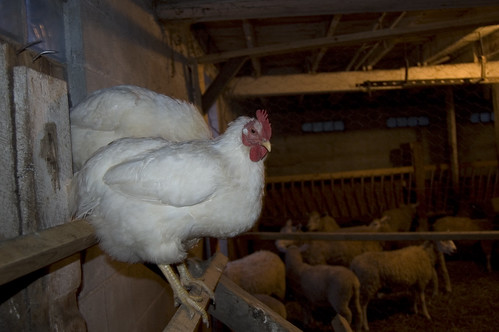
We mainly raise vegetables, but we have been expanding livestock on the farm.  For the past four years, we have raised broilers (chickens for eating, not laying) along with laying hens and a flock of sheep; last year we even tried our hand at a few pigs.

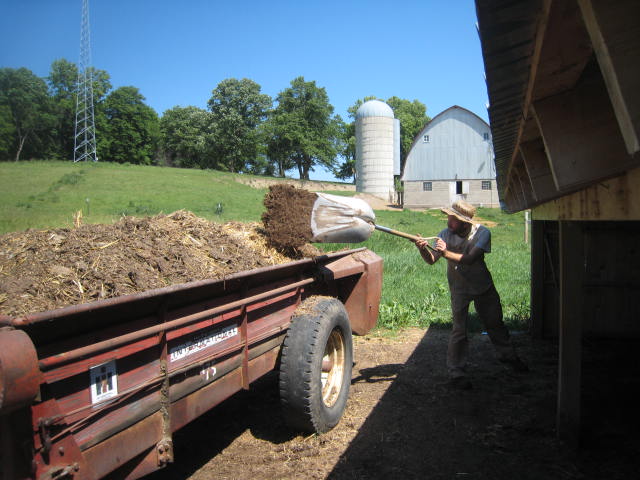
Why?  Meat is tasty and allows us something else to offer CSA members and other customers, but one really big reason is manure.  Veggies need a lot of fertility, and, when raising produce organically without high-powered manufactured fertilizers, you almost have to have livestock manure.

We keep experimenting with ways to create good compost out of manure.  One thing we have been trying is doing a slow composting method where we let the manure pack break down under a roof and out of the rain for 6 months + which keeps more nitrogen in the compost instead of leaching out in the elements.  

Tools of the trade - a manure fork and a grain shovel
Last week I shoveled out the chicken shed in preparation for this year's batch of 200 broilers.  We let last year's chicken litter break down since last August and we'll spread in a windrow in a shady spot on our hill to break down some more for fall spreading on the fields.    

Filling up the manure spreader
The finished product - half-complete compost
Shed ready for new birds!

Saturday, April 21, 2012

How much comes in a share?

Signing up for the season must feel like a leap of faith for people new to CSA.  What will I get each week?  Is it a bunch of crazy stuff I don't eat?  Is it too much?  Too little?  

At Lida Farm we deliver a bushel box of produce each week to both with full shares and every-other-week shares.  A full share should supply a family of 4 veggies for the season   

The picture below is an example from early July last year and the mix of things changes throughout the season.  In early July we were still delivering early season stuff last year with salad mix, greens like chard, kohlrabi, radishes, braising mix, spinach, garlic scapes, and strawberries.  
CSA box, early July 2011
We focus on growing all the staples, but also make sure there is a little surprise each week too.  Many of our members tell me they like the CSA experience because they end up trying new things.  That being said, I know people don't want a box of only weird stuff, so the majority of what we grow are staples like lettuce, sweet corn, potatoes, tomatoes, peppers, and radishes.

More details about the 2012 CSA season are found on the "Join our CSA" webpage.

Sunday, April 15, 2012

Lida Farm on TV

I spent a good portion of today getting pretty wet and cold.  I was bedding down young chickens in a leaky coop in the pasture, securing a greenhouse in some high winds, and seeding in our greenhouse kept cool so as not to burn too much propane in a spring storm.  To warm everybody up a bit, I thought I'd share this video Lakes Country Living TV program did on us last summer.  It was hot out and produce was peak season.  Try not to pay too close attention to that sea of foxtail in the onion patch!


Tuesday, September 22, 2009

Chickens, Chickens, Chickens

We got our first set of fryers in from my friend and fellow grower, Karen Terry of Fergus Falls. About 3 lbs in size, they are young and tender birds raised entirely on pasture with all organic feed. $6 each, click here to order at the local dirt site.

We'll have these available for delivery or pick-up at the farm until they are gone (I have only 24, so we're not talking a lot of birds here).

Karen will also be supplying us a set of larger birds in a couple weeks...more of a roaster size. While on the local dirt site, you can also arrange for other food for delivery or pick-up like cheese, butter, or extra produce like canning tomatoes or peppers. Frost has to be around the corner, so don't wait too long.