 Well, the big news over the last week has been the frost. Last Thursday we got a light patchy frost which only hit low-lying areas. But Friday night we got a pretty heavy frost which blanketed the whole garden. Since we knew a good frost was coming, we were able to stockpile as much as possible Friday night, throwing peppers and tomatoes into packing crates like mad. That’s why you will still see tomatoes, peppers, and eggplant in the box this week. Everything else is just a pile of mush out in the fields. It’s kind of sad to see, but everything needs to come to an end. You will also see the beginning of the winter squash in the box too. I always figure people are just not in the mood to prepare squash until those cool fall days come about…I know I never am.
Monday, September 24, 2007
Lida Farm Journal Week 14
Well, the big news over the last week has been the frost. Last Thursday we got a light patchy frost which only hit low-lying areas. But Friday night we got a pretty heavy frost which blanketed the whole garden. Since we knew a good frost was coming, we were able to stockpile as much as possible Friday night, throwing peppers and tomatoes into packing crates like mad. That’s why you will still see tomatoes, peppers, and eggplant in the box this week. Everything else is just a pile of mush out in the fields. It’s kind of sad to see, but everything needs to come to an end. You will also see the beginning of the winter squash in the box too. I always figure people are just not in the mood to prepare squash until those cool fall days come about…I know I never am.

Thursday, September 06, 2007
Lida Farm Journal: Week 12
 Summer is giving way to fall. This brings me quite a bit of relief, but a little sadness too. I just love bringing the season to an end, mowing down those plants which look like heck at this time of year. Most organic gardens look like an overgrown weedpatch this time of year—ours included—and it’s just stressful to look at. And I’m looking forward to having a little more time to just play with the kids and take some vacation time. I do worn out this time of year.
 IN THE BOX:
Tomatoes
A Couple Red Onions
Fresh Sage
A Couple Green Peppers
A Couple Italia Peppers
A few Sweet Colored Peppers
Another Baby Watermelon
A Baby Cateloupe
White
Cukes
Summer Squash
Leeks
Garlic
Beans
Eggplant
Edamame aka Edible Soybeans
Just boil the beans in the pod in salted water, shell, and eat. They are good with beer.
BREADED SLICED EGGPLANT
Printed from COOKS.COM
1 sm. eggplant
3/4 c. fine fresh bread crumbs
1/4 c. water
4 tbsp. vegetable oil
1 egg
1/4 c. freshly grated Parmesan cheese
Salt and pepper to taste
Flour for dredging
Cut eggplant in 1/2 inch thick slices; set aside. Combine bread crumbs and cheese. Mix egg, water, salt, and pepper. Dip eggplant in flour; remove excess. Dip in egg mixture. Remove excess; dip in cheese-bread crumb mixture. Pat slices firmly so they are evenly coated. Fry in hot oil until golden brown on both sides. Drain on paper towels.
Thursday, August 30, 2007
Lida Farm Journal: Week 11
 Where are the melons? If you’ve been wondering this since early august, just know that I’ve been wondering the same thing. But, finally, they have started to mature. We grew them using a plastic mulch called IRT this year for the first time. This is pretty typical on produce farms and something we did on Foxtail Farm where I used to work. IRT stands for InfraRed Transmitting, so the mulch allows in light to warm the soil and also stops weeds. This is the perfect recipe for growing melons, which love warm soil temperatures. One problem, on the other hand, is that the melons rely on irrigation lines below the mulch for moisture instead of rain. So, when you’re in charge of supplying “rain” to plants, you walk a real tightrope, balancing size and flavor. For example, if you irrigate a lot, you get big melons, but also flavorless melons. Myself, I was on the conservative side, so we ended up with small melons, but I think they have good flavor. Anyway, I’m just happy they finally made it!
 IN THE BOX:
Tomato Mix
The little green ones are an heirloom called Green Zebra. We’ve grown them for the first time this year. Smaller than I thought they’d be, but they have good flavor.
A Couple Yellow Onions
Parsley
Fresh Thyme
If you can’t get to using it soon, just let dry in your kitchen. We’re still using the stuff we dried last fall. If dry, you can put into a ziplock bag and knock around so all the leaves fell off the stems.
Sungold Cherry Tomatoes
Roma Tomatoes
Italian Beans
You’ll notice these beans are flat. They are a variety called Romano Bush and belong to a family of beans people call Italian beans, which are typical throughout the
Green Stuffing Peppers
A Couple Colored Peppers
Hot Peppers
The red ones are called cherry bombs—really mild when you remove the seeds and membranes.
Watermelons
The light-colored one is a yellow variety called Sunshine and the other is a red variety called Sugar Baby.
Stuffed Peppers
Salt
5 tbsp extra-virgin olive oil
1 medium yellow onion, peeled and chopped
1 clove of garlic, peeled and chopped
1 lb of lean ground beef
1 1/2 cup of cooked rice
1 cup chopped tomatoes
1 tbsp chopped fresh oregano or parsley
Fresh ground pepper
1/2 cup ketchup
1/2 tsp of Worcestershire Sauce
Dash of Tabasco sauce
1 Bring a large pot of water to a boil over high heat. Meanwhile, cut top off peppers 1 inch from the stem end, and remove seeds. Add several generous pinches of salt to boiling water, then add peppers and boil, using a spoon to keep peppers completely submerged, until brilliant green (or red if red peppers) and their flesh slightly softened, about 3 minutes. Drain, set aside to cool.
2 Preheat oven to 350 degrees F. Heat 4 tbsp of the oil in a large skillet over medium heat. Add onions and garlic, and cook, stirring often, until soft and translucent, about 5 minutes. Remove skillet from heat, add meat, rice, tomatoes, and herb, and season generously with salt and pepper. Mix well.
3 Drizzle remaining 1 tbsp. Oil inside peppers, arrange cut side up in a baking dish, then stuff peppers with filling. Combine ketchup, Worcestershire sauce,
Serves 4.
Monday, August 27, 2007
Lida Farm Journal: Week 10
Last week Maree was telling me that I shouldn’t go off on some tangent in my newsletter all the time. Just stick to the weather and how things are growing…that’s what people want to hear about. So, this week I’m going to do just that.
Tomatoes
I put in a real slug. I was thinking of this a good time to make sauce.
Onions
I put in one sweet (light colored…tear-drop shape), one red, and two yellow storage onions.
A Bunch of Carrots
Garlic
Corn
This is supposed to be a yellow variety called Bodacious, but it sat a bit too close to the bi-color and turned a bit bi-color itself. I tested it…still tastes good.
Dino Kale
Green Beans
Green Peppers
Italia Peppers
This is considered a “frying pepper” although it’s got great sweet taste raw too.
Globe Eggplant
Traditional Italian style. They come in slow, so if you didn’t receive one, you’ll get one next week.
An all-white variety. Seems like it’s good for frying, but I like for mashing.
*No flowers this week
Corn Chowder
1 Tbsp unsalted butter
1 strip of bacon
1/2 large yellow onion, chopped
1/2 large carrot, chopped (about 1/3 cup)
1/2 celery stalk, chopped (about 1/3 cup)
1 bay leaf
1 medium potato, peeled and diced
1/4 red bell pepper, chopped (about 1/4 cup)
Salt and fresh ground pepper
1/2 teaspoon fresh thyme leaves
3 ears of sweet corn, kernels removed from the cobs (about 2 cups), cobs reserved
1 In a large saucepan, melt the butter over medium heat. Add the bacon strip (skip this step for vegetarian option, just add more butter) and fry until the bacon renders its fat, but doesn't begin to brown, 3 or 4 minutes. Add the onion and sauté for 4 to 5 minutes, until soft. Add the carrot and celery and cook for 4 or 5 more minutes.
2 Break the corn cobs in half and add them to the saucepan. Add the milk and bay leaf. Bring to a boil and reduce heat to a bare simmer. Cover the pot and cook for 30 minutes. Make sure the heat is as low as can be and still maintain a gentle simmer (on our stove we had to use the "warm" setting) to prevent scalding the milk on the bottom of the pan.
3 Discard the cobs, the bacon strip, and the bay leaf. Raise the heat, add the potatoes, red pepper, 1 teaspoon of salt, fresh ground pepper to taste, bring to a simmer and reduce the heat to maintain a simmer for 15 minutes, or until the potatoes are almost fork tender.
4 Raise the heat, add the corn kernels and the thyme. Bring to a boil, reduce the heat, and simmer for 5 minutes.
Serves 4.
Friday, August 17, 2007
Lida Farm Jounal: Week 9
Earlier this week I attended an Extension training for farmers market managers in the twin cities. One of the other “hats” I wear is as president of the Lakes Area Farmers Market in
Heirloom Tomatoes
These are a variety called Cherokee Purple. They are totally ugly, but don’t let looks fool you, these have great taste. Best for fresh eating…don’t cook with them.
Tomatoes
These are our main crop tomatoes called Red Sun.
A few leeks
Check out the recipe below. To clean, cut lengthwise and peel back the leaves and wash.
A few onions
The yellow type is a sweet onion called Alisa Craig and the red is called Red Bull.
A Bunch of Carrots
Corn
A white variety called Silver King. First time I’ve grown it…nice size ears.
Summer Squash Mix
Red Norland Potatoes
Potato Leek Soup
4 T unsalted butter
1 large or 2 medium sliced leeks, white part only
4 cups chicken broth
4 cups potatoes, peeled and diced
1 cup heavy cream
1 cup milk (whole or 2%)
Salt and pepper to taste
2 T chopped parsley, optional
Thursday, August 09, 2007
Lida Farn CSA Journal: Week 8
 One thing we really shoot for at our place is to make sure nothing goes to waste. Sometimes we feel like some 19th century pioneer family trying to get the most out of everything. Probably the best example at our farm is what we do with leftover produce. It’s pretty rare for us to sell absolutely everything we bring to the Saturday market in
Roma tomatoes
These are a variety called Juliet, which are really good as salad tomatoes.
A few Regular Tomatoes
Early girl and the beginnings of the big main crop tomatoes.
A couple Green Peppers
A few Jalapeno Peppers
Fresh Oregano
A Bunch of Carrots
A mix. The purple one are a variety called purple haze, just to change it up a bit.
Corn
Yellow Beans
Cukes
Beets
Garlic
Dino Kale
| Balsamic Glazed Carrots |
|

| Submitted by: Harry Wetzel | Prep Time: 5 Minutes | Ready In: 15 Minutes |
"Carrots are sauteed in olive oil, and then briefly tossed with balsamic vinegar and brown sugar in this deceptively simple side dish."
INGREDIENTS:
| 3 cups baby carrots 1 tablespoon olive oil | 1 1/2 tablespoons balsamic vinegar 1 tablespoon brown sugar |
DIRECTIONS:
| 1. | Heat oil in a skillet over medium-high heat. Saute carrots in oil for about 10 minutes, or until tender. Stir in balsamic vinegar and brown sugar, mix to coat and serve. |
| ALL RIGHTS RESERVED © 2007 Allrecipes.com | Printed from Allrecipes.com 8/9/2007 |
Thursday, August 02, 2007
Lida Farm Journal: Week 7
Well, high season has finally arrived to
Cherry Tomatoes
These are mostly Sungold (an orange variety) with a mix of standard red cherries.
A couple early Tomatoes
The yellow one is named Taxi and the red one is Early Girl.
Red Bull Onions
A couple Summer Squash
Fresh Italian Parsley
Fennel
I’m throwing you for a loop on this one. I think fennel is really one of those “left-field” vegetables for most people, so I’ve included a recipe. I also know people grill it as well and add it to Italian sauces.
Bunch of Carrots
Corn
Green Beans
Fresh Basil
Cukes
Eggplant
Braised Fennel with Parmesan
From Deborah Madison, Vegetarian Cooking for Everyone
2 to 3 T butter
Salt and pepper
½ cup dry white wine or water
1/3 cup grated parmesan
Preheat the oven to 225 degrees. Rub a baking dish large enough to hold the fennel in a single layer with butter. Steam the fennel for 10 minutes, then arrange in dish. Dot with butter or drizzle with olive oil, season with salt and pepper, and add the wine. Cover and bake for 20 minutes. Remove the cover, baste the fennel with its juice, then add the cheese and continue baking until the fennel is completely tender, about 10 minutes more. Serve with chopped fennel greens or parsley.
Friday, July 27, 2007
Lida Farm Journal: Week Six
Whether you know it or not, you are part of a movement, the local foods movement. There has been a trend growing over the last decade or so for folks to get their food locally. The whole idea is that people source what they eat from a local farm, and, in return, they receive food which is fresh, get to know their grower, and support their local economy to boot. People have figured out that shipping substandard food covered in fungicides half way around the world doesn’t make a heck of a lot of sense. I call it a movement because it really is a strong trend you’ll find across the whole country; it’s not just something you find amongst only crunchy folks in California …you’ll find the same thing in Des Moines St. Paul Farmers Market today and you’d never guess that twenty years ago it looked pretty sparse with a dozen or so vendor huddled in a barren parking lot. The market we sell at on Saturdays, Lakes Area Farmers Market in Detroit Lakes New York Minnesota
Detroit Lakes Farmers Market, September 2006
Detroit Lakes Farmers Market, September 2006

Things have progressed to the point where a recent Star Tribune headline read “Too Many Markets or Too Few Farmers?” It described a new farmers market in
IN THE BOX:
Red Cabbage
Broccoli
Sweet Onions
A couple Summer Squash: You may already be getting sick of this stuff, so I took it down to two this week.
Fresh Italian Parsley
Lacinato Kale
Mini-head of lettuce
Red Potatoes
Cukes
Chiogga Beets : An heirloom variety. See recipe below.
Five Minute Beets
From Deborah Madison, Vegetarian Cooking for Everyone
4 beets, about 1 pound
1 T butter
Salt and pepper
Lemon juice or vinegar to taste
2 T chopped parsley, tarragon, dill, or other herb.
Grate beets into coarse shreds. Melt the butter into a skillet, add the beets, and toss with ½ teaspoon salt and pepper to taste. Add ¼ cup water, then cover the pan and cook over medium heat until the beets are tender. Remover the lid and raise the heat to boil off any excess water. Taste for salt, season with a little lemon juice or vinegar—balsamic or red wine is good—and toss with the herb. If you don’t mind the shocking color, you can stir in a tablespoon of yogurt or sour cream, always a good addition to beets.
Thursday, July 26, 2007
Lida Farm CSA Journal: Week 5
A couple weeks ago I went to a neighbor’s 50th wedding anniversary, and, naturally, everybody wanted to know how the big garden was growing. Usually when we begin talking about growing things (whether we’re talking soybeans or heirloom tomatoes), we typically end up talking about problems. There are so many things which can kill off a crop: hail, drought, fungus, countless viruses, dozens of insect varieties (striped cucumber beetle, squash bugs, Colorado potato beetle, aphids to name a few), but I would argue a child is the greatest danger to any plant. Our 2 year old Sylvia makes it her job to “help” us when we’re out working the fields. She pulls flowers when we pick flowers, she rips out potato plants when we pull out ragweed…I think you get the picture. She is our little Godzilla, but instead on stomping on Japanese people, she has a tendency to crush plants and vegetables.
Cabbage
Raspberries: A pint or a half-pint, depending on what you got last week.
Spring Onions: These are an Italian heirloom variety…most call them torpedo onions. They are mild like any red onion.
Mix of Summer Squash : You will see 3 of the 4 types we grow: Yellow Zucchini, Green Zucchini, Sunburst Pattypan Squash, or Yellow Straightneck Squash.
Fresh Basil
Garlic Chives
Salad Mix
Potatoes
Gold Beets: Use like you would any beet. I put in different varieties just to change it up.
Summer Squash Fritters
From Ryan Pesch
2 eggs, beaten
1 t basil
2 T olive oil
1 t oregano
2 spring onions, diced
Salt and pepper
This is a pretty loose recipe, so please experiment with seasonings and ingredients (I have added tomatoes in the past and made with thyme instead of basil/oregano). In a single bowl, mix eggs, squash, and seasonings. Heat oil in a skillet and fry like you would an omlette until the fritter is firm (cooked through) and lightly brown on each side. You can make one big fritter or a few small ones…it’s your call.
Thursday, July 05, 2007
Lida Farm CSA Journal:Week Three
 Yesterday I was thinking about heat. This season was short on it in May and early June, had plenty in late June, and is slated to have a good heat wave this weekend. When it comes to growing produce, it’s both good and bad. Since there’s such a diversity of crops out there, I sometimes pray for some warmth to push the plants along; other times I curse it. A lot of it relates to the three main growing seasons on a produce farm: early, high, and late. The vegetables of each season have differing needs and react differently to the heat.
 Like early season, we have a “compressed” late season. We basically squeeze both in just before and immediately after our most productive season in
Strawberries
These runts are the end of the line.
Green Onions aka Scallions
Swiss chard
1 pint “Sugar Ann” peas
I neglected to say last week that they are snap peas where the pod is edible. If you shelled, you probably didn’t get a lot a pea.
2 Kohlrabis
Many just peel, slice, and eat, but there are recipes where you cook them like stuffed kohlrabi.
3 heads of lettuce:
Everyone gets green oakleaf and red oakleaf plus green butterhead or green leaf
Chinese or
This is another one of those vegetables with two names. See recipe below.
Fresh basil
STIR FRIED SPICED CABBAGE
Printed from COOKS.COM
1 lb. Chinese cabbage (napa)
2 tbsp. sugar
2 tbsp. white vinegar
1 tbsp. soy sauce
1 tsp. salt
1/4 tsp. cayenne pepper
1 tbsp. vegetable oil
With a cleaver or sharp knife, trim the top leaves of the cabbage and the root ends. Separate the stalks and wash them under cold running water. Cut each stalk, leaves, and all, into 1 x 1 1/2 inch pieces.
In a small bowl: combine the sugar, vinegar, soy sauce, salt, and cayenne pepper and mix thoroughly. Leave the oil within easy reach.
Heat a 12 inch wok right after washing over high heat. When the last drop of water has been evaporated, pour in the oil, swirl it about in the pan and heat for 30 seconds, then turn the heat down to moderate. Immediately add the cabbage and stir fry for 2-3 minutes. Make sure all the cabbage is coated with the oil. Remove the wok from the heat and stir in the soy sauce, vinegar mixture. Transfer the cabbage to a platter and let it cool to lukewarm before serving. Or, if you prefer, serve it chilled. 4 servings.
Tuesday, June 12, 2007
CSA memberships still available
Your newest grower: Willem Grant Pesch
 Well, the season is well on its way with temperatures almost reaching 90 yesterday and MOST plants in the ground. I'm still being driven crazy by all the rain.
We still have 3 CSA shares available for this year's season. Instead of making the trip to the farmers market, we'll deliver the produce to your door. Give us a call or e-mail if you're interested: 218-342-2619 or pesch@umn.edu.
Above you can see we have another set of hands at Lida Farm. Will is now 6 months old, and, although he loves going outside, I can't imagine he'll be pulling weeds anytime soon.

 Well, the season is well on its way with temperatures almost reaching 90 yesterday and MOST plants in the ground. I'm still being driven crazy by all the rain.
We still have 3 CSA shares available for this year's season. Instead of making the trip to the farmers market, we'll deliver the produce to your door. Give us a call or e-mail if you're interested: 218-342-2619 or pesch@umn.edu.
Above you can see we have another set of hands at Lida Farm. Will is now 6 months old, and, although he loves going outside, I can't imagine he'll be pulling weeds anytime soon.
Monday, March 12, 2007
Returning from Winter Break
Ah, Spring is coming again! For growers like myself, we begin to wake up from hibernation and get ready to take on another year: planning, planting, weeding, harvesting, and, yes, BLOGGING.
Our big project this year is to grow our CSA from 2 shares to 15. With the birth of our son, Willem, we decided to find more CSA customers and attend fewer markets. I like selling at the farmers market, but it is pretty tough to juggle packing BOTH produce and kids.
CSA share from our farm, July 2006.
 One share costs $400 for the season (16 weeks from June-October) and you have the option of adding a cut flower share for an additional $25 (6-8 weeks from July-September). With each share you receive a box each week of whatever is in season each. Think of it as a subscription, but instead of receiving a magazine or newspaper, you get produce. We will deliver to your home or you can pick up at the farm.
You can see from the picture at the left an example of the variety you receive each week: basil, strawberries, red oakleaf and greenleaf lettuce, radishes, spinich, breen onions, broccoli, and kale.
Our big project this year is to grow our CSA from 2 shares to 15. With the birth of our son, Willem, we decided to find more CSA customers and attend fewer markets. I like selling at the farmers market, but it is pretty tough to juggle packing BOTH produce and kids.
CSA share from our farm, July 2006.
One share costs $400 for the season (16 weeks from June-October) and you have the option of adding a cut flower share for an additional $25 (6-8 weeks from July-September). With each share you receive a box each week of whatever is in season each. Think of it as a subscription, but instead of receiving a magazine or newspaper, you get produce. We will deliver to your home or you can pick up at the farm.You can see from the picture at the left an example of the variety you receive each week: basil, strawberries, red oakleaf and greenleaf lettuce, radishes, spinich, breen onions, broccoli, and kale.
Friday, September 22, 2006
Vermont...Local Foods Mecca.
Awesome Farmstand in Vermont,
Well, you probably thought I had disappeared...I was "right on" getting an entry into the blog every week until recently. I blame it on my day job. I've had to travel quite a bit lately, including a trip to the American Mecca of local foods as evidenced by this picture I've posted...boy, I wish I had a place like this one day.
One trip I just made was to Burlington, Vermont for an Extension Tourism conference. If you are at all interested in local foods, organics, and dairy products, Vermont is your place! I ate at a couple of restaurants which feature local foods. One called Flatbread uses all local ingredients for all food as well as the beer produced on site. Wow. It was impressive.
Just think if our own region of Minnesota started to connect as well with local farms...our region benefits from both quality food and the support to local economies. And what's really holding us back from doing so? Not much...we just need to connect and meet each others needs. Consumers need to think twice about where their food is coming from and give local producers a chance...local producers need to really hear what customers are looking for and grow to meet their needs.
Menu for Saturday's Market:
Tomatoes
Cucumbers
Peppers (sweet, colored, hot)
Red and White Potatoes
Red and Sweet Onions
Winter Squash (delicata, acorn, butternut)
Arugula
Edamame
Beets
Turnips and Rutabagas
Leeks
Greens (kale, collards, swiss chard)
Tongue of Fire shelling beans
Romanette green beans (flat pod)
A few cateloupe
Fresh herbs
Check it out folks...we dodged a bullet this past week, but I guarantee the frost will be here soon! All those peppers, tomatoes, etc. will be gone. This is your last chance.

Well, you probably thought I had disappeared...I was "right on" getting an entry into the blog every week until recently. I blame it on my day job. I've had to travel quite a bit lately, including a trip to the American Mecca of local foods as evidenced by this picture I've posted...boy, I wish I had a place like this one day.
One trip I just made was to Burlington, Vermont for an Extension Tourism conference. If you are at all interested in local foods, organics, and dairy products, Vermont is your place! I ate at a couple of restaurants which feature local foods. One called Flatbread uses all local ingredients for all food as well as the beer produced on site. Wow. It was impressive.
Just think if our own region of Minnesota started to connect as well with local farms...our region benefits from both quality food and the support to local economies. And what's really holding us back from doing so? Not much...we just need to connect and meet each others needs. Consumers need to think twice about where their food is coming from and give local producers a chance...local producers need to really hear what customers are looking for and grow to meet their needs.
Menu for Saturday's Market:
Tomatoes
Cucumbers
Peppers (sweet, colored, hot)
Red and White Potatoes
Red and Sweet Onions
Winter Squash (delicata, acorn, butternut)
Arugula
Edamame
Beets
Turnips and Rutabagas
Leeks
Greens (kale, collards, swiss chard)
Tongue of Fire shelling beans
Romanette green beans (flat pod)
A few cateloupe
Fresh herbs
Check it out folks...we dodged a bullet this past week, but I guarantee the frost will be here soon! All those peppers, tomatoes, etc. will be gone. This is your last chance.
Thursday, August 24, 2006
Get into summer before it's too late
Transplanter and Cultivator
 Saturday's Market Menu:
Canteloupe: new
Watermelon: both yellow and red
Turnips: new
Sweet corn: bi-color
Cucumbers
Summer Squash
Tomatoes: heirloom, roma, and beefsteak
Cherry Tomatoes: Sungold and grape
Beets
Eggplant
Potatoes: Yukon Gold and Norland
Cut Flowers
Leeks
Onions: red, sweet, and yellow
Garlic
Summer is just flying by if you havn't been paying attention.
It seems like just last week I was selling lettuce and early brassicas like kale, but I can already see the end from where I stand. Frost seems to appear by the second week of September...for those of you counting, that's just three weeks away!
 Saturday's Market Menu:
Canteloupe: new
Watermelon: both yellow and red
Turnips: new
Sweet corn: bi-color
Cucumbers
Summer Squash
Tomatoes: heirloom, roma, and beefsteak
Cherry Tomatoes: Sungold and grape
Beets
Eggplant
Potatoes: Yukon Gold and Norland
Cut Flowers
Leeks
Onions: red, sweet, and yellow
Garlic
Summer is just flying by if you havn't been paying attention.
It seems like just last week I was selling lettuce and early brassicas like kale, but I can already see the end from where I stand. Frost seems to appear by the second week of September...for those of you counting, that's just three weeks away!
Thursday, August 17, 2006
New Pictures
Market menu for Saturday, August 19:
Watermelons: Sunshine (yellow variety) and Sugar Baby (regular)
Tomatoes: cherry tomatoes, romas, heirlooms, and regular beefsteak varieties
Potatoes: Yukon Gold and Norland Red
Corn: Bodacious bi-color variety
Onions: yellow, sweet, red
Peppers
Beets
Garlic
Leeks
Some yellow beans...
Flower Bouquets
Turnips
Radishes
My Uncle Duane was visiting our farm back in July and he lives for taking pictures! He lives in California and so it was great he could spend a couple of days with us. Some of his shots are below.
Sunset over Greenhouse looking North

Barn with pasture and thistles

Moving drip irrigation lines...my dad helping, my grandmom supervising.

Setting up irrigation...a common sight in July

Watermelons: Sunshine (yellow variety) and Sugar Baby (regular)
Tomatoes: cherry tomatoes, romas, heirlooms, and regular beefsteak varieties
Potatoes: Yukon Gold and Norland Red
Corn: Bodacious bi-color variety
Onions: yellow, sweet, red
Peppers
Beets
Garlic
Leeks
Some yellow beans...
Flower Bouquets
Turnips
Radishes
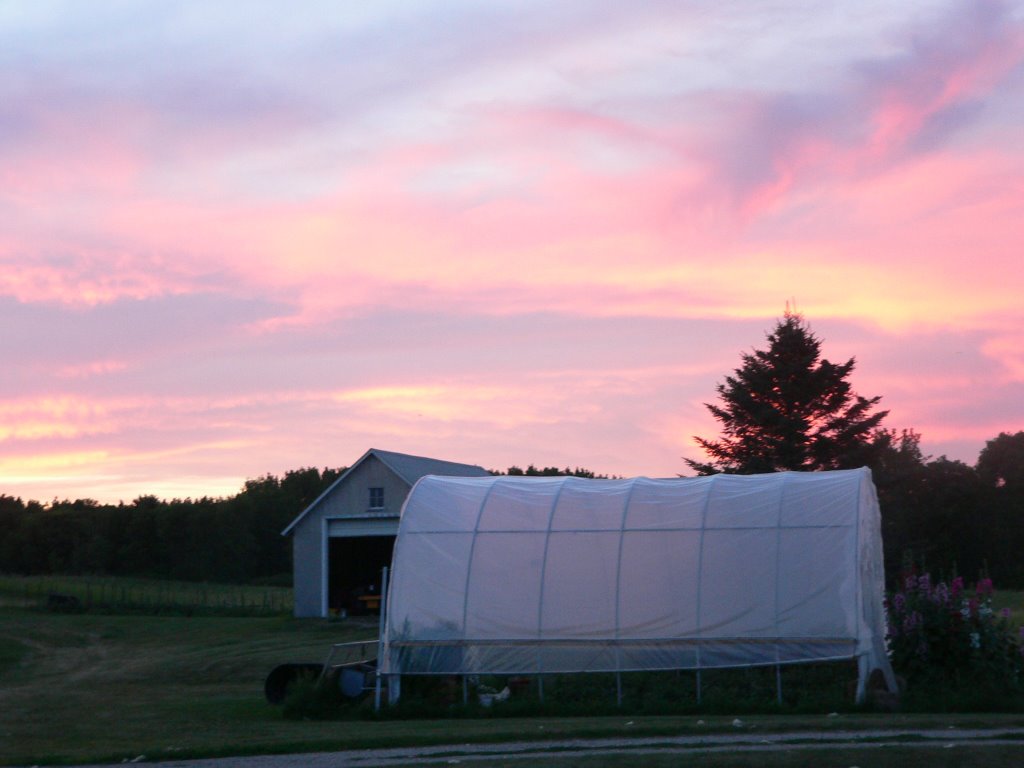
My Uncle Duane was visiting our farm back in July and he lives for taking pictures! He lives in California and so it was great he could spend a couple of days with us. Some of his shots are below.
Sunset over Greenhouse looking North
Barn with pasture and thistles

Moving drip irrigation lines...my dad helping, my grandmom supervising.
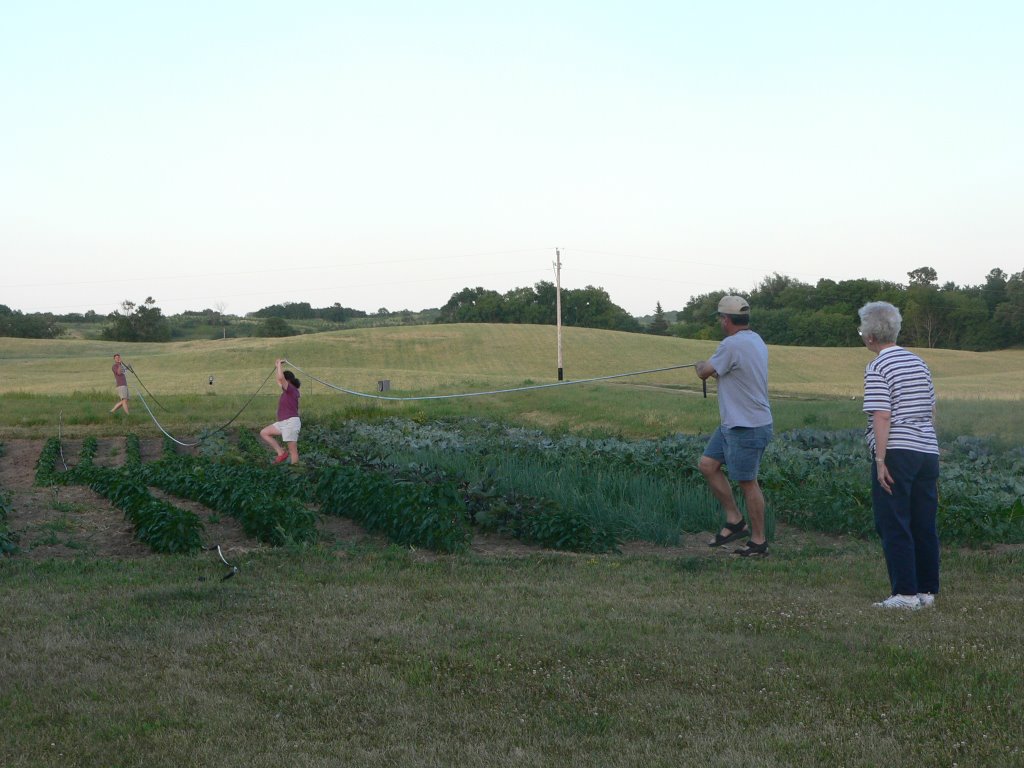
Setting up irrigation...a common sight in July

Thursday, August 03, 2006
Hot!
A absolute nightmare heat descended on Minnesota last week. My father-in-law follows weather like a hawk online and he said Vergas had a temperature of 97 and a dewpoint of 83 last sunday for a heat index of 122 degrees!! Man, it was insane.
As you can imagine this is not good for any crop. Even vegetables like melons and tomatoes which really like heat just shut down and try to survive, especially with such little moisture in the soil. Luckily we got nearly an inch of rain last Friday night, so I think all the plants have made it "over the hump." So, pray for a solid 80-some degrees with a weekly rain from here until frost.
Saturday's menu:
Juliet paste or plum tomatoes (new)
Taxi yellow tomatoes (new)
Valley Girl tomatoes (new)
...all these small, early-variety tomatoes are just coming in, so supply won't be great.
Beets (new)
Mix of Cherry Tomatoes: Grape, Sungold orange variety, and Washington Cherry variety
Cucumbers
Summer Squash and Zucchini
Sweet Onions
Red Onions
Garlic and a couple Garlic Braids
Bok Choy
Last of Broccoli
Red Cabbage
Cut Flower Bouquets
Norland Red Potatoes
I'm out of town until Friday night, so let's hope I have time and energy to pull off harvest!
As you can imagine this is not good for any crop. Even vegetables like melons and tomatoes which really like heat just shut down and try to survive, especially with such little moisture in the soil. Luckily we got nearly an inch of rain last Friday night, so I think all the plants have made it "over the hump." So, pray for a solid 80-some degrees with a weekly rain from here until frost.
Saturday's menu:
Juliet paste or plum tomatoes (new)
Taxi yellow tomatoes (new)
Valley Girl tomatoes (new)
...all these small, early-variety tomatoes are just coming in, so supply won't be great.
Beets (new)
Mix of Cherry Tomatoes: Grape, Sungold orange variety, and Washington Cherry variety
Cucumbers
Summer Squash and Zucchini
Sweet Onions
Red Onions
Garlic and a couple Garlic Braids
Bok Choy
Last of Broccoli
Red Cabbage
Cut Flower Bouquets
Norland Red Potatoes
I'm out of town until Friday night, so let's hope I have time and energy to pull off harvest!
Thursday, July 27, 2006
July is a Trying Time
Staked Tomatoes
 Although a field of 900 tomatoes plants all staked and in neat little rows is a beatiful sight...
Mar and I Staking Tomatoes

I think staking tomatoes used to be a medieval torture treatment. Basically you need to string 4 lines of twine along side of every tomato. You do this by extending a line under the foliage of the plants and tighten the line around each stake. And you try to do this without knocking off any little tomatoes or blossoms!
Striped Cucumber Beetle - most hated insect ever!
 Enemy number one: Striped Cucumber Beetle. This guy is really making my July tough.
I've been battling this bug since early June, but it has really exploded since early July and is really insult to injury in our dry conditions.
They like anything in the cucurbit family which includes all melons, squash, and cucumbers. Right now they are eating all blossoms and crewing on the fruit of the plants, especially the zucchini.
I have been treating the plants with a substance called PyGanic, which is an organically-approved (OMRI) insecticide made out of Pyrethrin, a natural insecticide made from a plant.
Still the battle is not as successful as hoped. I am now tossing out about 1/3 of all summer squash due to insect damage. So, if you see some little pock marks on a zucchini, sqush, or melon throughout the season, you now know the culprit. But don't worry, it's only cosmetic.
Saturday's Market Menu:
Red Potatoes (new)
Cherry Tomatoes
Red and Sweet Onions
GreenBeans
More Zinnia Bouquets
Mini Bok Choy (new)
Cucumbers
Garlic
Summer Squash
A few Eggplants
 Although a field of 900 tomatoes plants all staked and in neat little rows is a beatiful sight...
Mar and I Staking Tomatoes
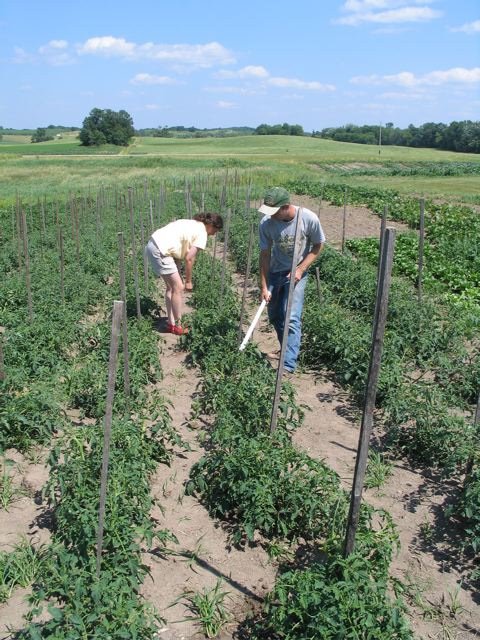
I think staking tomatoes used to be a medieval torture treatment. Basically you need to string 4 lines of twine along side of every tomato. You do this by extending a line under the foliage of the plants and tighten the line around each stake. And you try to do this without knocking off any little tomatoes or blossoms!
Striped Cucumber Beetle - most hated insect ever!
 Enemy number one: Striped Cucumber Beetle. This guy is really making my July tough.
I've been battling this bug since early June, but it has really exploded since early July and is really insult to injury in our dry conditions.
They like anything in the cucurbit family which includes all melons, squash, and cucumbers. Right now they are eating all blossoms and crewing on the fruit of the plants, especially the zucchini.
I have been treating the plants with a substance called PyGanic, which is an organically-approved (OMRI) insecticide made out of Pyrethrin, a natural insecticide made from a plant.
Still the battle is not as successful as hoped. I am now tossing out about 1/3 of all summer squash due to insect damage. So, if you see some little pock marks on a zucchini, sqush, or melon throughout the season, you now know the culprit. But don't worry, it's only cosmetic.
Saturday's Market Menu:
Red Potatoes (new)
Cherry Tomatoes
Red and Sweet Onions
GreenBeans
More Zinnia Bouquets
Mini Bok Choy (new)
Cucumbers
Garlic
Summer Squash
A few Eggplants
Tuesday, July 18, 2006
History of Pesch Farm and Produce
 It seems kind of strange to write about the history of Pesch Farm and Produce since there is so little of it, but I thought you'd like to know how we got here.
Cast of characters:
Me - Ryan
Mar - Maree, my wife
Sylvie - Sylvia, our daughter
We hightailed out of St. Paul and moved to our farm halfway between Pelican Rapids and Vergas two years ago. I'm originally from East Grand Forks and Mar's from Lake Elmo, so we lucked out in landing halfway between both our families.

So how did you get into vegetable farming?
Some 6 years ago I was a kid out of college living in St. Paul. After a stint in a law office shuffling papers and realizing just how boring the real world of employment actually is, I decided to make a sharp left turn and find an apprenticeship on one of the many local organic farms in the "vegetable belt" around the twin cities. I ended up working for Paul and Chris Burkhouse of Foxtail Farm for two seasons before Mar and I got married. At Foxtail I learned all there was to managing a produce farm and CSA (community supported agriculture).
In 2002 Mar and I did a "dry run" on our own. We were tenants on her uncle's land in Lake Elmo and sold at the Northeast Minneapolis Farmers Market. Also at the same time I worked at Mississippi Market Food Co-op in St. Paul as a greengrocer, a job I had until we moved up to Otter Tail County.
So, for us, being able to afford a small farm and actually start up our own place is a dream come turn. It's been a long road, but we're happy to be here.
OK, Ryan, thanks for the history, but I just want to know what you're bringing to market on Saturday...
Cucumbers (new)
Eggplant (new)
Pickling cucumbers
Summer squash: zucchini, crocked-neck, sunburst (new)
Green onions (last week for season)
Broccoli
Green beans
Garlic
Sweet Onions
Zinnias
Maybe potatoes...
Friday, July 14, 2006
Local Foods on the March
I've decided that we have really turned a corner with how people view what they eat.
For a long time only a small group of folks were talking about the importance and pleasure of buying fresh and local food. Not only is a local head of lettuce about 100 times fresher than the three-week old head of Iceberg, but you encounter a huge variety of produce, support local farmers, and learn a lot about your local community in the process.
But two articles have changed my view. 1. Wednesday the Star Tribune ran a series of articles on the ethics of buying food http://www.startribune.com/438/story/547730.html 2. Today I read an article on Wal-Mart bringing organic foods to their stores http://adage.com/article?article_id=110482 When Wal-Mart joins in, you know all this talk about organic and local foods is no longer relegated to crunchy people who hang around health food stores! This is big.
In our own small way we've seen this at the little Lakes Area Farmers Market. The number of people shopping is up from last year as is the number of vendors selling. Sometimes we just think we're a backwater--a bit behind the times--but, on this, we are right in the mix. We're growing our own local food system right here.
Coming to Market:
Peas
Green Beans
Broccoli
Pickling Cucumbers
Summer Squash
Lettuce
Sweet onions
Green onions
Kale
Swiss Chard
For a long time only a small group of folks were talking about the importance and pleasure of buying fresh and local food. Not only is a local head of lettuce about 100 times fresher than the three-week old head of Iceberg, but you encounter a huge variety of produce, support local farmers, and learn a lot about your local community in the process.
But two articles have changed my view. 1. Wednesday the Star Tribune ran a series of articles on the ethics of buying food http://www.startribune.com/438/story/547730.html 2. Today I read an article on Wal-Mart bringing organic foods to their stores http://adage.com/article?article_id=110482 When Wal-Mart joins in, you know all this talk about organic and local foods is no longer relegated to crunchy people who hang around health food stores! This is big.
In our own small way we've seen this at the little Lakes Area Farmers Market. The number of people shopping is up from last year as is the number of vendors selling. Sometimes we just think we're a backwater--a bit behind the times--but, on this, we are right in the mix. We're growing our own local food system right here.
Coming to Market:
Peas
Green Beans
Broccoli
Pickling Cucumbers
Summer Squash
Lettuce
Sweet onions
Green onions
Kale
Swiss Chard
Friday, July 07, 2006
Market Day 7-8-06
Well, already another market day is upon us. The week has just whizzed by and tomorrow is already Saturday.
Market menu:
Lettuce: red bibb, green bibb, red oakleaf, romaine, and green butterhead
Scallions (or green onions, if you prefer...the two names are confusing!)
Kohlrabi
Green garlic (just hasn't been dried or cured yet): it's just more flavorful and with a little kick.
Summer Squash: zucchini and yellow crocked neck
Collards
Basil
Kale
Market menu:
Lettuce: red bibb, green bibb, red oakleaf, romaine, and green butterhead
Scallions (or green onions, if you prefer...the two names are confusing!)
Kohlrabi
Green garlic (just hasn't been dried or cured yet): it's just more flavorful and with a little kick.
Summer Squash: zucchini and yellow crocked neck
Collards
Basil
Kale
Subscribe to:
Posts (Atom)