Friday, August 17, 2012

The Next Crop of Growers

For the last 4 years we've raised chickens (broilers) in addition to produce.  Up until this year we always loaded up chickens into a stock trailer around midnight in order to wake up at 5 am and truck down to Ashby, where there's a federally-inspected plant.  After unloading, I'd get home in time to get harvesting for the CSA box.  Sound like fun, eh?   Not really.  

Anyway, this year we processed our birds on farm which really took down the stress of the birds and myself.    I was able to do this because we rented equipment from former students of mine at the Sustainable Food Production program at M-State, Andy Hayner and Noelle Hardin.  They rent out equipment and help us do the processing right on site, which is a great value and we knew we were getting our birds done right.  Since there isn't a federal inspector on site, you have to pick up your birds from the farm instead of my being able to deliver them.  

When out processing the birds, my thoughts besides plucking feathers was about how great it is to have new energy and people getting into local food production in the area - it's been pretty lonely sometimes being an organic vegetable grower in Otter Tail County.  In the farm marketing and management course I teach as part of the Sustainable Food Production program, I've now seen almost 30 student go through the 2-semester diploma program and I'm thinking about half have started businesses and all are doing something in food production if only for themselves.  It's a great thing to see and certainly something we need more of.  

If you know of somebody interested in small farms, local foods, and learning the ropes of farming, please get them in touch with me.  I'd be happy to give them more details about the program.  There's still time to start this fall!

In the Box: 
  • Tomatoes 
  • A couple Stuffing Peppers (big ones)
  • An Italia Pepper - the green/red one which is sweet, not hot.  This is considered a frying pepper and has a great flavor.  
  • A couple Anaheim Peppers - the brighter green skinny peppers which have a mild heat.  This is the pepper behind chile rellenos. 
  • Silver King Sweet Corn - an all-white variety with a good mellow corn flavor
  • A couple Yellow Summer Squash 
  • A Yellow Onion 
  • A Red Onion
  • A Bulb of Garlic
  • Bunch of Carrots - Sorry these are a bit small and should have grown a bit more, but I was determined to get some more carrots in the box since I haven't had them in for quite a while.  The yellow carrots are a variety called Yellow Sun and the orange ones are Scarlet Nantes
  • A Melon - I had to scrimp to get the right number of ripe melons, so it's a real mixed bag.  It's not fair, I know, but some of you may find a little Asian melon called Sun Jewel, others will find standard canteloupe, and one lucky duck will get this nice sized watermelon.  
  • Purple Queen Purple Beans - these are tricky in that when you cook them, they loose their color.  Otherwise treat as you would any other bean.  
  • Parsley

Sunday, August 05, 2012

Farm Stand Now Open

Although it gets exhausting to fill every day with picking, packing, and delivering produce every day of the week, I always feel good about opening the farm stand at the end of the driveway, which is did just this morning.  We already have CSA deliveries on Friday and the Farmers Market in Detroit Lakes on Saturday.

Farm Stand with Willem on Bike, 2011
I always like the farm stand because it brings so many people right to our farm and it feels good that we're feeding our neighbors, which is the majority of people who stop.  I think part of the allure of the farm stand for customers (and it is open to everybody, not only CSA members as some people have thought) is that you're looking right at the fields where the produce came from.  There's no wondering "I these guys putting me on...did they really grow all this stuff or are they shipping in some stuff from down the road? (This is something we never do by the way)"  There's also ample evidence that we don't use herbicides since you'll see some weeds taller than me.

Anyway, if you know anybody who isn't interested into the commitment of a CSA membership, but into picking up some good local produce every so often, please let them know about the farm stand.  It's open 24 hours a day, 7 days a week from today until October.  The stand is self-serve, so simply stop, pick out what you want, and leave payment in the box on the right side of the stand.

In the CSA box for the week:

  • Norvalley White Potatoes
  • A couple Mini Heads of Lettuce 
  • A dozen ears of Sweet Corn - the variety is either Ambrosia or Paydirt
  • Mix of Cherry Tomatoes - If they are a color other than red, they are supposed to be that color:  Sungold (orange), Sweet 100 (red), Black Cherry (purple), White Cherry (white).  
  • A couple Japanese Eggplant 
  • A couple Leeks 
  • Basil - a mix of red and green just to give you some variety.  To give you a little advice on storing basil, do not put in the refrigerator.  Instead, trim the bottoms and leave in a vase with a little water like you would cut flowers or store at room temperature in an open zip lock with a couple damp paper towels.  
  • Scarlet Queen Turnips - The pink/red root vegetable with the long greens. Use as you would any turnip.  
  • Yellow Wax Beans - These came in really heavy this week, so I put in quite a bunch.  
  • A Couple Cukes

Friday, July 27, 2012

Missing the Sweet Corn Craze

There's probably no other occasion in the Midwest produce season quite like the beginning of the sweet corn crop.  So you can understand my frustration, when, everywhere I turn, I see some guy (or usually kid) at the side of the road selling sweet corn, and I find my own to be a few days short of ripe.  People have been asking me about sweet corn easily for the last 4 weeks even though it would take some kind of magic corn to be ripe at the beginning of July.  I keep thinking these "fake roadside stands" that simply truck in corn from Iowa and Nebraska really early are messing with people's sense of season and sense of what we can actually grow in Minnesota, especially when they put sweet corn next to some peaches next to cherries in mid-July.  Still, when actual local growers are at the side of the road, I have no excuse.
Sweet Corn on Lida Farm

Raising produce commercially is often a huge juggle where each year one crop or another under or over-performs.  I'm always out in the fields telling myself "That should have gotten in the ground 10 days earlier" or "Man, I should have weeded that patch earlier."  Throw in some interesting weather-a little hail here and there-and I really should be amazed that any crops come at all.  The trick in what we do is to keep as many of those balls in the air as possible and keep all of them moving forward and growing.  I commonly work through 5-7 different tasks a day in June and July (maybe starting with cultivating on the tractor, hand weeding a few crops, then moving to wheel hoe a couple other beds, etc). If I get stuck too long on any one crop or job, I can easily miss the window to take care of another crop, and, yes, sometimes a crop just gets written off.  So, in the context of all this juggling of 60+ different crops, sweet corn appearing a bit late shouldn't be the end of the world, but I still feel a bit like a professional musician who missed hitting a C chord on stage.

In the box:
Norland Red Potatoes
Bunch of Carrots
Cucumbers
Green Beans
Fresh Oregano: Tiny fragrant bunch of greens with a red band
Fennel: The frawns (greens) has a pretty strong anise flavor, but the bulb itself is more mild (see recipe below)
Cilantro
Peppers: One Islander (purple) and a couple green

Fennel goes especially well with chicken and fish.  Here's a simple recipe using chicken: http://www.nytimes.com/2007/01/31/dining/313lrex.html


Friday, July 20, 2012

Coming into High Season

As you'll see from the delivery this week, we're starting to get into high season.  Green beans have come into season and we were able to get a couple peppers for everybody this week too.  No tomatoes or sweet corn yet, but they are just around the corner.  


Reminder: We're having our open house at Lida Farm this Sunday, July 22 from 2-4 pm.  Come on out, have a little drink and a snack, and check out how the crops are growing.  This is open for member and non-members alike, so feel free to bring a friend.

In the box:
  • Savoy Cabbage: I promise not to give you any more cabbage for some time...I think it's been 4 weeks now. But cabbage keeps forever in a refrigerator and this stuff was just so beautiful I just had to put it in the box. 
  • French Breakfast Radishes
  • Braising Mix: These are the frilly, purple and green bunch of greens. These are cooking greens. 
  • Fresh Thyme: The little tiny bunch of fragrant herbs.  If you've never cooked with fresh herbs, this is your chance.  I'm sure you'll taste a difference. 
  • Bunch of Beets: These are a mix of Chiogga and Red Ace. The Red Ace are your standard beet and Chiogga are a brighter red and striped red/white on inside.  You prepare as you would any beet. 
  • Contender Green Beans 
  • A couple Sweet Onions: There's a red torpedo onion and an Alisa Craig.  Th big Alisa Craig is more mile if preparing things with fresh onion.  
  • A couple Cucumbers
  • A couple Summer Squash: We had a mix of yellow straightneck, zucchini, and yellow zucchini
  • A Purple Islander Pepper and an Ace Green Pepper
  • A Japanese Eggplant: These guys have just started to come into season along with peppers, so some a pretty small.   Here's Bobby Flay giving you some ideas on how to grill these guys: 


Friday, July 13, 2012

Two Season Crops

We'll the spring brassicas (cabbage, kohlrabi, broccoli) are working their way past the finish line; I have the flail mower on the tractor and ready to mow them down.  This allows us to clean up the field as well as make room for a new crop.  But even while I eye the spring brassicas, I took an hour yesterday and planted the fall brassicas, including broccoli, cabbage, and cauliflower.  The nice think about fall brassicas is that they typically do better than their spring brethren since they have a long cool fall to mature.  I've given up trying to raise cauliflower in the spring which simply gets purple and ugly due to stress in the summer heat.

This two season cropping is also common with other veggies on the farm.  We also have a spring and fall crop of spinach, cool-season greens, and head lettuce makes a comeback as well.  So, if you're a cool-season veggie-eater yourself, don't despair; just wait a couple months.

In the box:
Green Cabbage
Broccoli
Red Ace Beets
Summer Squash - we mostly had zucchini but there are some yellow zucchini and yellow staightneck squash too.
Parsley
Red Basil
Fresh or "green" garlic - this is uncured garlic which is a bit stronger tasting than cured.  You can simply leave on your kitchen counter for a week and I'll dry down if you'd like to cure yourself.
Purple Kohlrabi - I know, you're sick of kohlrabi, but at least this one's a different color!
Dino Kale - the dark green which is all crinkly (see recipe below)
Frisee - the frilly green also called curly endive.  This is in the endive family, so has a nutty flavor.  It's typically mixed in a lot of salad mixes you would buy.
Green onions

Note - check out our facebook page where we've been posting a picture of the box each week with each veggie labeled.

Ryan's Never Fail Greens Recipe 
1 bunch greens (collards, kale, chard)
2-3 slices of bacon
1 small onion

Dice onions, bacon, and greens.  Fry bacon in skillet together with the onion or garlic.  When the onion gets translucent, throw in greens until wilted and season with some salt.  Done.  If you like heat, add red pepper flakes.

Friday, July 06, 2012

Dealing with Bad Weather on the Farm


I swear I spend half of my time complaining about weather on this website, but this week I have good reason. 

Monday night we got some serious hail.  Typically we experience 30-45 seconds of hail when the weather front first comes through, but this time it just kept coming down for a good ten minutes.  You’ll see evidence of this on the produce like white blotches on the peas where they took a hailstone or greens with healed over holes. 

Some of the best advice I got from my mentor on whose farm I apprenticed was “if you get hail, don’t even look at the plants for a couple days.”  Even though hail inflicts a lot of damage, it’s amazing how quickly the plants recover. 

Now, today, I’m sitting in our kitchen writing this because our power’s out after a major streak of lightening tried hitting our house while a rain poured on my head out picking peas.  I can’t even fill the tanks to harvest and wash produce.  But desperate times call for desperate measures, so I fired up the PTO generator just to make some coffee. 


In the box:
  • Snap peas: fatter peas, which are edible pod, so don’t try shelling.  You'll see these white marks where hail hit, but I've been eating a bunch in the field and I think they are fine.
  • Snow peas: the flat ones
  • Kohlrabi: see recipe below
  • Red Sails red leaf lettuce: the leafy red green
  • Radicchio: the small round red green.  It is often mixed into a mix of other greens in a salad.  It's got a pretty strong nutty, bitter flavor, so it's not for everybody.  
  • Small Romaine lettuce
  • Broccoli
  • Green cabbage
  • Basil
  • Cilantro
  • A couple sweet onions (Alisa Craig variety)
  • First cucumber of the year

Honey-Mustard Kohlrabi from St. Paul Farmers Market Cookbook
2 cups kohlrabi, peeled and sliced
2 T olive oil
2 T honey
1-2 T Dijon mustard
Steam kohlrabi until tender, about 10 minutes.  In a bowl, mix together oil, honey, and mustard.  Taste and adjust for flavor.  Toss with cooked kohlrabi.  Makes 4 servings. 

Friday, June 29, 2012

Minerals on the Farm

This week as I was harvesting broccoli for the box, I was looking across the brassica field where we have the kohlrabi, cabbage, broccoli and brussel sprouts and thought just how good the field looked this year.  The good timings I've had with cultivating helps, but one thing which I'd like to highlight is the mineral fertilizer I've incorporated this year.
Ryan harvesting Napa Cabbage

Plants in the brassica family like broccoli are pretty heavy "feeders" of micronutrients (macro-nutrients are nitrogen, potash, and potassium) like calcium, boron, and manganese.  To better feed the plant, this year we sourced a mineral blend from Midwestern Bio-Ag which the brassicas really responded to.  We've never had such healthy-looking cabbages.  People always wonder what we do about insects when raising vegetables without pesticides, but this is part of the secret.  If you have healthy plants with proper nutrition, the bug pressure is always less - kind of like those healthy people you know who never get sick.

In the box:
  • Cilantro
  • Kohlrabi 
  • Napa Cabbage: It seems like not a lot of people cook with Napa, but I absolutely love the stuff!  Follow this recipe below from the Epicurious website for an idea on how to use it.  
  • Radishes 
  • Strawberries
  • Snap Peas: These are edible pod peas, so please don't try to shell; just eat them.  
  • Spinach 
  • Broccoli 
  • Red lettuce: Most people got a red oakleaf variety called Cocarde, but some did Red Sails red leaf. 
  • Salad Mix  
Spicey Napa Cabbage Slaw with Cilantro Dressing from Epicurious

  • 1/4 cup rice vinegar (not seasoned)
  • 2 teaspoons sugar
  • 1 teaspoon grated peeled ginger
  • 2 tablespoons vegetable oil
  • 1 fresh serrano chile, finely chopped, with seeds
  • 1 small head Napa cabbage (1 1/2 pounds), cored and cut crosswise into 1/2-inch slices
  • 1 bunch scallions, sliced
  • 1/2 cup coarsely chopped cilantro

  • Whisk together vinegar, sugar, ginger, oil, chile, and 1/2 teaspoon salt. Add remaining ingredients and toss well. Let stand, tossing occasionally, 10 minutes.
    Read More http://www.epicurious.com/recipes/food/views/Spicy-Napa-Cabbage-Slaw-with-Cilantro-Dressing-243168#ixzz1zDu8T5Ia
     

    Friday, June 22, 2012

    My Farm Philosophy (CSA week 1)


    We'll this is week number one for our 8th CSA season as Lida Farm!   I'm feeling good about where we're heading and I think it'll be a great season.  

    I think individual farms have their own "take" on agriculture and how their farm fits in the world; this is probably even more important for CSA operations where people choose an operation to make "their farm" for the season.  My own farm philosophy is geared towards three things: soil, people, and community.

    We are committed to growing our produce without the use of any synthetic chemicals EVER (we haven't use a chemical on the place for the 8 years we've lived here).  We also do the best we can to build the soil as much as possible each year, incorporating livestock into our operation and interplanting cover crops to fix nitrogen and add organic matter.

    People are the core of our operation.  We do our utmost to make sure our members and farmers market customers get clean, quality food.  I love the feeling of knowing we are helping to feed families and giving them a direct connection to farming.  I love getting to know people who eat our food and learning about what their interested in.  We're going to have a few events over the season this year to make connecting a bit easier, including an open house and fall feast so stay tuned.  We want our farm to be your farm, so please make a point to attend some events or simply come out and visit!

    Lastly, community is big for us.  Not only our local communities of Pelican Rapids and Vergas, but also our fellow local farmers.  Just as local residents support us in becoming CSA members and customers, we in turn support our local businesses.  Building up a stronger local economy in our little rural part of the state is a core part of our mission and I feel so much more can be accomplished if we all cooperate together.  We also take on a role of educating the community on sustainable agriculture.  For the last 3 years we've hosted Pelican Rapids early childhood classes in the fall and the local 4-H club was out just last week.

    In the Box: 

    • Bok Choy 
    • Garlic Scapes - the curly green bunch.  Think of scapes and use them as garlic-y green onions.  You can also use them in place of garlic cloves; they'll be a bit more mild than garlic cloves.  
    • Arugula - the bunch of greens which look like elongated oak leaves.  This can be eaten fresh or steamed or in a pasta; a traditional Italian green.  I prefer as a simple side salad with parmesan, oil, pepper, and some balsamic vinegar. 
    • Radishes - some got cherry belle (red variety) and others got French breakfast variety (look like long pink/white bobbers).  
    • Red Russian Kale - big bunch of purple greens.  These need to be cooked.  I typically do kale with sauteed bacon and onions and then simmer down the cropped greens for 10 minutes or so.  
    • Green Onions
    • Salad Mix (in the bag) or Romaine Lettuce  
    • Spinach - loose greens with the pink roots 

    Stir-Fired Bok Choy from the Food Network

    Ingredients

    • 1 tablespoon olive oil
    • 2 cloves garlic, minced
    • 1 tablespoon minced fresh ginger
    • 8 cups chopped fresh bok choy
    • 2 tablespoons reduced-sodium soy sauce
    • Salt and ground black pepper

    Directions

    Heat oil in a large skillet over medium heat. Add garlic and ginger and cook 1 minute. Add bok choy and soy sauce cook 3 to 5 minutes, until greens are wilted and stalks are crisp-tender. Season, to taste, with salt and black pepper. 
    I suggest you use the garlic scapes in this recipe in place of the garlic cloves - it'll work fine.  


    Wednesday, June 13, 2012

    Why Raise Livestock on a Produce Farm?

    We mainly raise vegetables, but we have been expanding livestock on the farm.  For the past four years, we have raised broilers (chickens for eating, not laying) along with laying hens and a flock of sheep; last year we even tried our hand at a few pigs.

    Why?  Meat is tasty and allows us something else to offer CSA members and other customers, but one really big reason is manure.  Veggies need a lot of fertility, and, when raising produce organically without high-powered manufactured fertilizers, you almost have to have livestock manure.

    We keep experimenting with ways to create good compost out of manure.  One thing we have been trying is doing a slow composting method where we let the manure pack break down under a roof and out of the rain for 6 months + which keeps more nitrogen in the compost instead of leaching out in the elements.  

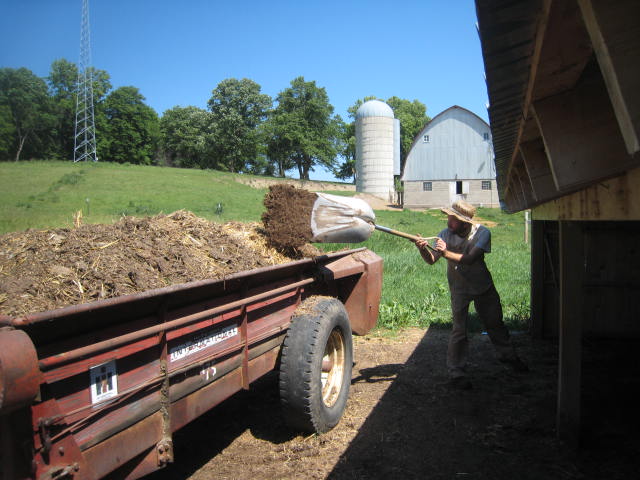
    Tools of the trade - a manure fork and a grain shovel
    Last week I shoveled out the chicken shed in preparation for this year's batch of 200 broilers.  We let last year's chicken litter break down since last August and we'll spread in a windrow in a shady spot on our hill to break down some more for fall spreading on the fields.    

    Filling up the manure spreader
    The finished product - half-complete compost
    Shed ready for new birds!

    Saturday, June 02, 2012

    A few CSA shares available for 2012 season

    Our first CSA delivery of fresh in-season produce will be coming up in a few weeks.  We're a small operation which is totally family run.  Maree and I both the owner/operators and the entire workforce of Lida Farm (plus three kids under the age of 7, but they are not great contributors yet).  Last year I harvested for and assembled about 30 shares each Friday.  We currently stand at about 27 shares, so it's not too late to sign up.

    Our season runs for 16 weeks (Mid-June through Mid-October) and we also do every-other-week shares for couples or families which just want to try out a CSA.  The cost is $450 for a full share delivered directly to your home or $250 for every other week.  We also give a $50 discount if you pick up at the farm yourself (at $400/season, this is $25/week).  Besides the produce we will also be hosting a few events on-farm for the 2012 season for our members.  Check out details under "Join our CSA" on this website or get a hold of us at lidafarmer@gmail.com or 218-342-2619.

    early season CSA veggies, lida farm CSA, pelican rapids CSA
    CSA box from June, 2011

    Saturday, April 21, 2012

    How much comes in a share?

    Signing up for the season must feel like a leap of faith for people new to CSA.  What will I get each week?  Is it a bunch of crazy stuff I don't eat?  Is it too much?  Too little?  

    At Lida Farm we deliver a bushel box of produce each week to both with full shares and every-other-week shares.  A full share should supply a family of 4 veggies for the season   

    The picture below is an example from early July last year and the mix of things changes throughout the season.  In early July we were still delivering early season stuff last year with salad mix, greens like chard, kohlrabi, radishes, braising mix, spinach, garlic scapes, and strawberries.  
    CSA box, early July 2011
    We focus on growing all the staples, but also make sure there is a little surprise each week too.  Many of our members tell me they like the CSA experience because they end up trying new things.  That being said, I know people don't want a box of only weird stuff, so the majority of what we grow are staples like lettuce, sweet corn, potatoes, tomatoes, peppers, and radishes.

    More details about the 2012 CSA season are found on the "Join our CSA" webpage.

    Sunday, April 15, 2012

    Lida Farm on TV

    I spent a good portion of today getting pretty wet and cold.  I was bedding down young chickens in a leaky coop in the pasture, securing a greenhouse in some high winds, and seeding in our greenhouse kept cool so as not to burn too much propane in a spring storm.  To warm everybody up a bit, I thought I'd share this video Lakes Country Living TV program did on us last summer.  It was hot out and produce was peak season.  Try not to pay too close attention to that sea of foxtail in the onion patch!


    Monday, February 27, 2012

    Hanging out with other Foodies at the MOSES Conference

    Maree, Graham, and I finally made our way down to the mecca of organic growers in the US, the Midwest Organic Conference (http://www.mosesorganic.org/conference.html).  About 3,200 organic growers, wanna-be farmers, and organic foodie types descended on LaCrosse, WI last Thursday-Saturday to take in workshops about soils and raising livestock as well as a poetry slam and a lot of organic foods and snacks.

    I presented a poster as Ryan Pesch, Extension Educator, about a food survey I did in Renville County-it was not  the headliner of the event-but the ideas we got for our own farm were the highlights.  Since we raised three hogs last year, we appreciated the session on raising hogs on pasture and also the session on integrating CSA with other enterprises like farmers market and livestock.  The presenters were doing some cool things around farm to table like making pizzas made with all-farm ingredients for on-farm dinners, but we didn't think it was something we'd pull off for this year.  Still, at the very least, we're much more fired up about the farm season.  Inspiration is great fuel!

    Friday, February 10, 2012

    Looking for a Few Good CSA Members

    Well, even though I try to hibernate as much of winter as possible, the stirrings of spring have begun to pull my mind towards the 2012 CSA season.  For those of you who were members of Lida Farm CSA last year, you should have received a brochure and order form to join for this year by mail.  For those of you just perusing the web for a CSA, we serve the lakes district between Pelican Rapids and Detroit Lakes and would welcome your membership in the 2012 season.  Please check out our 2012 CSA Brochure for details.

    If you know of others who may be interested in joining a CSA in the area, please feel free to forward the link and materials to them.  We will be adding a few more shares this year, so are looking for new recruits.

    Friday, October 07, 2011

    End of the CSA Season

    Wow, quite a season!  After just coming  back from the last CSA delivery, I'm always reflective.  This season was probably the hottest since I've been farming in Otter Tail.  It was also one of the driest.
    Kids on Way to Farmers Market
    This made for great crops which love the heat like melons, tomatoes, and anything in the cucurbit family like cucumbers and summer and winter squash.  The way the season ran allowed these plants to get established well with heat and moisture and then ripen under dry conditions.  It's a good recipe for good looking produce.  Some other things, however, didn't like this weather.  For example I always plan for  a planting of brassicas like broccoli and kohlrabi in the fall as well as the spring, but the fall set didn't go anywhere with little fall rain.   Any which way, each season is it's own beast and I thank each of you sharing the ride with us.  

    In the box: 
    Komatsuna bunch: a green with a stalk kind of like boc choy.   This is an Asian green which is good in a stir fry.  You simply chop up and add at the end until wilted a bit.  Here's a link to a Komatsuna recipe which looks simple and quick since it's one of those odd "crazy" greens:
    http://woodwart.blogspot.com/2005/10/komatsuna-saute.html
    Spinach: the one with dark green and round leaves.  You could use for either a salad or cooked. 
    Butternut squash: big tan squash 
    Celeriac: The strange-looking bulb on the end of a small stalk of celery.  You can use it in replace of celery in recipes  It has the same flavor and also keeps well in the crisper in your fridge.    
    Delicata squash: yellow and green-striped squash.  This one should be baked without a water bath because the outside shell is pretty thin. 
    Buttercup squash: the dark green squash with the little button the bottom
    Russet potatoes
    Carrot bunch 
    A couple onions 
    A head of garlic
    A few small turnips
    "Better than Nothing" beets


    Friday, September 30, 2011

    Hot but Still Fall

    This past week felt like summer even though the tasks were fall in nature.  Typically when I think of work at the end of september/early october, I think of dunking my hands in freezing water trying to hold a brush to clean squash, but not this year.  Today we were cleaning squash outside with a slight breeze in the air and a warm sun in the sky.  It was nice.  Also I was out pulling in the turnips this morning and it didn't seem right that I was harvesting this crop in a t-shirt.  However, it's undoubt-ably fall because everything in the fields just doesn't grow.  Even with warm days, the loss of sunlight and shorter days really slows things down.  I keep having high hopes that the carrots in the last bed will bulk up, but they just seem to sit there.  There's no issue with greens bolting too soon, however, so let's be thankful.

    On Monday we had the Pelican Rapids Early Childhood classes out and it was a real blast to have that many people here.  Our quarter-mile driveway was lined with cars and I had to do three groups for the haywagon ride.  The kids got a kick out of throwing old tomatoes to the pigs, seeing the sheep and our one donkey, and finding a pumpkin to take home.  I made sure to do a little ag education when taking people on the tour, pointing out how we graze our sheep in rotation and giving the lowdown on what's alfalfa and hay vs. straw.

    In the box:
    Braising mix: this is a mix of greens you can use at the end of a stir fry or as a cooked side green.  Simply start with some garlic and oil in a skillet, chop the greens, and saute until wilted a bit.
    A turnip or two
    An onion or two
    Celery
    Brussels sprouts: the big ugly stick in the box.  You don't eat the stick, just the sprouts
    Acorn Squash
    Spaghetti Squash: See video below to see how to prepare as a pasta.
    Long Island Cheese Squash or Kakai Pumpkin: The Long Island Cheese looks like a cheese wheel and is the color of a Butternut.  Mar and I really dig the flavor of this squash and Maree makes these pumpkin-cream cheese bars with them.  A Kakai pumpkin is dark green and orange and is supposed to be super for pumpkin seeds.
    Carrots

    Vegetable Garden Spaghetti Squash:

    Friday, September 23, 2011

    Workers Matter in Agriculture

    I was really struck this week when I read a short article on leaflets being left at Hugo's groceries in the sugar aisle by union workers currently locked out of the American Crystal plants when the company left negotiations.  The leaflets were pretty basic that just asked customers to go to this website http://www.bctgm.org/ACS_Lockout.html and read up on the issue.

    I grew up in East Grand Forks in a union household (my dad was a member of IBEW local 1426) and used to work at Hugo's myself carrying out groceries, so the lockout is personal to me.  These workers aren't "those people" I can quickly brush off, but my peers, parents of schoolmates, neighbors, and the people I went to church with.  I never got the impression that sugar beet plant workers were a bunch of overpaid lazybones as you hear on angry AM talk radio all day,  but really modest folks who had to go into work at 11 pm or do these crazy 14-hour shifts through harvest season.  

    When reflecting about this and farming, I think Americans tend to overlook workers in agriculture and instead focus on farmers.  We think that agriculture begins and ends with those working the land, proud and heroic farm owner-operators who till the soil and bring in bountiful harvests in the American heartland.  We see this all the time from Chevy truck commercials to every politician talking about the farm bill.  I like that romantic imagery too.  But in that picture we paint of agriculture, every now and then we should stop looking only at the proud farmer in the center of the picture and appreciate the harvest crew or processing plant in the background.  They are just as integral a part of how food gets to the table today.  Without them, the system stops.

    Reminders: Our harvest party is this saturday at 6:30.  Also the last box is Friday, Oct. 7.

    In the box:
    Broccoli Raab: Yes, a crazy green. See recipe.
    Fresh Dill: Chop up with the potatoes and some butter or sour cream
    A couple green peppers
    A butternut squash
    A couple Blue Bonnet squashes or a couple Carnival squashes
    A pie pumpkin: bake upside down on a pan and use cooked pumpkin in replacement of any of that stuff that comes out of a can
    White onion
    Garlic
    Edamame: This is the big mess of brown sticks in the box.   You only want to use the pods on the stalk.  Simply boil in salt water for a few minutes, drain, and eat with beer...it's good.
    A mix of carrots
    Russet potatoes

    Recipe: Sauteed Broccoli Raab
    Note: don't use the center stem of the raab since it gets woody, but use the leaves, small stems, and florets.

    • 1 bunch broccoli rabe
    • 2large garlic cloves, thinly sliced lengthwise
    • 1/4 cup extra-virgin olive oil
    • 1 teaspoon salt (preferably sea salt), or to taste


    • Accompaniment: lemon wedges

    Cut off and discard 1 inch from stem ends of broccoli rabe. Cook broccoli rabe, uncovered, in 2 batches in a 6- to 8-quart pot of boiling salted water until just tender, about 3 minutes, transferring with a slotted spoon to a large bowl of ice and cold water to stop cooking. Drain well in a colander.
    Cook garlic in oil in a 12-inch nonstick skillet over moderate heat, stirring occasionally, until garlic is golden, about 5 minutes. Add broccoli rabe and cook, tossing to coat with oil, until heated through, 3 to 5 minutes. Toss broccoli rabe with salt.

    Read More http://www.epicurious.com/recipes/food/views/Sauteed-Broccoli-Rabe-109539#ixzz1YpEfcDSp

    Friday, September 09, 2011

    A Race against Time

    I always feel like I'm racing against time in early September. It has been beautiful lately but I typically can count on a September 15 first frost date, so I feel a need to take in as many of those summery veggies as possible. It is like working on the crew of a ship which you know is going to hit a big iceberg...I'm trying to get as many into the lifeboats to safety as possible but I know some will die needlessly. A pretty melodramatic vision, I know.

    This week we had to irrigate for the first time this season. It's getting just like cement out there. Especially for some of these fall crops I have planted like kohlrabi and broccoli, they need some water if they are going to get to size.

    In the Box:
    A couple Red Onions
    Tomatoes
    Sugar Baby Watermelon
    Cantaloupe
    A little salad mix
    Celery
    Acorn squash: I figure it's getting to be the time of year when people get in the mood for Delicata winter squash: a sweet potato squash. Winter squash gets sweeter as it's cured, so leave in a dry sunny place until ready to eat.
    Peppers: a sweet Italia pepper, a green pepper, and a semi-hot Anaheim (the small green pointy one)
    Rosemary: small bunch of pine-needles
    Oregano

    Friday, September 02, 2011

    Summer's Coming to a Close

    The produce season is about where it should be this time of year.  Last week we harvested all the onions and put into the barn to cure.  The tomatoes and peppers are coming due in a big way and those melons are ripe for their annual two week window.  I was peeking at the winter squash and pumpkins and many look like they are ready to go.  Nights are getting cooler and our minds turn to autumn.

    With fall upon us, one thing which should get on your schedule is our annual fall harvest party.  It will be Saturday, September 24 at the farm from 6:30 pm to whenever.  This is a time to check out the farm and meet some other interesting people who are also CSA members.   This is an appetizer/drinks/bonfire event.  We used to do a potluck dinner, but this is more relaxed and casual affair.  We provide all drinks and snacks, so just show up for a while.

    Another thing you should be thinking about in fall is turkey.  I'm happy to partner with a neighbor of mind, Alex Johnson, who is raising free-range turkeys.  His family's been in the business since 1888 which makes him a 4th generation turkey farmer who really knows what he's talking about.  Later this fall he will have heritage-breed Bourbon Red turkeys at $2.05/pound and standard white turkeys at $1.50/pound.  I'm helping him get the word out, so please call or email us to reserve a turkey and we'll make arrangements.  


    In the box:
    Celebrity slicing tomatoes
    A Green pepper
    A couple sweet Carmen peppers
    An orange or yellow bell pepper
    Cippolini onions: this is a really nice, flavorful onion from Italy.  I dig it.  I remember when I was studying in Rome, you'd see long braids of these things in the markets.  I was thinking about this today and I just have to some more next year so we can do this because it's so cool.
    Garlic
    Potatoes
    A smattering of Tongue of Fire beans: this is a fresh shelling bean.  Like dried beans, you can use in a soup or other dish, but the cooking time is a lot less since they are fresh.
    Daikon Radish: This is the white radish with the top.  Peel and use as you would any radish.  Since it's an Asian radish, a typical way I like to make it up is grated with some rice vinegar and sugar.
    Eggplant
    Yellow watermelon
    Athena canteloupe