Tuesday, September 30, 2008
Monday, September 22, 2008
Farm Stand Open for Business
 It’s been a great growing week over the last five days or so. I always worry about those things which are planted, but just need some more heat and light to ripen and get ready for the box. Although a lot of those melons are still not ripe, at least the late corn seems to be coming along and you’ll see some this week. Also there are those “fall crops” which we plant in July or so which I’m always worried about…fall lettuce, spinach, carrots, turnips, broccoli, and cabbage. I get worried because the fall can be so fickle; it can be so cold and wet that a lot of those crops just don’t finish in time and that just drives me crazy! We did all the work to bring the crop along, but mother nature just didn’t get the memo about our plan. This weather sure helps, so I expect some of those greens to make it next week, namely salad mix and arugula.
The other news I’m really excited about is the completion of the farm stand. It turned into one of those summer projects which had so many details that I just couldn’t bring myself to finish it off. Kind of like an afghan or something you started…”boy, this is going to be nice, but I know I’m going to have to put in another 40 hours to finish it.” Kind of kills your motivation, especially if a bunch of other things are consuming your time.
 Still, it was a bunch of work. My father-in-law and I had it all framed in late July, but I still had to level out a place to sit it on as well as put on the tin roof and back wall. You see, since we have one of those raised driveways, I had to dig in a retaining wall and fill in an area to make it somewhat level…otherwise the stand would have sat at a 45% angle—not good. Mar and I spend a couple nights this week collecting big rocks from our pasture and our neighbor’s land. Along the way we even had a medical emergency since Will got carried away with throwing rocks out of the wagon and beaned his sister with a rock the size of my fist…not cool! Anyway, at the end of the rock-hauling project, it was just me, a diesel tractor, a 700-pound farm stand on skids, and a few chains. When I get into these “farm engineering” projects, I just can’t help dreaming up scenarios where the farm stand is completely destroyed, the tractor starts on fire, or I’m fatally wounded. I had similar visions when we were moving the walk in cooler in the machine shed. Luckily, I dodged another bullet to tell you all about it.
Now that the stand is at the end of our driveway, we just need to put on some finishing touches like a sign and a lock box as well as get the word out (which may not be too hard since we had our first customer come by looking for produce 90 minutes after pulling it in place). But this is the easy and fun part and we’re sure to have things up and running by Sunday. Our plan is to have the stand open Friday-Sunday for sure.


Frost
 The big news on the farm this week was the patchy frost which came in Tuesday morning. I was outside watching it make its way across the grass when I got up early to do some things before work. It’s tough to watch for me, of course, because I’m deluding myself in thinking it’s still summer…which it’s not. It was only a matter of time till it came, but it always gets me mad anyway. The great saving grace was that it had rained the day before, so plants and veggies were wet enough that the damage was minimal. What happened is that the cold temperatures put a very thin protective coating of ice on the fruit instead of the frost directly, which leaves the fruit undamaged. It’s a curious thing…why wouldn’t the ice damage the fruit? I don’t know, but I’m glad it happened that way. Basically we lost the tops of some eggplant plants which sat in the lowest part of our fields, which is no big deal at all.
 Otherwise, the other big news is that Sylvia went to her first day of school ever on Wednesday. Granted it’s only preschool, which lasts 3 hours of something, but it’s still a big step…maybe more so for the parents than Sylvie herself. Just another sign that summer is over. Oh well...
The Alternative Local Economy

Last week, after a very good market day in
The problem with a farmers market is that you have to wake up early, harvest like crazy people for four hours, and then race off to the farmers market to frantically set up and sell produce for another four hours. Last Saturday was so busy we had a line up of a dozen people or so even before we had things on the table…pretty nuts and it kept up that way for a good three hours. Needless to say we were a bit tired, so much so that we bagged the idea of going to the Fair on Sunday. Fighting crowds and walking for miles on end didn’t sound like a real relaxing time to a family with no energy, and, although we really like fair food, it’s not really good food.
So, instead, we decided to check out a place in
When I first started as a farm apprentice at Foxtail Farm by
Friday, August 29, 2008
Sliding into Fall
 Well, I was pretty happy with the rain we got earlier in the week. It should have given crops the last push they need to fill out for the season. Even if we don’t get another solid rain and the temperatures are normal, plants are well assured of producing a crop. Before the rain plants were looking a bit stressed and I was running all over the place trying to get the last short-term crops of the year to germinate like fall salad mix.
Thursday, August 21, 2008
Farm Stand Almost Done
I’m feeling pretty good about where things are at this week after last week’s aggravations. Seems like our electric fence is keeping out raccoons and those high-season crops are actually ripening (thanks to 85+ degree heat). It’s tough when you keep slogging through all that work and the plants don’t holding up their end of the bargain; I’ve cultivated, weeded, and trellised tomatoes, but the tomato plants are just giving me green fruit.
Racoon War '08
I was going to write about the ins and outs of organic certification for you’all, but I’ve got coons on my mind right now and I can’t shake them.
 A neighbor of mine says that coons are never a problem until the corn gets just right, then they will show up two days before you want to pick it. Well, I’d have to say that his thinking is right. They completely decimated the planting that I was going to pick on Friday…two days before, right on time! Yesterday I noticed that some plants were stripped of their cobs here and there, which was surprising because I’d never had any problems with coons before. I knew that once they had my number that they weren’t going to go away—kind of like zombies in an old horror movie…they just won’t stop. The major outcome
is that the good looking bi-color sweet corn which SHOULD have been in the box today didn’t make it.
Monday, August 11, 2008
What makes a farm nowadays?
 What makes a farm nowadays? The word farm has a split personality in our day and age between its “popular” and “modern” meanings. “Modern” farms produce a large amount of today’s output. Large scale operations which produce only a few crops, they are not what many think about when you say farm, but then again, today few of us have a direct connection to these operations. The “popular” notion of a farm invokes a diversified 160 acre farm with an old red barn, International H tractor, and a big old garden out of which grandma canned all the food for the family. My “modern” farm friends say that this is just an relic of the past…people have this nostalgic version of a farm stuck in their heads from the last century, but I say “not so fast.”
Thursday, August 07, 2008
Farming with Children
 People are used to seeing us spend most of our time running after our kids: Sylvia, 3; and Willem, 1. At this age, all you are doing is damage control, especially with the boy, stopping them from doing things like running in the street and destroying property. So, when people learn that we farm produce besides my day job, the usual reaction is “How do you do it?” We wonder this ourselves sometimes too, but, really, it comes down to some serious time management.
Soil Matters
I’m sure as I write you that each one of you have a slightly different soil in your backyard. Yours may be a bit sandy, good black loam, or a yellow clay. A grower has drastically different experiences depending on that soil type. At the farm, our soil is a pretty heavy clay. This has its advantages 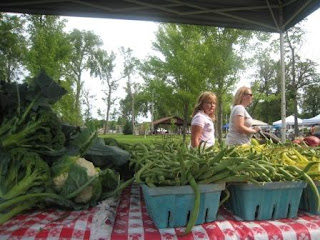 and its disadvantages. The major advantage is that it seriously retains moisture. For
example, last year when it was extremely dry after June, we didn’t have to set up irrigation until the end of July. Places with sandy soils like near Erhard and Dent had crops simply burn up. The couple disadvantages are compaction and soil
temperature. Both of these issues have been challenges this year since we’ve had the “monsoon season” most of the summer. As I’m sure your own plants did, many crops just sat in the mud not growing at all because of the low soil temperature as well as the retention of moisture. With so much water, plants were turning yellow because they simply weren’t getting oxygen due to saturated ground and not functioning to their best abilities because of the low temperatures. Compaction is the other issue which I think we’ve been skirting to the best of our abilities. The trick here with a clay soil is to use machinery only when the ground is pretty dry, if not, you’ll have cement where the tire tracks are and mud chunk cement pieces where you tilled—not good. This, of course, messes with when you can cultivate to take out the weeds. Basically I’ve been working on being more patient this season, so I should be a better person for it.
 and its disadvantages. The major advantage is that it seriously retains moisture. For
example, last year when it was extremely dry after June, we didn’t have to set up irrigation until the end of July. Places with sandy soils like near Erhard and Dent had crops simply burn up. The couple disadvantages are compaction and soil
temperature. Both of these issues have been challenges this year since we’ve had the “monsoon season” most of the summer. As I’m sure your own plants did, many crops just sat in the mud not growing at all because of the low soil temperature as well as the retention of moisture. With so much water, plants were turning yellow because they simply weren’t getting oxygen due to saturated ground and not functioning to their best abilities because of the low temperatures. Compaction is the other issue which I think we’ve been skirting to the best of our abilities. The trick here with a clay soil is to use machinery only when the ground is pretty dry, if not, you’ll have cement where the tire tracks are and mud chunk cement pieces where you tilled—not good. This, of course, messes with when you can cultivate to take out the weeds. Basically I’ve been working on being more patient this season, so I should be a better person for it.
Wednesday, July 23, 2008
Organic Strawberry Production
Strawberrries certainly have their season. They’re so good, all of us at the farm get extremely excited when they first come in. Between jobs, I saunter down to the patch to steal a few berries, and, of course, the kids kind of attack the strawberries in an all-out assult whenever near the garden. The strawberries are like a kid magnet of sorts. Still, after all this excitement, we’ve now hit the point where we can barely look at another one, so it’s good that the season is coming to a close.
Organic strawberries are a real challenge. If you visited, you’d find some towering thistle plants amidst the strawberries. It’s tough because the main crop of berries comes the year after I plant them. But, unlike many other crops, you can’t “clean” the field of weeds in the spring using cultivation. You can weed by hand, but the window to do this is extremely small because strawberry plants will start putting flowers and small berries on early in the season and you don’t want to walk through the patch crushing your potential harvest.
Monday, July 21, 2008
New Developments for 2008
 For both repeat members and new members, I thought I’d write about a few new developments at the farm in 2008.
Tuesday, July 08, 2008
Hail! The Bane of Growers Everywhere
Man, I feel like I just can’t catch a break lately. When an isolated storm came through this week, I figured, what’s the chance. But looking at the TV satellite, I noticed the path was slated to come right over the top of our place. And came it did…bringing not just a heavy rain, but about 10 minutes of hail too. Hail! Every growers nightmare. What’s worse it came with a strong wind, so it cuts through plants even better. Basically this affects some crops more than others. The hardest hit are plants with broad leaves like Swiss Chard and the like…you’ll notice that this salad mix isn’t as beautiful as it was just two days ago (there may be a little “picking through” necessary, so look out). It’s actually good that some plants are not as far along as they should be like peppers; right now they are still just little plants with little foliage to lose…it would have been disastrous if actual peppers were on the plants. All told, it could have been worse.
Anyway, I’m thinking the rest of the season will be on the up and up since we’ve gotten the bad stuff out of the way. The soil around here is very heavy and is finally starting to warm up, which gets the plants growing. Up until our recent heat wave, a number of plants just sat there—not much bigger than when I put them in.
Anyway, I’m thinking the rest of the season will be on the up and up since we’ve gotten the bad stuff out of the way. The soil around here is very heavy and is finally starting to warm up, which gets the plants growing. Up until our recent heat wave, a number of plants just sat there—not much bigger than when I put them in.
Monday, June 30, 2008
First CSA delivery
 As all of you already know, this spring has been a real bear…not a nice cuddly bear, but a tough ugly bear who brings plenty of snow, rain, and cold. We shoot to do our first CSA delivery during the third week of June, but it just didn’t happen this year. Things just took too long to plant, and, when planted, didn’t want to grow in cold, wet soils. Things have started growing just enough to pull together a box this week, but, I have to admit, it was tight. Expect the boxes to become fuller as the season moves on.
Thursday, April 24, 2008
CSA filled for the season
 We had 15 shares available, but all have been taken for the season.
Man, am I glad winter is done!
Thursday, December 13, 2007
I'm taking a break for the off-season
I take time off from blogging in the winter. See you in the spring.
-Ryan.
-Ryan.
Wednesday, October 24, 2007
Lida Farm Journal: Week 16
 Well, this week we’ve come to the end of the line. I don’t know about you, but sometimes the produce season seems like it went by in a blur and other times it seems like a couple years. It was just like yesterday when I was weeding onions and planting potatoes. On the other hand, sometimes when I think about all the stuff which has happened between now and when I started seeds in March, the season seems pretty darn long. Sure, we have a number of chores to put the farm to rest for the winter, but right now I’m looking forward to sitting in a chair, just reading seed catalogs and dreaming of next season. That’s pretty much what growers do in the off season…dream about beautiful, weed-free fields of produce. Still, what I dream up in the off season and what actually happens typically doesn’t match up.
Lately I’ve been dreaming of a rustic little roadside stand at the end of our driveway just overflowing with produce…let’s see if it actually comes to fruition.
Friday, October 05, 2007
Lida Farm Journal: Week 15
I was talking to another vendor at the farmers market the other day about people stocking up on things in the fall. He sells beef at the market and was saying that he makes about ¾ of his sales in the last weeks of September and beginning of October, when people feel the winter coming on and choose to buy a quarter or half of beef. We agreed that’s it’s something like a squirrel complex we all feel, but, instead of burying nuts, we burying food in freezers. We certainly do this ourselves. After deliveries today, I’m going out to scour the tomato patch for the last of the tomatoes which survived the frost and do some extra canning.
Grandpa’s Meats (Grant Langerud): www.grandpasmeats.com or 218-483-4195
Monday, September 24, 2007
Lida Farm Journal Week 14
 Well, the big news over the last week has been the frost. Last Thursday we got a light patchy frost which only hit low-lying areas. But Friday night we got a pretty heavy frost which blanketed the whole garden. Since we knew a good frost was coming, we were able to stockpile as much as possible Friday night, throwing peppers and tomatoes into packing crates like mad. That’s why you will still see tomatoes, peppers, and eggplant in the box this week. Everything else is just a pile of mush out in the fields. It’s kind of sad to see, but everything needs to come to an end. You will also see the beginning of the winter squash in the box too. I always figure people are just not in the mood to prepare squash until those cool fall days come about…I know I never am.
Thursday, September 06, 2007
Lida Farm Journal: Week 12
 Summer is giving way to fall. This brings me quite a bit of relief, but a little sadness too. I just love bringing the season to an end, mowing down those plants which look like heck at this time of year. Most organic gardens look like an overgrown weedpatch this time of year—ours included—and it’s just stressful to look at. And I’m looking forward to having a little more time to just play with the kids and take some vacation time. I do worn out this time of year.
 IN THE BOX:
Tomatoes
A Couple Red Onions
Fresh Sage
A Couple Green Peppers
A Couple Italia Peppers
A few Sweet Colored Peppers
Another Baby Watermelon
A Baby Cateloupe
White
Cukes
Summer Squash
Leeks
Garlic
Beans
Eggplant
Edamame aka Edible Soybeans
Just boil the beans in the pod in salted water, shell, and eat. They are good with beer.
BREADED SLICED EGGPLANT
Printed from COOKS.COM
1 sm. eggplant
3/4 c. fine fresh bread crumbs
1/4 c. water
4 tbsp. vegetable oil
1 egg
1/4 c. freshly grated Parmesan cheese
Salt and pepper to taste
Flour for dredging
Cut eggplant in 1/2 inch thick slices; set aside. Combine bread crumbs and cheese. Mix egg, water, salt, and pepper. Dip eggplant in flour; remove excess. Dip in egg mixture. Remove excess; dip in cheese-bread crumb mixture. Pat slices firmly so they are evenly coated. Fry in hot oil until golden brown on both sides. Drain on paper towels.
Subscribe to:
Posts (Atom)