Friday, September 11, 2009
The State Fair (CSA Week 12)

Friday, September 04, 2009
CSA week 11
The lack of heat is still the weather story around here. This is the second week for melons. We're glad to have them, but they are late. Some things you may not even notice, like the okra that never comes to market because the plants just sit there doing nothing. I'll complain about it, but my sympathies are with other farmers out there like the one I talked to last week: 600 acres of soybeans and he doesn't see them making a harvest. Boy, that makes my 2 acres where some things are good and some bad not too bad a problem really. This is why sustainable ag types highly appreciate diversity in crops...if one thing "crashes and burns", there may be another which does well. In many respects, we're trying to bring back a tradition on farms where many things were produced from a couple hogs and a steer to garden produce, grains, hay. Even if the growing season went to pot, at least you could feed yourself.
In the box:
Leeks: keep refridgerated and cut lengthwise to clean out before using...dirt gets into the leaves.
Carrots
A couple tomatoes
Dill: This is for using the frawns, not the seed head like in pickling. See recipe below.
Cherry Tomato mix
Corn: mostly a white variety called Silver Queen. It's pretty mellow and I love the name. Last week's yellow variety is called Bodacious, which is another cool name.
A red onion
White Potatoes
A couple peppers: The small slender one is an Anaheim (slightly hot, really mild) and the other is a Cubanella (sweet, not hot).
Cauliflower
Cantaloupe: most of you got a variety called Athena, others got an "eastern type" called Halona, which has prominent ribs
A couple cukes
Cucumber, Mustard, And Dill Salad
From Gourmet | October 2004
2 teaspoons white-wine vinegar
2 teaspoons Dijon mustard
1/2 teaspoon salt, or to taste
1 1/2 teaspoons sugar
1 tablespoon mild olive oil
1 large seedless cucumber (usually plastic-wrapped; 1 lb), peeled
2 tablespoons chopped fresh dill
Whisk together vinegar, mustard, salt, and sugar in a bowl, then add oil in a slow stream, whisking.
Halve cucumber lengthwise and remove seeds with a small spoon, then cut halves crosswise into 1/8-inch-thick slices.
Add cucumber and dill to vinaigrette, tossing to coat.
Friday, August 21, 2009
Scotland (CSA week 9)
Apparently a front from Scotland has settled over the area. It's been constantly cold and wet. Man, I just can't figure this summer out! Still, tomotoes have started to come in regardless, which you'll see in the box this week. Thursday, August 13, 2009
Corn Harvest (CSA Week 8)
by Maggie Ruggiero
Sure, go ahead and cook your favorite sausages, but be sure to use every iota of their flavor: Reheat the skillet and work some pork-based magic on a seasonal array of onion, fennel, tomatoes, and corn. Yield: Makes 4 servingsActive Time: 20 min Total Time: 35 min 4 (5-to 6-ounces) fresh pork sausages 1/3 cup water 3/4 cup chopped sweet onion 1 medium fennel bulb, chopped 1 cup grape tomatoes (5 oz) 2 ears corn, kernels cut from cob 1/4 cup coarsely chopped dill Prick sausages a few times. Simmer with water in a 12-inch heavy skillet, covered, over medium heat 7 minutes. Uncover and cook, turning occasionally, until water has evaporated and sausages are well browned and cooked through, 7 to 10 minutes more. (You may need to add 1 tablespoon oil to skillet, depending on sausages.) Transfer sausages to a plate and pour off all but 1 tablespoon fat from skillet if necessary. Cook onion, fennel, and tomatoes with 1/2 teaspoon salt and 1/4 teaspoon pepper in skillet over medium heat, stirring and scraping up brown bits, until onion and fennel are crisp-tender and tomatoes are soft and beginning to burst, about 7 minutes. Add corn and dill and sauté 2 minutes. Slice sausages and serve with vegetables. |
Monday, August 10, 2009
Farm Stand Now Open
We don't have a lot in this first week, but expect all the summer produce you crave to show up soon. Right now we have beans, cucumbers, summer squash, cabbage, onions....simply pick out what you want and drop cash or check or an IOU into the paybox.
Find us at:
View Larger Map
Wednesday, August 05, 2009
Send Heat, Please (CSA week 7)
Thursday, July 30, 2009
Balancing Family and Farmwork (CSA week 6)
Friday, July 24, 2009
High Season? (CSA week 5)
Sunday, July 19, 2009
Workday and Newletter
Thursday, July 16, 2009
Organic Agriculture (CSA week 4)
Friday, July 10, 2009
Packing Produce (CSA week 3)
Spicy Napa Cabbage Slaw with Cilantro Dressing
- 1/4 cup rice vinegar (not seasoned)
- 2 teaspoons sugar
- 1 teaspoon grated peeled ginger
- 2 tablespoons vegetable oil
- 1 fresh serrano chile, finely chopped, with seeds
- 1 small head Napa cabbage (1 1/2 pounds), cored and cut crosswise into 1/2-inch slices
- 1 bunch scallions, sliced
- 1/2 cup coarsely chopped cilantro
Thursday, July 02, 2009
The Art of Cultivation (CSA week 2)
If you grow organically, you have to learn to cultivate and there's a lot to it...hence the art. The term is used pretty generally nowadays to mean "grow" or "nurture" things as in "Target has been cultivating customers through their new marketing plan..." Stuff like that. But in farming cultivation means something quite specific: breaking up the ground with a cultivator to kill weeds. I cultivate in a couple of different ways. One is what's called "blind cultivation", where you drag a cultivator right over the top of the bed, including the plants. I do this with our new contraption of the year, a Williams Tool System, which is a kind of tine weeder. I always feel like I'm going to kill all the plants, but the tines are designed to put on enough pressure to take out the little weeds, but leave the rooted plants. It has done great work and things like the corn, onions, and potatoes havn't looked this weed-free before. The other way we cultivate is with a traditional two-row cultivator, which has these shovels and knives on either side of the row to take out anything between the plants.
Friday, June 26, 2009
Welcome to Lida Farm...CSA week 1
Welcome to Season 4 of Lida Farm CSA! For some of you, this is something new while others are “old hands” at this point. We’ve been plugging away, working up to this first delivery. A lot like last year, I’ve been nervously looking at the fields, hoping something would grow enough to get into this first box. I can’t say that the last couple of springs have been good to us; the only variation from last year is that it was mostly cold and dry until recently, whereas last year was cold and extremely wet. Either way, a lot of plants have been just sitting there in a holding pattern of sorts.
Typically the Lida Farm Journal includes some news of the farm, a listing of this week’s produce, and a simple recipe which features a veggie or two. But, being that this is the first week of the season, I outline what to expect for the CSA season, so you all know what you’ve gotten yourself into.
1. Boxes: The box gets delivered every Friday, typically late morning to early afternoon. Each week we exchange your box. You set out last week’s empty and we give a new one filled with veggies. The boxes are waxed and get used for 2-3 seasons (this cuts down on all that excess packaging that gets thrown away). We don’t have a lot of extras, so please remember to empty and put out. Please also return green trays and flower vases for flower share.
2. E-mail Newsletter: Up till now we’ve always printed out a paper copy of our newsletter. But, both to cut down on paper and general ease of delivery, we’re moving to an electronic newsletter which will come to your e-mail. When I add something to our blog (http://www.lidafarm.com), you’ll receive an e-mail automatically. Since all news is on our blog, you can also add comments for others to follow…maybe add a recipe of your own.
3. “I’m out of town”: If you are gone some delivery day and will not be around to receive your box, please make arrangements for somebody to pick up at your drop site and put the produce to use. Once we get a route, it’s tough to change it and we really prefer not to make a special drop-off. If not, just give us a call and we’ll work something out.
4. Cooperation: As the name CSA (Community Supported Agriculture) implies, you are buying a share of this year’s harvest as a member of our farm. We will always do our best to supply produce in good quality, quantity, and variety each week, but part of a CSA is that you share in the risk with us. Anything can happen between now and October which may affect supply from a hailstorm to a cucumber beetle infestation which can make the box can get a bit light. We’re all in this together. We share in both the risk and the bounty.
5. Communication: Please contact us with any issues or concerns you may have throughout the season. If you simply need help indentifying a weird green the box or have a concern about the quality of produce or time of delivery, give us a call. We want to make sure things are working for you and would much assume hear about problems sooner rather than later. Maree is typically home during the day and can be reached at 218-342-2619, whereas I’m around evenings and weekends. I’m also available by e-mail at lidafarmer@gmail.com
6. Season’s Schedule: We will run a 16 week season, so the last delivery will be October 9. If there is a change to our schedule, I will notify you through the newsletter.
7. Add-ons: This is something new this year we’re trying after hearing from members and non-members alike. As part of this, we will offering things in addition to the weekly box like cut flowers, organic cheese/butter, eggs, extra produce, and other local foods we can source from other growers. Every other week, you’ll get an e-mail of what’s available and order up what you want. We’ll deliver with your box on Friday. We’re calling it the “Marketbasket” program. Stay tuned for details.
IN THE BOX:
Salad mix: This has been washed once (unlike the bagged mix which does a triple wash), so please soak in some water before spinning again, especially because we’ve had some heavy rains which gets soil on plants.
Collards: The standard southern green. To prepare, chop bacon and onions and brown together in a frying pan. Chop collards and add to pan. Once wilted, add some water and cover for a few minutes.
Deep Purple Green Onions: yes, they’re purple…a little change up from white.
Green Lance: An Asian green which is also known as Chinese kale…tastes much like other veggies in the cabbage family. It’s great added to a stir fry for the last minute or two or fry up until sautéed till wilted as a side.
Bok Choi: See recipe below.
Greenleaf Lettuce
A few Radishes
Eggs: Free-range fed on transitional organic feed.
Honey-Soy Grilled Pork Chops with Crunchy Bok Choy from Everyday Food
Vegetable oil, for grates
1 cup long-grain rice
2 T. rice vinegar
1/4 t. red pepper flakes
salt and ground pepper
2 T. honey
1 t. soy sauce
1 t. finely grated, peeled fresh ginger
4 bone-in pork rib chops (8 to 10 oz. each)
bok choy, halved lengthwise (2-4 heads)
1 T. toasted sesame oil
1. Heat grill to high; lightly oil grates. Cook rice according to package instructions. With a fork, stir in vinegar and red pepper flakes; season with salt. Cover and set aside.
2. Make glaze: Combine honey,soy sauce, and ginger in a small bowl; season with salt and pepper. Gill until opaque throughout, 5 to 7 minutes per side. Brush pork with glaze, and grill 30 seconds more per side. Transfer pork to a plate to rest.
3. In a bowl, drizzle bok choy with sesame oil. Season with salt and pepper and toss to coat. Grill until lightly charred on both sides, 1 to 3 minutes. Transfer to plate with chops. Serve pork and bok choy with rice alongside.
Wednesday, June 03, 2009
Disaster Strikes!
Sunday, May 24, 2009
Planting Sweet Corn with Holland Transplanter
This video shows our transplater and how we get most of our planting in the ground in the spring. The transplanter makes really light work of many plants...could you imagine planting 1300 tomato plants by hand? With this Holland Transplater you can put all of them in an afternoon.
We got ours from a family by Viroqua Wisconsin where they used to grow a lot of tobacco before the quota buyout. Since tobacco has to be set in the ground as a plant as opposed to a seed and often the farms are small, you'll find a lot of transplanters in areas where tobacco is grown, but not many up in northern Minnesota. Typically people don't know what I'm talking about when I use the term transplanter, or, if they do, they often say something like "oh, you mean a tree planter!" I guess.
Wednesday, March 04, 2009
Now taking CSA memberships for 2009
We deliver each week for 16 weeks, starting in Mid-June and ending in Mid-October. An important note is that we only deliver in the lakes district around and between Pelican Rapids and Detroit Lakes. We go as far west as the Cormorant area, up to Highway 10 on the north, highway 108 on the south and as far east as Detroit Lakes itself.
We're looking at some other options for marketing food directly to customers this season, so even if you're not in that area, I'd still like to hear from you. We may be able to work something out.
Contact me at lidafarmer@gmail.com or Ryan or Maree at 218-342-2619.
Thursday, November 27, 2008
The Farm in Winter
Thursday, October 16, 2008
End of the Season

We are at the end of the season. Reflecting on things, I think we’ve really turned a corner. This is our fifth season vegetable farming on our own, and up to this point each season seemed like a huge battle. I typically get all anxious and stressed by July and completely burnt out by mid-September, but not this year. I think this has happened because we’ve let past seasons get ahead of us, so we’ve played a lot of catch up, which is very frustrating because in vegetable farming you never catch up. We have gotten into the catch-up game because we’ve not had the equipment, set-up, or general organization to stay on top of things in the past. One example is cultivation, where you mechanically kill weeds by tilling the soil. In past seasons, we ended up doing a lot of hand weeding or cultivation with a wheel hoe because the weeds got too tall or we simply didn’t have the cultivation equipment set up in time or on-hand. This year, we cultivated most plantings twice at the right time, so we had a lot more time to spend on other things which needed attention. Add this to all the other little improvements we’ve been making over the years, and that’s why I say we’ve really turned a corner from a farm start-up with all the problems that entails, to a somewhat established farm, where, as long as you keep up with a routine day-in and day-out, the season works out.
Other accomplishments have been building and starting up the farm stand and getting into a few new crops like dried flowers, a new mix of winter squash, and some oddities like broom corn, daikon, and some new heirlooms. A lot of the fun of what we do is trying new things. Some are good, and some are terrible, so we keep the best for next season and drop the rest. We also try new techniques to improve how we do things. Like this year I rigged up a new way of trellising where I use a big spool of twine set in a school backpack to make the task go quicker and with less frustration. We also used some remay cover cloths more to keep out bugs and get a crop to grow better, which made a real difference. Also this is the first year we’ve successfully used a cover crop of rye and vetch, so we’ll see what difference that makes on the fertility of field next year. Like vegetable varieties, we keep what works and keep fine-tuning production.
Harvest Party at Lida Farm
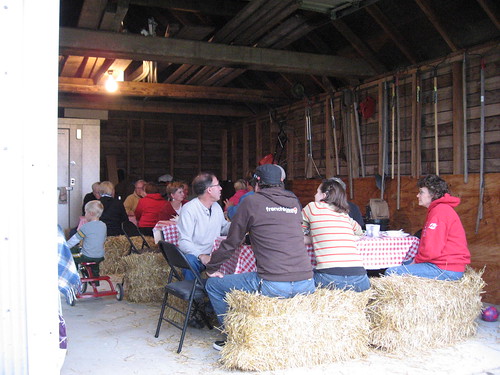
We’ve had a couple of events recently at the farm, which is out of the ordinary for Maree and me. Typically it’s rare for us to have visitors besides our families, so it was great to have the harvest party last Sunday and equally cool to host the early childhood kids tonight (Thursday). We had a good number of people out for the harvest party—if you were unable to make it, please stop by and I’ll re-give the tour and you can pick a pumpkin. Too often farming is such a solitary existence where you grow something for people you will never meet. I had such a good feeling to see “our” community gathered together in our machine shed, just eating good food and enjoying others company. Special thanks to member Ruth Sollie for the picture!
The Good, Bad, and Ugly of 2008
As we approach the end of the season, we start playing the good/bad crop game. When you’re cleaning up a bed of one crop at the end of the year, you can’t help but judge how the year went. So, kind of like the Oscars for vegetables, we have the good, the bad, and the ugly for the year.The Good:
• Peppers: Hey I was just in the entryway where we have a few bushels of peppers and I can still smell them…great. Now that a number are turning colors, these clearly go into the good category. Not only did we have a lot, but they were a good size too…last year the Italias looked like big jalapelos or something.
• Salad mix: I’m finally getting the hand of growing this stuff well. We should have had a second planting for mid-season, but the stuff we put in the box looked great.
• Spring brassicas: this is the cabbage, broccoli, kohlrabi, and cauliflower at the beginning of the season. The cool wet spring worked well for these crops. What was most impressive is how long the spring bassica season lasted…you probably got sick of broccoli or cabbage at some point there!
• Tomatoes: a surprise here. Although it has taken forever for them to ripen, the plants set a lot of fruit and they look in good shape.
The Bad:
• Garlic: A real disappointment because I just go crazy for a good garlic crop. These plants do not grow well in a mud puddle like they had to this season.
• Green onions: This is in the bad category because it was the crop that never happened…do you ever remember getting green onions? They got planted first thing in the spring but that entire patch got overrun with weeds and I never got another succession planted—you can also put cilantro in this camp too.
• Head lettuce: After last season when we had a bumper crop, the lettuce was worthless. The window of lettuce was short and a lot bolted before it came of size.
The Ugly:
• Melons: There’s been a whole lot of ugliness here. The main factor is all of those cucumber beetles, who attack the plants and kill them off mid-season and then chew up the fruit if it starts to grow. Ugly.
• Second set of cucumbers: in part due to those pesky cucumber beetles and the new ground, this second planting put on nothing but deformed cukes. The timing was right to take over when the first planting pettered out, but they were too ugly to use.
All told, I can’t complain too much about the season. The weather was funny, but things still got produced and I know we improved on last year overall even if some crops did worse. Since you have to be optimistic in this line of work, what we do is ask ourselves how we can improve for next year.