Friday, August 21, 2009

Scotland (CSA week 9)

Apparently a front from Scotland has settled over the area. It's been constantly cold and wet. Man, I just can't figure this summer out! Still, tomotoes have started to come in regardless, which you'll see in the box this week.

I'm still praying for heat and sunshine...we'll see if that ever pans out.
Keeping it short and sweet this week.

In the box:
Some sweet corn: Not the best stuff ever, but ears are really not interested in filling out this year.
Purple pepper: Pretty cool, eh? The variety is called Islander
A couple Jalapenos
Bunch of cilantro
Mix of cherry tomatoes: sungold (orange), sweet 100 (red in color), grape
Orange Blossom Tomato
A couple Celebrity tomatoes: your standard tomato
Bunch of carrots
A pesto-sized bunch of basil: See recipe below. If holding over, our member Tammie had a good way of keeping basil. She puts the basil in a shallow cup of water and cover the leaves with a sandwich bag at room temperature. A lot of people try putting basil in the fridge...that's a big no-no.
Bunch of kale: some got Red Russian Kale, some got Dino Kale.
A couple sweet onions
A couple summer squash: one yellow, one green zucchini.
Classic Basil Pesto
Makes 1 cup, enough for 1 pound dried pasta
2 cloves garlic, peeled
3 T. pine nuts (can use walnuts)
1/4 t. salt
3 ounces basil leaves (about 3 cups loosely packed)
1/2 cup extra virgin olive oil
1/2 cup grated Parmigiano-Reggiano
Food Processor Method:
Process the garlic, pine nuts and salt until finely ground, about 15 seconds. Add the basil and proccess in spurts just until no whole leaves remain. With the machine running, pour the oil through the feed tube in a steady stream. The mixture should be ground to a pastelike consitency but a little bit of the leaves' texture should remain. Add the cheese and pulse until just incorporated.
Toss with cooked pasta using cooking water to thin, if desired.


Thursday, August 13, 2009

Corn Harvest (CSA Week 8)

Things really get crazy for us this time of year. This is the time when I either get reinvigorated by all the great produce which is coming in or I "hit the wall." I don't know which way I'm going to go this year, but I appreciate all the things which are finally coming in. This is the first week of tomatoes-albeit only cherry tomatoes and small yellows-as well as good-sized carrots, peppers, and sweet corn. Man, that's exciting...sweet corn. I've only had people asking about sweet corn at the farmers market for about 6 weeks (people get impatient and I run out of excuses), so now it's finally here.

I have a real love-hate relationship with picking sweet corn. What I love about it is that it's the first thing I do when I go out to get ready for the CSA or market. This is that time of the morning when I'm all by myself and it's really peaceful out. Still, I like the action of grasping, pulling, and twisting off cobs in one motion...something really feels good about it. Unlike other crops, corn is really satisfying because you go from an empty crate to a full one in about 15 minutes instead of something like beans where you feel like you're filling up a mason jar one grain of sand at a time. This is why I have Maree pick all those things :) Like the yellow beans in the box this week and last week...as you see from the picture Mar is trying her hand at pickling them this week. My patience is only so good.

On the other hand, picking corn first thing in the morning can be a cold, wet ordeal. If any of you had to do this, you know what I'm talking about. First thing in the morning, the dew is really heavy, and, instead of sitting in the comfort of home, drinking a cup of coffee and reading the paper, you're outside wresting 6-foot tall corn plants, getting your clothes soaked through, and getting these little cuts on your arms from the leaves.

All told, I like it more than dislike it. Even when I'm not in the mood, I still like to step back and admire the harvest in the packing shed over some coffee. It just feels good.

In the box:
Sweet corn: There is a mix of two early varieties. The bi-color (white and yellow) is called Native Gem and the all-yellow is called Spring Treat (far from spring, but Mid-August treat just doesn't sound as good).
Yellow Wax Beans
Flat Italian Beans
Kohlrabi
Red Onion
Carrots: A variety called Little Finger...a fresh eating variety which should not be too big.
A couple cucumbers
Tomato sampler: Some cherries (one variety called sungold is supposed to be orange), a grape if you're lucky, a couple yellow Taxi, and a few Julia roma tomatoes. Not many, but a start
Some peas: a mix of snow and snap peas, so the pods of each are edible...so don't try to shell.

Gourmet | August 2009

by Maggie Ruggiero

Sure, go ahead and cook your favorite sausages, but be sure to use every iota of their flavor: Reheat the skillet and work some pork-based magic on a seasonal array of onion, fennel, tomatoes, and corn.

Yield: Makes 4 servings
Active Time: 20 min
Total Time: 35 min
ingredients
4 (5-to 6-ounces) fresh pork sausages
1/3 cup water
3/4 cup chopped sweet onion
1 medium fennel bulb, chopped
1 cup grape tomatoes (5 oz)
2 ears corn, kernels cut from cob
1/4 cup coarsely chopped dill
preparation

Prick sausages a few times. Simmer with water in a 12-inch heavy skillet, covered, over medium heat 7 minutes. Uncover and cook, turning occasionally, until water has evaporated and sausages are well browned and cooked through, 7 to 10 minutes more. (You may need to add 1 tablespoon oil to skillet, depending on sausages.) Transfer sausages to a plate and pour off all but 1 tablespoon fat from skillet if necessary.

Cook onion, fennel, and tomatoes with 1/2 teaspoon salt and 1/4 teaspoon pepper in skillet over medium heat, stirring and scraping up brown bits, until onion and fennel are crisp-tender and tomatoes are soft and beginning to burst, about 7 minutes. Add corn and dill and sauté 2 minutes.

Slice sausages and serve with vegetables.

I figured this would be good if you're still holding onto some fennel from last week.


Monday, August 10, 2009

Farm Stand Now Open

We're getting close enough to all those "high season" crops to open our farm stand today! We set up the self-serve stand at the end of our driveway last year to allow people near our farm to conveniently pick up a few things. It blew down in a snowstorm this spring, but we've resurrected it with the help of my father-in-law, Don Klatt, and my neighbor, Marvin Kratzke. It's looking good and solid as a rock.

We don't have a lot in this first week, but expect all the summer produce you crave to show up soon. Right now we have beans, cucumbers, summer squash, cabbage, onions....simply pick out what you want and drop cash or check or an IOU into the paybox.

Find us at:

View Larger Map

Wednesday, August 05, 2009

Send Heat, Please (CSA week 7)

Well, another week gone by and another week of way-too-cold temperatures. I thought this summer would be "normal" after last summer, but it may just be weirder than last.

So, how big of an affect is this on the produce? Well, the biggest issue is getting those warm season crops to market and in the box. One example is that our earliest corn, a 58 day sweet corn (that is, 58 growing days from emergence to ripe corn) is still not ready and it was planted in mid May. I'm sure that's going to make it since all we need are the kernals to fill out, but what about the late season corn which is 78 days? What about that popcorn I'm trying this year at 90 days? Yikes! Warm season crops just grow so slow when we only hit 75 during the day and the plants completely shut down when we hit 50 degrees at night. Those nights when you can't sleep because it's too hot and muggy are what we need because then things are growing even then...we haven't had a single night like that.

I'm certain we'll get these warm-season crops to come in, but the season will be pretty short. We'll have an avalanche of stuff at the end of August til Mid-September, which is good, but I'd rather the stuff be in now until Mid-September.
In the box:
One Japanese Eggplant
Cucumbers
Parsley
One Garlic...fresh, so a bit different to peel.
Zucchini
Sweet Onion-a big variety called Alisa Craig
Torpedo Onion
Yellow Beans
Beets
Broccoli
Baby Red Potatoes
A Baby Bok Choi
More raspberries: we're making the rounds...definately need to plant more so we're not scrounging and can supply everybody for a couple weeks.

2 Cucumber Salads
3 cups cucumbers (thinly sliced)
1/2 cup onion (thinly sliced)
Salad 1:
Place cucumbers and onions in a large bowl and sprinkle with 1 tsp. salt. Let stand 1 hour; drain.
1/3 cup sugar
1/4 cup vinegar
1/2 tsp. celery seed
Mix together in a saucepan. Bring to a boil, cook and stir until sugar is dissolved. Pour over cucumbers. Cover and marinate in refrigerator for several hours or overnight. Keeps several days.
Salad 2:
1/4 cup vinegar or lemon juice
2 T. oil
1/2 t. salt
1 T. sugar (optional)
Mix together and add to the cucumbers and onions.

Thursday, July 30, 2009

Balancing Family and Farmwork (CSA week 6)

It's a little too easy to get wrapped up in your work, no matter what you do. I used to think that farming was worse because you never escaped; I just have to look out the window to find work staring right back at me. Nowadays everybody seems to be taking their work home...those laptops are just too convenient, so you can work even though you're 30 miles from the office.

This time of year in high season, I find myself constantly trying to get the bottom of a bottomless to do list....it's never ending. So at times like these especially, it's important to remind myself what's important. Tonight, even though I had cucumbers to wash, boxes to set up, dirty dishes in the sink, and a CSA box and newsletter to think through, I got into the house before nightfall just to be with our kids and put them to bed. We didn't do anything exciting, we just read a couple books, talked about a movie they like, and said goodnight.

I have to admit there are nights when Maree needs to yell out the back door way past sunset to get me in while I feverishly try to finish "one last thing." Well, I could find "one last thing" forever. This growing season more than ever, I've been mindful to carve out that time with family, friends, a good dinner like with a couple members at our workday last Sunday. And you know what? I'm no more "behind" than any year past, and, actually I'm feeling much better than years past too! There's a reason my traditional farming neighbors stubbornly take 5 meals a day because they realized long ago that you can't keep hammering away on work and think you're getting somewhere. A little rest, some conversation, and you'll save more time getting done what needs to be done.

In the box:
Fennel
Broccoli
Green Beans
Cukes: the big long one is an English Cuke, the other your standard joe cuke
Scallions aka Green Onions
Green Cabbage
Dino Kale: also known as Lacinato Kale, an Italian variety...my favorite.
Radishes: a variety called French Breakfast
Sweet Onion
Raspberries-This is the start...not in your box this week? Expect them next week (or even the following week).

Grilled Fennel
From Vegetarian Cooking for Everyone
Cut the stalks from a fennnel bulb. If the bulb is small, cut it in half lengthwise. If it is large, cut into 1/2 inch slices, making sure that each slice has a piece of the root attached. Steam for 10 minutes, then brush generously with olive oil and season with salt. Grill for 5 to 6 minutes on each side. Serve with garlic mayonnaise:
Garlic Mayonnaise
Coursely chop 4-6 garlic cloves. Put them in a mortar, add a pinch of salt, and pound until a smooth paste forms, which will happen quite quickly. (If you don't have a mortar, chop the garlic and salt together until smooth.) Stir it into mayonnaise, add lemon juice to taste, then thin with hot water or leave it thick, depending on intended use.

Note: This sauce also goes well with green beans, potatoes, asparagus, cooked carrots, and cauliflower. Use in a sandwich, or spoon into a soup or pasta.


Friday, July 24, 2009

High Season? (CSA week 5)

This time of year we enter what I call "high season", when those warm-season crops come in and we're at the peak of variety. We're certainly a bit off the mark for the year because of the cold start, but we're right on the cusp...I found about 5 mature cucumbers yesterday! This is far from enough for the whole membership, but a good sign. We also found about 4 quarts of beans ready to go, again, close but not close enough.

Still, even though it means more work for me, I really like high season. It's exciting to take in big quantities of beans, peppers, and tomatoes. I like pulling in bushels of corn early in the morning before most people are awake. It's exhilarating. The bad part of high season is that weeds like it too...it's tough to keep up the fight when you spend a lot of time harvesting. Even though I thought some beds looked pretty good a couple of weeks ago, if I look at them today, I get a little panic-y..."boy, I have to get to that, and that, and that...yikes!" Anyway, things seem to work out and the lesson is that you should celebrate what's good and forget the bad part.

In the box:
New Norland Potatoes: Your standard red. I just hope the potato bugs leave some for us since they're really bad this year!r
Garlic: Not the best I've ever grown, but better than nothing.
2 Red Onions
Beets: Not much, but it's a start. Since you haven't had chard yet due to the deer, you can use these greens too.
Some Little Lettuce
Zucchini
Broccoli Raab: The bunched green with jagged edges. This is pretty standard in pasta recipes or as a side.
Cauliflower
Cabbage: Half of you got a purple cabbage called Red Express and half got a crinkly savoy cabbage called Alcosa
2 Daikon Radishes: A white radish with a peppery taste, salt mellows it out.
Some Thai Basil: This likes to put on a lot of buds (probably wants more heat...I'm thinking it gets it in Thailand), but the leaves seem good. It is a bit different from your standard Italian Basil...check it out.

Daikon Salad
From Moosewood Restaurant Daily Special
2 lbs. Daikon
1 1/2 t. salt
1 carrot
1 T. sugar
1 T. white vinegar
dash of sesame oil
3 scallions
2 T. canola or other vegetable oil

Trim the ends of the Daikon, peel and coarsely grate it. In a colander set into a larger bowl, toss the grated Daikon with the salt. Set aside to drain for 20 to 30 minutes, until about a cup of liquid has collected in the bowl. (Squeezing some of the liquid out of the Daikon will speed up the process.)
Meanwhile, peel and coarsely grate the carrot and place it in a serving bowl. In a small bowl, mix together the sugar, vinegar and sesame oil and set aside. When the Daikon is well drained, stir it into the carrots. Add the vinegar mixture and toss well.
Slice the scallions thinly on the diagonal and mound them on top of the salad. Heat the vegetable oil until smoking and immediately pour it over the scallions. Toss well. Serve at room temperature or chilled. Serves 6-8.
Note: You will likely need to halve the recipe (or use more carrot) and could use the red onion from this box instead of scallions.

Sunday, July 19, 2009

Workday and Newletter

I couple of notes for CSA members:

1. Newsletter. I know a number of members are not automatically receiving the newsletter by e-mail. I think the problem comes in with so many computer firewalls not accepting a bulk e-mail. I suggest you go to this website at http://www.lidafarm.com and check each week. The same is on the web as in the e-mail and I typically post late thursday night or friday morning before deliveries.

You can try to subscribe again, but putting your e-mail in the "subscribe" textbox at the right...you need to reply to the confirmation e-mail you receive to finalize the set up.

2. Workday. We'll be hosting a workday next Sunday, July 26 from 3-6 pm. This is a totally optional thing...but if you'd like to get your hands dirty and see the farm up close and personal, please come out. A workday is pretty common with CSAs. We'll be doing general weeding--what I call hand-to-hand combat this time of year, row-by-row. At 6 we'll be supply a light supper. Please e-mail or call to let me know if you plan on coming to plan for supper.

Directions to farm...we're halfway between Vergas and Pelican Rapids on Highway 4. 6 mi west of Vergas, turn right onto 275th ave. 8 miles east of Pelican, turn left onto 275th ave.

-Ryan.

Thursday, July 16, 2009

Organic Agriculture (CSA week 4)

Things have been a bit cool lately, but I was really thankful for the rain we got this week (almost an inch). We were getting worried about moisture levels out there, but it'll be no problem for a while. Acually, since we have such a heavy clay soil, we can get away withought rain or watering for 2-3 weeks.

I figured I'd write about organic ag this week and about certification in particular, simply because I feel like there are some real misconceptions out there and I'd like to explain where we sort out.

I think there's a lot of confusion simply because organic has gone through some changes in the last decade, the biggest being the National Organic Program (NOP), established by the federal government throught USDA. Today, when you say Organic, it means you grow according to the NOP standards and have been certified for doing so. Unless somebody sells less than $5,00o of food, you can't use the term organic...you could actually be fined for doing so.

Often, when I talk certification with people, they often say, "oh, doesn't that take three years of not spraying your land?" Yes, and a whole lot of other things. When a certification agency is auditing and inspecting your farm, they want to know about all your inputs (fertilizers, insecticides, mulches, potting soil, etc.) and practices (cover cropping, cultivation, conservation measures on the farm) and they want to see record and documentation of such. So it isn't just not spraying for three years that matters, it's following these standards across the board and presenting an audit trail to prove it...no small matter. I've actully started an audit trail so we can become officially certified in a few years--even though we have only used certified inputs, I can't prove a thing and need the records.

So, I think often people have the impression that just because somebody grows organically, that they don't use any inputs on the farm but manure and hard work, although that is a lot of it. For insects, there are organic sprays (some think this is an oxymoron). The only insecticide we use is called Pyganic, the chief ingrediant of which is natural pyrethrum, an insecticide derived from chrysanthemums. We also use a small amount of an organic fertilizer called Renaissance. It's actually a mix of soybean meal, feather, and bone meal. We mainly use it to sidedress the sweet corn, which is a pretty heavy feeder. Both of these are OMRI-certified, which is the agency which certifies whether a product meets the national organic standards. Otherwise, we do use a fair amount of composted manure for fertility, both from our sheep and from a neighboring turkey farm.

In the box:
Basil: please don't refrigerate. I find it does best with a damp cloth in an opened plastic bag at room temperature
Packman Broccoli
Kohlrabi: mostly purple variety
Strawberries: kind of pathetic...getting pretty slim out there
Spinach
Boston Fireball Lettuce: By far the prettiest lettuce I've grown...also called "bibb" or "butterhead" It's can be a bit bitter, almost like endive...you may want to mix with the greenleaf.
Greenleaf Lettuce: variety called Marin after the county in CA. This is the end of the lettuce, so put into a plastic bag and leave in the refridgerator...it should keep up to three weeks.
"Spring" onions: one torpedo onion and one sweet.
Yellow Sebring Zucchini: see recipe below
A bit o' mint (see recipe below)

Zucchini and Fresh Herb Fritters
from Vegetarian Cooking for Everyone by Deborah Madison
(This is a real classic cookbook I would recommend for anyone)
Salt and pepper
2lbs. green or golden zucchini, grated
2 eggs, beaten
1 bunch scallions or spring onions (thinly sliced)
1 cup dried bread crumbs
2 garlic cloves, finely chopped
1/2 cup chopped parsley
1 T chopped basil
1 t chopped mint
olive oil as needed

Lightly salt zucchini and set aside in a colander to drain for 30 minutes. Meanwhile, mix the remaining ingredients together except the oil and pepper. Quickly rinse the squash, sqeeze out the excess water, then stir into batter. Taste for salt and season with pepper.

Film two skillets with olive oil. When hot, drop in the batter-quarter cup makes a fritter about 3.5 inches across-and cook over medium heat until golden on bottom. Turn and cook other side. Serve hot...serves 4.

Friday, July 10, 2009

Packing Produce (CSA week 3)

Well, things are finally starting to grow. Since it's been so warm lately, I forget how cold it was earlier in the year, and I wonder why things aren't ready for harvest. But those days in May and early June make a real differencel on when things are ready. But I'm thankful for the warmth...it allows us to watch those warm-season crops take off and finish off the cold season ones (like the spinich which made it in the box before it "bolted" or went to seed). I'm also thankful for the mild rain we had yesterday instead of the "monster storm" we were supposed to get. I feel that we've already had our hail for the year and don't want another round.

One new development for the year is our new packing shed where we bring in all the produce to be washed and packed in boxes. The shed isn't exactly new, but we converted our machine shed for the purpose. Up til now, we've used the greenhouse, which isn't optimal for a number of reasons. One being that it's just a dirt floor and after sloshing around water for a while, I always find myself in a big mud puddle....the heat of the greenhouse didn't help either!

The set up of the packing shed is pretty important. It's kind of like a little manufacturing plant...produce comes in, goes through a couple stations and finished CSA boxes go out. I have it set up with all the washing tubs on one side and the tables which hold the boxes on the other. We have a whole bank of tubs and sinks so that we can soak a different crop in each tub for a while, since it's really important to hydrocool produce for a good half-hour to take out the field heat. If we didn't do this, the produce would look good when you first get it and then mysteriously go bad in a couple days. In the back is our walk-in cooler--out of the way--where things can be held over for a while. I even just got a set of roollers (kind of like a conveyor belt with rollers) which we'll be settting up to lessen the time we spend shifting crates of produce around...when the boxes are done, we'll be able to just count them off and push them down the rollers to the van instead of take two at a time, walking back and forth from the van.

In the box:
Napa Cabbage (see recipe): the recipe is for a cold slaw, but napa is a traditional stir-fry stand by. I like cooked more myself.
Pint o'strawberries
Summer squash (some zucchini and some yellow pattypans)
Kohlrabi
Cilantro (wish I had some tomatoes to go with this!)
Braising Mix: this is a mix of young greens which can be sauteed on their own with some onions or garlic or added a stir fry at the very end. Just chop and fry.
Red Oaklead Lettuce: one of my favorites...it's pretty and has a nice nutty flavor.
Romaine Lettuce
Spinich
  • 1/4 cup rice vinegar (not seasoned)
  • 2 teaspoons sugar
  • 1 teaspoon grated peeled ginger
  • 2 tablespoons vegetable oil
  • 1 fresh serrano chile, finely chopped, with seeds
  • 1 small head Napa cabbage (1 1/2 pounds), cored and cut crosswise into 1/2-inch slices
  • 1 bunch scallions, sliced
  • 1/2 cup coarsely chopped cilantro

Whisk together vinegar, sugar, ginger, oil, chile, and 1/2 teaspoon salt. Add remaining ingredients and toss well. Let stand, tossing occasionally, 10 minutes.

Thursday, July 02, 2009

The Art of Cultivation (CSA week 2)


If you grow organically, you have to learn to cultivate and there's a lot to it...hence the art. The term is used pretty generally nowadays to mean "grow" or "nurture" things as in "Target has been cultivating customers through their new marketing plan..." Stuff like that. But in farming cultivation means something quite specific: breaking up the ground with a cultivator to kill weeds. I cultivate in a couple of different ways. One is what's called "blind cultivation", where you drag a cultivator right over the top of the bed, including the plants. I do this with our new contraption of the year, a Williams Tool System, which is a kind of tine weeder. I always feel like I'm going to kill all the plants, but the tines are designed to put on enough pressure to take out the little weeds, but leave the rooted plants. It has done great work and things like the corn, onions, and potatoes havn't looked this weed-free before. The other way we cultivate is with a traditional two-row cultivator, which has these shovels and knives on either side of the row to take out anything between the plants.

This sounds pretty straightforward, but a grower needs to keep a fine eye to details to cultivate well, and, frankly, I'm not that great at it. The timing has to be right (best when a lot of weed seeds have germinated, but still just seedlings), the soil moisture good (too wet and you get clods to last the summer), the shanks and shovels have to be digging at the right depth (not too deep, not too shallow), and all the while you have to run the tractor as straight as the rows you planted in the spring or you take out half the row. So far, so good this year.

When I got to thinking about cultivating, it made me think about a conversation I had with my neighbor Marvin last year. Since he's farmed all his life, I asked him about how many farmers still cultivate and he figured about 5% since life with chemicals is so much easier...instead of cultivating 3-4 times, you can spray twice and kill off every single weed. I thought that was kind of low, but as I was driving around last year I saw only one person other than Marvin and myself cultivating a field! Keep you eye's peeled...you may still see some out there.

Weather report....hail last saturday, but not terrible. You will probably see some holes in the lettuce, but I promise it will taste the same.

In the box:
Fresh Basil
Kohlrabi: simply peel, cut, and serve...some recipes call for the greens.
Arugula: can mix in with lettuce for salad or find pasta recipe
Red Sails Lettuce
Green Leaf Lettuce
Garlic Scapes: the tops a garlic plant will send up...like a garlicy green onion. Chop fine, sautee a bit, and throw in mashed potatoes.
Quart o' Strawberries
Some radishes
Red Russian Kale

Kale Colcannon
St. Paul Farmers Market Produce Cookbook
5 med. potatoes, peeled and quartered 1/3 cup lowfat milk
4-6 cups kale, with stems removed, washed and chopped 1 t. salt, or to taste
2 T. butter or margarine 1/8 t. black pepper
1 small onion, chopped

Boil potatoes until tender. Steam kale separately until tender, about 10 minutes. While potatoes and kale are cooking, heat butter or margarine in a large pot. Saute onion until soft. Mash potatoes, add kale, onion, milk, salt, and pepper. Mix well. Reheat and adjust seasonings.
Makes 4-6 servings.


Friday, June 26, 2009

Welcome to Lida Farm...CSA week 1


Welcome to Season 4 of Lida Farm CSA! For some of you, this is something new while others are “old hands” at this point. We’ve been plugging away, working up to this first delivery. A lot like last year, I’ve been nervously looking at the fields, hoping something would grow enough to get into this first box. I can’t say that the last couple of springs have been good to us; the only variation from last year is that it was mostly cold and dry until recently, whereas last year was cold and extremely wet. Either way, a lot of plants have been just sitting there in a holding pattern of sorts.

Typically the Lida Farm Journal includes some news of the farm, a listing of this week’s produce, and a simple recipe which features a veggie or two. But, being that this is the first week of the season, I outline what to expect for the CSA season, so you all know what you’ve gotten yourself into.

1. Boxes: The box gets delivered every Friday, typically late morning to early afternoon. Each week we exchange your box. You set out last week’s empty and we give a new one filled with veggies. The boxes are waxed and get used for 2-3 seasons (this cuts down on all that excess packaging that gets thrown away). We don’t have a lot of extras, so please remember to empty and put out. Please also return green trays and flower vases for flower share.
2. E-mail Newsletter: Up till now we’ve always printed out a paper copy of our newsletter. But, both to cut down on paper and general ease of delivery, we’re moving to an electronic newsletter which will come to your e-mail. When I add something to our blog (http://www.lidafarm.com), you’ll receive an e-mail automatically. Since all news is on our blog, you can also add comments for others to follow…maybe add a recipe of your own.
3. “I’m out of town”: If you are gone some delivery day and will not be around to receive your box, please make arrangements for somebody to pick up at your drop site and put the produce to use. Once we get a route, it’s tough to change it and we really prefer not to make a special drop-off. If not, just give us a call and we’ll work something out.
4. Cooperation: As the name CSA (Community Supported Agriculture) implies, you are buying a share of this year’s harvest as a member of our farm. We will always do our best to supply produce in good quality, quantity, and variety each week, but part of a CSA is that you share in the risk with us. Anything can happen between now and October which may affect supply from a hailstorm to a cucumber beetle infestation which can make the box can get a bit light. We’re all in this together. We share in both the risk and the bounty.
5. Communication: Please contact us with any issues or concerns you may have throughout the season. If you simply need help indentifying a weird green the box or have a concern about the quality of produce or time of delivery, give us a call. We want to make sure things are working for you and would much assume hear about problems sooner rather than later. Maree is typically home during the day and can be reached at 218-342-2619, whereas I’m around evenings and weekends. I’m also available by e-mail at lidafarmer@gmail.com
6. Season’s Schedule: We will run a 16 week season, so the last delivery will be October 9. If there is a change to our schedule, I will notify you through the newsletter.
7. Add-ons: This is something new this year we’re trying after hearing from members and non-members alike. As part of this, we will offering things in addition to the weekly box like cut flowers, organic cheese/butter, eggs, extra produce, and other local foods we can source from other growers. Every other week, you’ll get an e-mail of what’s available and order up what you want. We’ll deliver with your box on Friday. We’re calling it the “Marketbasket” program. Stay tuned for details.

IN THE BOX:
Salad mix: This has been washed once (unlike the bagged mix which does a triple wash), so please soak in some water before spinning again, especially because we’ve had some heavy rains which gets soil on plants.
Collards: The standard southern green. To prepare, chop bacon and onions and brown together in a frying pan. Chop collards and add to pan. Once wilted, add some water and cover for a few minutes.
Deep Purple Green Onions: yes, they’re purple…a little change up from white.
Green Lance: An Asian green which is also known as Chinese kale…tastes much like other veggies in the cabbage family. It’s great added to a stir fry for the last minute or two or fry up until sautéed till wilted as a side.
Bok Choi: See recipe below.
Greenleaf Lettuce
A few Radishes
Eggs: Free-range fed on transitional organic feed.

Honey-Soy Grilled Pork Chops with Crunchy Bok Choy from Everyday Food

Vegetable oil, for grates
1 cup long-grain rice
2 T. rice vinegar
1/4 t. red pepper flakes
salt and ground pepper
2 T. honey
1 t. soy sauce
1 t. finely grated, peeled fresh ginger
4 bone-in pork rib chops (8 to 10 oz. each)
bok choy, halved lengthwise (2-4 heads)
1 T. toasted sesame oil

1. Heat grill to high; lightly oil grates. Cook rice according to package instructions. With a fork, stir in vinegar and red pepper flakes; season with salt. Cover and set aside.
2. Make glaze: Combine honey,soy sauce, and ginger in a small bowl; season with salt and pepper. Gill until opaque throughout, 5 to 7 minutes per side. Brush pork with glaze, and grill 30 seconds more per side. Transfer pork to a plate to rest.
3. In a bowl, drizzle bok choy with sesame oil. Season with salt and pepper and toss to coat. Grill until lightly charred on both sides, 1 to 3 minutes. Transfer to plate with chops. Serve pork and bok choy with rice alongside.

Wednesday, June 03, 2009

Disaster Strikes!

I haven't been strong enough until now to write about this episode. A high wind blew the farm stand into our field on May 15, totally trashing the landmark I was once so proud of. As you can see, the kids and Cosmo were out assessing the damage.

I don't like surprises early in the morning but that's what I had when I stepped out, looked down the driveway, and didn't see anything. After all the high winds the night before, in a millisecond I knew exactly what happened. Picture me running across the field yelling "NOOOO!!!" as if rushing to the aid of a fallen comrade.

But fear not, the stand will rise again from the ashes. The original builders, myself and my father-in-law, Don, have already drawn up plans for a better, stronger farm stand which won't blow away. We still plan on opening in July, hopefully with no more surprises.

Sunday, May 24, 2009

Planting Sweet Corn with Holland Transplanter


This video shows our transplater and how we get most of our planting in the ground in the spring. The transplanter makes really light work of many plants...could you imagine planting 1300 tomato plants by hand? With this Holland Transplater you can put all of them in an afternoon.

We got ours from a family by Viroqua Wisconsin where they used to grow a lot of tobacco before the quota buyout. Since tobacco has to be set in the ground as a plant as opposed to a seed and often the farms are small, you'll find a lot of transplanters in areas where tobacco is grown, but not many up in northern Minnesota. Typically people don't know what I'm talking about when I use the term transplanter, or, if they do, they often say something like "oh, you mean a tree planter!" I guess.

Wednesday, March 04, 2009

Now taking CSA memberships for 2009

With the 2009 season right around the corner, we are now taking sign-ups for members. Our first priority are previous members, but we will be taking on more members, increasing from 15 to 20 shares.

We deliver each week for 16 weeks, starting in Mid-June and ending in Mid-October. An important note is that we only deliver in the lakes district around and between Pelican Rapids and Detroit Lakes. We go as far west as the Cormorant area, up to Highway 10 on the north, highway 108 on the south and as far east as Detroit Lakes itself.

We're looking at some other options for marketing food directly to customers this season, so even if you're not in that area, I'd still like to hear from you. We may be able to work something out.

Contact me at lidafarmer@gmail.com or Ryan or Maree at 218-342-2619.

Thursday, November 27, 2008

The Farm in Winter

It looks like we've hit winter around here.  The ground is frozen and our work now moves indoors, although I just got garlic planted extremely late this week.  I had to ask our garlic suppliers about what to do and they suggested planting right into soil mix on top of the ground.  This way, the plants will come up in the spring and we can replant like green onions once they ground thaws...if we didn't do this, the garlic would be bust next year, especially the hardneck varieties.  

Anyway, unless something really interesting happens this winter, I'm signing off for the season.  I won't update this blog regularly until spring again.  Enjoy hibernating.  -Ryan.  

Thursday, October 16, 2008

End of the Season

We are at the end of the season.  Reflecting on things, I think we’ve really turned a corner.  This is our fifth season vegetable farming on our own, and up to this point each season seemed like a huge battle.  I typically get all anxious and stressed by July and completely burnt out by mid-September, but not this year.  I think this has happened because we’ve let past seasons get ahead of us, so we’ve played a lot of catch up, which is very frustrating because in vegetable farming you never catch up.  We have gotten into the catch-up game because we’ve not had the equipment, set-up, or general organization to stay on top of things in the past.  One example is cultivation, where you mechanically kill weeds by tilling the soil.  In past seasons, we ended up doing a lot of hand weeding or cultivation with a wheel hoe because the weeds got too tall or we simply didn’t have the cultivation equipment set up in time or on-hand.  This year, we cultivated most plantings twice at the right time, so we had a lot more time to spend on other things which needed attention.  Add this to all the other little improvements we’ve been making over the years, and that’s why I say we’ve really turned a corner from a farm start-up with all the problems that entails, to a somewhat established farm, where, as long as you keep up with a routine day-in and day-out, the season works out. 

Other accomplishments have been building and starting up the farm stand and getting into a few new crops like dried flowers, a new mix of winter squash, and some oddities like broom corn, daikon, and some new heirlooms.  A lot of the fun of what we do is trying new things.  Some are good, and some are terrible, so we keep the best for next season and drop the rest.  We also try new techniques to improve how we do things.  Like this year I rigged up a new way of trellising where I use a big spool of twine set in a school backpack to make the task go quicker and with less frustration.  We also used some remay cover cloths more to keep out bugs and get a crop to grow better, which made a real difference.  Also this is the first year we’ve successfully used a cover crop of rye and vetch, so we’ll see what difference that makes on the fertility of field next year.  Like vegetable varieties, we keep what works and keep fine-tuning production.      

Lastly, thank you so much for being members this season!  We cannot do what we do without you.  Certainly the fee you pay keeps us in business, but the support we hear and receive from you means a lot.  It’s extremely helpful to know that we are part of a community.  

Harvest Party at Lida Farm

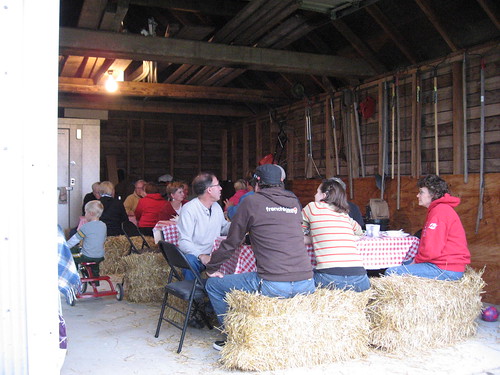
We’ve had a couple of events recently at the farm, which is out of the ordinary for Maree and me.  Typically it’s rare for us to have visitors besides our families, so it was great to have the harvest party last Sunday and equally cool to host the early childhood kids tonight (Thursday).  We had a good number of people out for the harvest party—if you were unable to make it, please stop by and I’ll re-give the tour and you can pick a pumpkin.  Too often farming is such a solitary existence where you grow something for people you will never meet.  I had such a good feeling to see “our” community gathered together in our machine shed, just eating good food and enjoying others company.   Special thanks to member Ruth Sollie for the picture! 

 Tonight was a different, although equally rewarding experience.  We hosted the early childhood classes in Pelican Rapids, which annually do a “pumpkin patch” outing for 1-5 year olds and their parents.  I had been working like a dog since 8 am trying to pull in as much produce as possible since I expect a frost tomorrow morning and I was a bit in a daze when I watched car after car after car pull into our driveway.  This thing was bigger than I expected.  And, with about 40 little kids running around, it was a real whirlwind event.  I took everybody on a hayride to the pumpkin patch in the front field and there were so many that I had to take two trips.  On the hayride it was a lot of fun to stop and quiz the kids about the different vegetables.  Going with my theme about connection, like the harvest party, I found the event really rewarding.  I figured this may be one of those few times when kids can really get on a farm and learn about where their food comes from.  We need kids to connect with farms if we expect younger generations to know of anything other than Taco Bell, Cheetos, or Coke.  

The Good, Bad, and Ugly of 2008

As we approach the end of the season, we start playing the good/bad crop game. When you’re cleaning up a bed of one crop at the end of the year, you can’t help but judge how the year went. So, kind of like the Oscars for vegetables, we have the good, the bad, and the ugly for the year.

The Good:
• Peppers: Hey I was just in the entryway where we have a few bushels of peppers and I can still smell them…great. Now that a number are turning colors, these clearly go into the good category. Not only did we have a lot, but they were a good size too…last year the Italias looked like big jalapelos or something.
• Salad mix: I’m finally getting the hand of growing this stuff well. We should have had a second planting for mid-season, but the stuff we put in the box looked great.
• Spring brassicas: this is the cabbage, broccoli, kohlrabi, and cauliflower at the beginning of the season. The cool wet spring worked well for these crops. What was most impressive is how long the spring bassica season lasted…you probably got sick of broccoli or cabbage at some point there!
• Tomatoes: a surprise here. Although it has taken forever for them to ripen, the plants set a lot of fruit and they look in good shape.

The Bad:
• Garlic: A real disappointment because I just go crazy for a good garlic crop. These plants do not grow well in a mud puddle like they had to this season.
• Green onions: This is in the bad category because it was the crop that never happened…do you ever remember getting green onions? They got planted first thing in the spring but that entire patch got overrun with weeds and I never got another succession planted—you can also put cilantro in this camp too.
• Head lettuce: After last season when we had a bumper crop, the lettuce was worthless. The window of lettuce was short and a lot bolted before it came of size.

The Ugly:
• Melons: There’s been a whole lot of ugliness here. The main factor is all of those cucumber beetles, who attack the plants and kill them off mid-season and then chew up the fruit if it starts to grow. Ugly.
• Second set of cucumbers: in part due to those pesky cucumber beetles and the new ground, this second planting put on nothing but deformed cukes. The timing was right to take over when the first planting pettered out, but they were too ugly to use.

All told, I can’t complain too much about the season. The weather was funny, but things still got produced and I know we improved on last year overall even if some crops did worse. Since you have to be optimistic in this line of work, what we do is ask ourselves how we can improve for next year.

Monday, September 22, 2008

Farm Stand Open for Business

It’s been a great growing week over the last five days or so. I always worry about those things which are planted, but just need some more heat and light to ripen and get ready for the box. Although a lot of those melons are still not ripe, at least the late corn seems to be coming along and you’ll see some this week. Also there are those “fall crops” which we plant in July or so which I’m always worried about…fall lettuce, spinach, carrots, turnips, broccoli, and cabbage. I get worried because the fall can be so fickle; it can be so cold and wet that a lot of those crops just don’t finish in time and that just drives me crazy! We did all the work to bring the crop along, but mother nature just didn’t get the memo about our plan. This weather sure helps, so I expect some of those greens to make it next week, namely salad mix and arugula.

The other news I’m really excited about is the completion of the farm stand. It turned into one of those summer projects which had so many details that I just couldn’t bring myself to finish it off. Kind of like an afghan or something you started…”boy, this is going to be nice, but I know I’m going to have to put in another 40 hours to finish it.” Kind of kills your motivation, especially if a bunch of other things are consuming your time.

Still, it was a bunch of work. My father-in-law and I had it all framed in late July, but I still had to level out a place to sit it on as well as put on the tin roof and back wall. You see, since we have one of those raised driveways, I had to dig in a retaining wall and fill in an area to make it somewhat level…otherwise the stand would have sat at a 45% angle—not good. Mar and I spend a couple nights this week collecting big rocks from our pasture and our neighbor’s land. Along the way we even had a medical emergency since Will got carried away with throwing rocks out of the wagon and beaned his sister with a rock the size of my fist…not cool! Anyway, at the end of the rock-hauling project, it was just me, a diesel tractor, a 700-pound farm stand on skids, and a few chains. When I get into these “farm engineering” projects, I just can’t help dreaming up scenarios where the farm stand is completely destroyed, the tractor starts on fire, or I’m fatally wounded. I had similar visions when we were moving the walk in cooler in the machine shed. Luckily, I dodged another bullet to tell you all about it.

Now that the stand is at the end of our driveway, we just need to put on some finishing touches like a sign and a lock box as well as get the word out (which may not be too hard since we had our first customer come by looking for produce 90 minutes after pulling it in place). But this is the easy and fun part and we’re sure to have things up and running by Sunday. Our plan is to have the stand open Friday-Sunday for sure.

Frost

The big news on the farm this week was the patchy frost which came in Tuesday morning. I was outside watching it make its way across the grass when I got up early to do some things before work. It’s tough to watch for me, of course, because I’m deluding myself in thinking it’s still summer…which it’s not. It was only a matter of time till it came, but it always gets me mad anyway. The great saving grace was that it had rained the day before, so plants and veggies were wet enough that the damage was minimal. What happened is that the cold temperatures put a very thin protective coating of ice on the fruit instead of the frost directly, which leaves the fruit undamaged. It’s a curious thing…why wouldn’t the ice damage the fruit? I don’t know, but I’m glad it happened that way. Basically we lost the tops of some eggplant plants which sat in the lowest part of our fields, which is no big deal at all.


Otherwise, the other big news is that Sylvia went to her first day of school ever on Wednesday. Granted it’s only preschool, which lasts 3 hours of something, but it’s still a big step…maybe more so for the parents than Sylvie herself. Just another sign that summer is over. Oh well...

The Alternative Local Economy


Last week, after a very good market day in Detroit Lakes, all of us went down to St. Paul to stay with Maree’s relatives. We had tickets to a concert on Harriet Island on Monday and we had plans to check out the state fair as well as attend our nephew’s second birthday in Red Wing.


The problem with a farmers market is that you have to wake up early, harvest like crazy people for four hours, and then race off to the farmers market to frantically set up and sell produce for another four hours. Last Saturday was so busy we had a line up of a dozen people or so even before we had things on the table…pretty nuts and it kept up that way for a good three hours. Needless to say we were a bit tired, so much so that we bagged the idea of going to the Fair on Sunday. Fighting crowds and walking for miles on end didn’t sound like a real relaxing time to a family with no energy, and, although we really like fair food, it’s not really good food.


So, instead, we decided to check out a place in South Minneapolis called Common Roots Café for lunch. I’ve heard about the place through a sustainable ag listserve since they host a monthly local foods happy hour there for interested foodie-types. I’ve found this one of the best examples of what I call the “alternative local economy” based on local production, connecting people to growers and each other, and fair trade. The restaurant currently source 87% of their food from local sources and pays their entire staff a living wage (which start at $11/hour in MPLS), and, beyond that, they have created a comfortable place where the quality of the food comes before quantity and speed (fast food). It’s a place where people are expected to slow down, talk to their neighbors, and celebrate good food…more of this is needed in this world! This experience, of course, got me thinking about what is possible in our own region of the state.


When I first started as a farm apprentice at Foxtail Farm by Taylors Falls in 2000, there were only a handful of CSAs in Minnesota and pretty much all of them were in the vegetable belt around the twin cities. Even there we pretty much felt like the fringe of society since it seemed like only those crunchy people who hung out a local food coops were talking about local foods and organics. But now the tide has really turned. Many people are searching out farms like our because they not only want fresh produce, but they are pulled to this local alternative economy where people are people and not just consumers, where you can get to know the person who grows your food, where your dollars can stick around and support your community…connections you will not find at your nearest Walmart. So, when I see how the twin cities local foods community has matured in eight years, I imagine where we will be in eight years ourselves… Will there be common roots café in our neck of the woods? Will local cut flowers be available down the street? How about local grains? Local beer? I don’t know about you, but I’m optimistic.

Friday, August 29, 2008

Sliding into Fall

Well, I was pretty happy with the rain we got earlier in the week. It should have given crops the last push they need to fill out for the season. Even if we don’t get another solid rain and the temperatures are normal, plants are well assured of producing a crop. Before the rain plants were looking a bit stressed and I was running all over the place trying to get the last short-term crops of the year to germinate like fall salad mix.

This is an interesting time of year because you’re really in transition from summer to fall. Just the other day, somebody at the market was asking if things were winding down for the season and I looked at him like he was out of his mind “There’s still 1400 tomato plants with tons of green tomatoes…don’t you dare mention winding down!” For him, it was a fairly cool morning and the leaves had started to rustle a bit with autumn in the air; for me, I still in the trenches battling weeds and harvesting like mad. It shows how the perspectives of two people can really diverge when talking about the same thing. Still, even I feel things slow down a bit. July truly is the nightmare month, and it is about this time in August when I “let it ride” for the rest of the season. What I mean isn’t that I stop working, but I let go of the idea of tending the garden with the same intensity necessary earlier to keep up on the weeds and bugs and such. Just the shortened days alone cause growth to slow down. A weed which germinates this week probably won’t even go to seed before the frost, so why worry. And this is really helpful to us, because it may be a surprise to know that the real challenge about farming isn’t the physical work, but the psychological stress. A season really is a wild ride that you just have to keep on all the way to October. It’s filled with too many tasks to list and too many risks to think about and the stress of that can really grate on a person as the season wears on. That’s why I too celebrate hitting this time of year. Although there are many more things to do, we do start to slow down with the days.

Thursday, August 21, 2008

Farm Stand Almost Done

I’m feeling pretty good about where things are at this week after last week’s aggravations. Seems like our electric fence is keeping out raccoons and those high-season crops are actually ripening (thanks to 85+ degree heat). It’s tough when you keep slogging through all that work and the plants don’t holding up their end of the bargain; I’ve cultivated, weeded, and trellised tomatoes, but the tomato plants are just giving me green fruit.

One project we’ve made significant progress on is the farm stand which we plan on setting up later this year at the end of our driveway. My father-in-law is a carpenter and he helped me do the framing this past weekend. Our concept is to make it an honest-to-goodness farm stand which makes for a good customer experience. Sometimes people just set up a card table with a couple of coolers or a Menards-built utility shed and try to pawn that off as a farm stand; it just doesn’t do it for me. What we’re building is a 10x6-foot lean-to structure made of recycled barn wood…something that really looks like a farm stand. I keep picturing it spilling over with fall crops this September, so much produce that extra bushel baskets overflow onto the grass…nice sight, eh?. It’s one of those projects you dream up without any sense that you’d ever get to it, but I’m excited it’s actually becoming reality!

The garden work is also in a good place or going according to schedule. We’ve just planted the last seeds for the year like salad mix and radishes. This should give them enough time to get into the boxes by the end of the season as long as we get some germination in this heat. Last night we set the kids up in the van to play (they really like playing in cars) while Mar and I pulled all the garlic out of the ground til nightfall—it’s always a good feeling to be heading to the house at dusk after finishing a job. Also we almost have all the mulch down in between the tomatoes, eggplant, and peppers.

It feels good to be mostly “on schedule” at this point because we’ll be hitting the high harvest period as the tomatoes, peppers, corn, and such come in. We end up in a blurry non-stop picking routine from now until mid-September, which makes it tough to get to anything else. Still, other big project await, like pulling all the onions to cure and putting tilling ground for this fall’s cover crops.

Racoon War '08

I was going to write about the ins and outs of organic certification for you’all, but I’ve got coons on my mind right now and I can’t shake them.

A neighbor of mine says that coons are never a problem until the corn gets just right, then they will show up two days before you want to pick it. Well, I’d have to say that his thinking is right. They completely decimated the planting that I was going to pick on Friday…two days before, right on time! Yesterday I noticed that some plants were stripped of their cobs here and there, which was surprising because I’d never had any problems with coons before. I knew that once they had my number that they weren’t going to go away—kind of like zombies in an old horror movie…they just won’t stop. The major outcome
is that the good looking bi-color sweet corn which SHOULD have been in the box today didn’t make it.

With the next planting of corn ripening in another week, I’m guessing what I’ve now dubbed “Coon War ’08” does not end there. My mind is consumed with plotting the next round with these critters. I’ve already told my wife that the dog and I will be sleeping in the machine shed to shoo the racoons away—typically a dog will chase anything most garden-attacking critters, but ours is used to sleeping inside each night. I’m sure if we left him out on his own, he’d just sleep on the deck by the house, so he need a little encouragement. Also, following another neighbor’s technique, I’m looking to set up a polywire fence. Polywire is a tape that carries an electric charge. The trick is to set a single strand just a few inches off the ground. Since raccoons walk with the head down and low, the single strand keeps them out. I like this approach since it is in the organic production mold…pest prevention instead of pest eradication, which needs some form of poison. I’ll stand guard over the next week, and, if all goes well, deliver a slug of corn in your box next Friday—let’s keep our fingers crossed.

Monday, August 11, 2008

What makes a farm nowadays?

What makes a farm nowadays? The word farm has a split personality in our day and age between its “popular” and “modern” meanings. “Modern” farms produce a large amount of today’s output. Large scale operations which produce only a few crops, they are not what many think about when you say farm, but then again, today few of us have a direct connection to these operations. The “popular” notion of a farm invokes a diversified 160 acre farm with an old red barn, International H tractor, and a big old garden out of which grandma canned all the food for the family. My “modern” farm friends say that this is just an relic of the past…people have this nostalgic version of a farm stuck in their heads from the last century, but I say “not so fast.”
Sure, this popular vision of a working farm may be somewhat nostalgic, but we celebrate the diversified farm for good reason. One, these farms have NOT fully disappeared from the landscape. Many are still functioning over a century after they were begun and new ones are sprouting up daily like our own—take a look at the modern organic movement and the number of new growers who operate small farms across the country for proof. Two, there are real positive benefits which diversified farms bring to both the landscape and the local economy. Instead of simply pumping out one or two crops, a diversified farm balances animal husbandry with multiple crops, pastures, and gardens. This supplies not only cash crops for export outside the community and possibly overseas, but food for the family and the local community. The diversified farm is not only a big importer of outside inputs like fertilizer, herbicides, and seeds, but supplies its own fertilizer and compost by caring for animals as well as crops. Just having animals causes the grower to purchase local inputs in ways a number of large cash-grain farms simply don’t. You always need feed, supplies, and possibly vet services to keep a diversified farm going. I often think this is part of the reason many of those communities which relied on the agricultural economy just aren’t doing so well. These modern operations just don’t need what the community has to sell anymore; inputs are gotten in big quantities elsewhere, and modern farms just don’t need people when the only thing you’re caring for is one big tractor.

Thursday, August 07, 2008

Farming with Children

People are used to seeing us spend most of our time running after our kids: Sylvia, 3; and Willem, 1. At this age, all you are doing is damage control, especially with the boy, stopping them from doing things like running in the street and destroying property. So, when people learn that we farm produce besides my day job, the usual reaction is “How do you do it?” We wonder this ourselves sometimes too, but, really, it comes down to some serious time management.

One thing we’ve learned is that we have to specialize our labor. We’ve tried working at the same time, hoping that the kids will just stick around, but it typically ends up a disaster. Something like digging potatoes or picking weeds holds a kid’s attention an average of 1-2 minutes; after that, they move onto bigger and better things. So, when we try this, one of us is always chasing after kids and we end up arguing over whose turn it is to catch them before they get hurt or trample a whole crop. Now we trade off a lot. One watches the kids and the other concentrates on farm work. Yesterday I took the kids for a 2-hour bike ride to the lake and Mar did some serious bean picking.

The great part of farming with children is watching them grow up with the farm. Sylvia knew the word “kohlrabi” at a very young age and Will THINKS he’s ready to drive a tractor. I read an article recently by an author named Gene Logsdon in Farming magazine about all the toys farm kids enjoy that you can’t buy in stores: everything from ponds to rocks and bugs. It made me think about the kids’ favorite toy of late: corn. For the past couple of weeks they keep asking us to go ‘play corn’ where they run up and down the corn rows screaming and trying to surprise one another and me. It’s pretty cool that we have four corn patches, so when they get bored with one area, they can move onto another. For me, as a parent, I just love it and I often think about the memories we make for our children. I have great memories of gardening at our plot near the sugar plant in East Grand Forks, wondering off looking for fox along the rail lines or harvesting corn with my family up by Warren, MN. And I grow concerned for those who will only have memories of Playstation, TV, and chatrooms...I’m concerned for their person and I’m concerned for a world where we have no real connection to land and family and community.

Soil Matters

I’m sure as I write you that each one of you have a slightly different soil in your backyard. Yours may be a bit sandy, good black loam, or a yellow clay. A grower has drastically different experiences depending on that soil type. At the farm, our soil is a pretty heavy clay. This has its advantages and its disadvantages. The major advantage is that it seriously retains moisture. For
example, last year when it was extremely dry after June, we didn’t have to set up irrigation until the end of July. Places with sandy soils like near Erhard and Dent had crops simply burn up. The couple disadvantages are compaction and soil
temperature. Both of these issues have been challenges this year since we’ve had the “monsoon season” most of the summer. As I’m sure your own plants did, many crops just sat in the mud not growing at all because of the low soil temperature as well as the retention of moisture. With so much water, plants were turning yellow because they simply weren’t getting oxygen due to saturated ground and not functioning to their best abilities because of the low temperatures. Compaction is the other issue which I think we’ve been skirting to the best of our abilities. The trick here with a clay soil is to use machinery only when the ground is pretty dry, if not, you’ll have cement where the tire tracks are and mud chunk cement pieces where you tilled—not good. This, of course, messes with when you can cultivate to take out the weeds. Basically I’ve been working on being more patient this season, so I should be a better person for it.

With our clay soil, we constantly do a bit each year to amend the soil both to increase fertility as well as change its texture. We want a fertile soil obviously, but we also want one which is more porous and loamy instead of dense yellow clay. In an organic system, this means adding compost and planting cover crops. For example this year we have a cover crop of vetch and rye planted as a cover crop on ground we’re bringing into production next year. Vetch is a legume which looks like a bushy vine with purple flowers; it both fixes a good amount of nitrogen in the ground and adds a lot a biomass when incorporated. By biomass, I mean, a lot a plant material which will decompose into the soil and improve its texture.